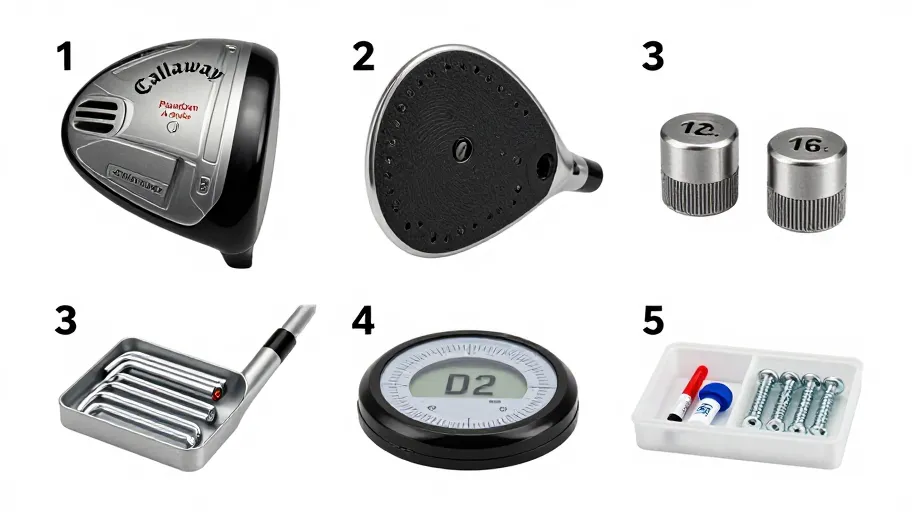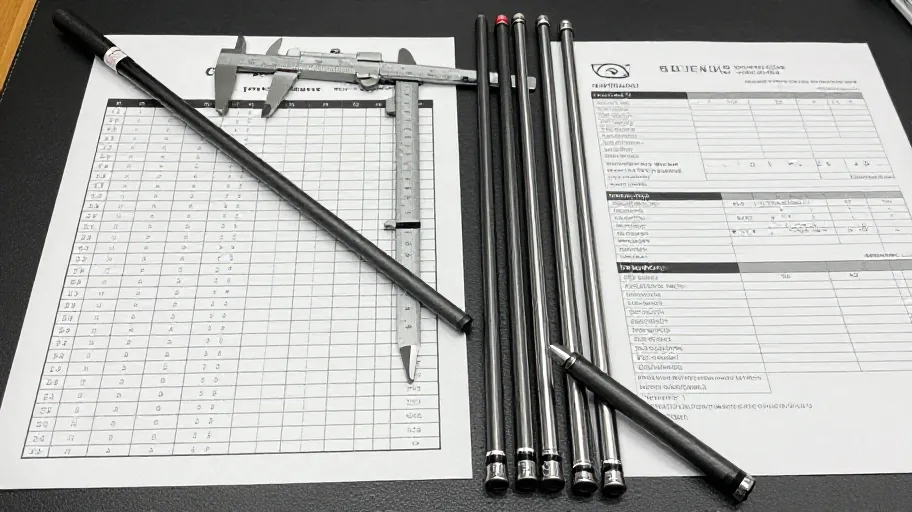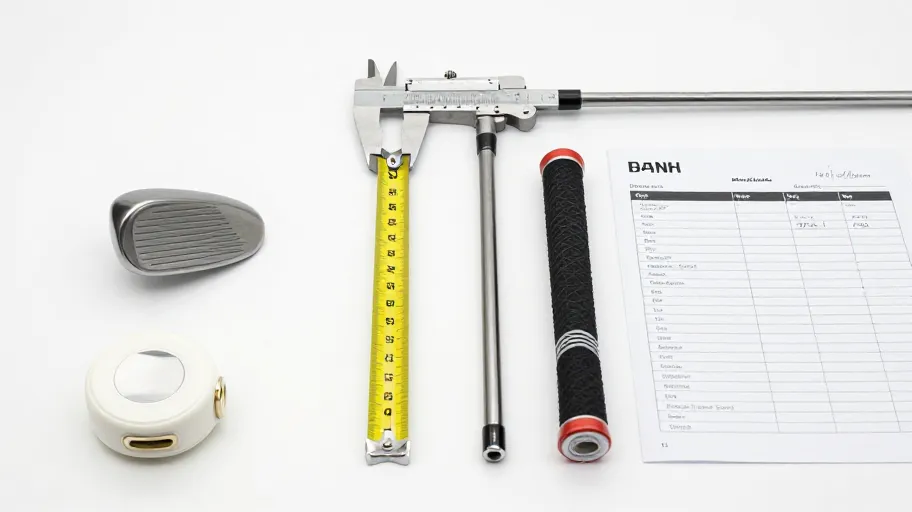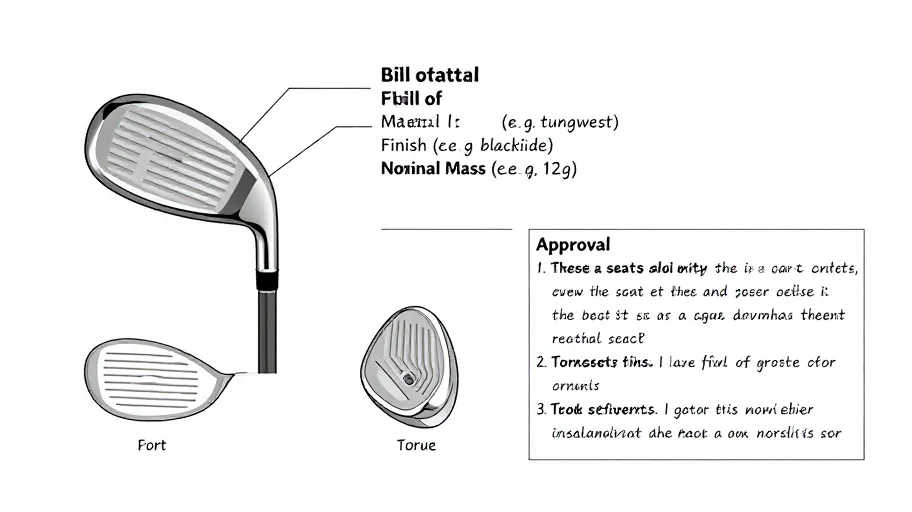
When you source a replacement or tuning golf club weight, three documents should carry the decision: the drawing holds geometry (thread, seat, port diameter, profile), the bill of materials holds substance (material, finish, nominal mass), and the approval notes hold the questions you ask before ordering. Placing each detail in the right document prevents the two failure modes builders encounter: a weight that does not fit, and a weight that fits but does not tune as intended.
This article walks through the DRAW–BOM–APPROVE gate so you can document a weight purchase for a specific club brand, family and model — and confirm compatibility before you commit.
The DRAW–BOM–APPROVE gate
The framework is deliberately simple:
- DRAW — capture every geometric attribute on a drawing or spec sheet so you can compare it against the port on your clubhead.
- BOM — capture the substance attributes: material, finish or coating, and nominal mass.
- APPROVE — ask the supplier or store the questions the documents cannot answer on their own: current stock, batch consistency, return handling and any model-specific caveats.
The order matters. Geometry first, because no amount of correct mass rescues a weight that will not seat. Substance second, because material and finish affect durability and appearance. Questions last, because they are cheapest to ask before payment and most expensive to ask after.
What belongs on the drawing
Geometric details are the ones you can compare directly to your clubhead's weight port. Record:
- Thread type and size, if the weight screws in — verify against the exact port on your model, since families within a brand can differ.
- Port or bore diameter for press-in or slide-in weights.
- Seat geometry: flat, conical, shouldered or washer-supported.
- Head profile and overall length, so the weight does not protrude or sit recessed in the sole.
- Tool interface: hex, torx, slot or specialised driver.
- Centre-of-mass location relative to the body, which affects how the weight influences play even at identical mass.
Do not assume that two weights with the same nominal mass from different product lines share geometry. Confirm each attribute against your club's model documentation or a direct measurement of the port you intend to fill.
What belongs in the BOM
The bill of materials answers "what is it made of and what does it weigh":
- Nominal mass, stated in the unit your swingweight math uses.
- Material, such as steel, brass, aluminium or tungsten-bearing formulations — material density determines how compact a given mass can be, which in turn affects profile.
- Finish or coating, where appearance or corrosion behaviour matters to the build.
- Count and any kit composition, if you are sourcing a set of increments rather than a single weight.
- Accompanying hardware: screws, washers, o-rings or tools, if these are part of the line item.
A weight listed at a nominal mass is not a guarantee of exact mass. If your build is sensitive to small increments, ask the supplier how mass consistency is documented for the batch you would receive — as an open question, not an assumption.
What belongs in the approval notes
Approval notes are your written record of what was confirmed before purchase:
- Confirmation that the weight is specified for your exact club brand, family and model.
- Current stock status for the exact item, at the time of order.
- Shipping, return and exchange policy as it stands today — these can change, so record the answer rather than relying on memory.
- Any disclaimers the supplier gives about fitment, finishing or batch variation.
- The name of the person or channel that confirmed each point.
The approval note is your reference if the delivered component differs from what was described. Without it, you are comparing memory against a product page.
Decision table: which detail, which document
| Detail | Drawing | BOM | Approval notes |
|---|---|---|---|
| Thread type and size | ✔ | ✔ (model-specific confirmation) | |
| Port/bore diameter | ✔ | ||
| Seat geometry | ✔ | ||
| Head profile and length | ✔ | ||
| Tool interface | ✔ | ✔ (if tool included) | |
| Centre-of-mass location | ✔ | ||
| Nominal mass | ✔ | ✔ (consistency question) | |
| Material | ✔ | ||
| Finish or coating | ✔ | ||
| Kit composition and count | ✔ | ||
| Stock status | ✔ | ||
| Shipping/return policy | ✔ (confirm current policy directly) | ||
| Model-specific caveats | ✔ |
Approval questions to send before ordering
Copy these into your enquiry and keep the replies:
- Is this weight specified to fit the exact model and family I have named, and what evidence supports that — a fitment list, a drawing, or a measurement?
- What thread and seat geometry does it use, and can you provide the drawing or spec sheet?
- What is the stated nominal mass, and how is mass documented for the batch I would receive?
- What material and finish is the weight, and does the finish require any handling precautions during installation?
- Is the item in stock now, and what is your current shipping, return and exchange policy for it?
- Are any tools or hardware included, and if not, which tool interface does the weight use?
None of these questions assumes an answer. Their purpose is to move unknowns from your side of the table to the supplier's written response.
Fitment versus tuning intent
Fitment and tuning are separate decisions. A weight can fit perfectly and still be the wrong increment for your build. Before selecting a mass step:
- Establish your current configuration: head weight, shaft, grip and any existing weights.
- Decide whether you are correcting swingweight, adjusting feel, or rebalancing after a shaft or grip change.
- Record the before state so that after the swap you can evaluate the change against evidence rather than impression.
Any launch-monitor or performance claim should come from your own measured before-and-after data for your build. Do not accept performance improvement as a purchasing premise without it.
Pre-purchase checklist
- Club brand, family and model identified and written down
- Port geometry captured (thread, bore, seat) from measurement or model documentation
- Drawing or spec sheet obtained for the candidate weight
- Geometry compared line by line against the port
- Material, finish and nominal mass recorded in the BOM
- Approval questions sent and answers saved in writing
- Stock, shipping and return policy confirmed for the exact item today
- Tuning intent documented with a before-state measurement
- Fitment selector run before adding the component
Use the fitment selector before adding a component — it is the fastest way to confirm that the golf club weights you are considering match your exact model, before any of the paperwork above matters.
FAQ
Do all weights in the same mass increment fit the same club? No — nominal mass says nothing about thread, bore or seat geometry. Verify the drawing attributes against your clubhead's port for every candidate component, even within the same mass class.
Can I confirm fitment from the product listing alone? A listing can narrow the candidates, but confirmation should come from a fitment check for your exact model plus the drawing or spec sheet. Where anything is unclear, ask the supplier directly and keep the reply.
How do I know the mass is accurate? Ask how mass is documented for the batch you would receive. If your build is sensitive to small increments, weigh the delivered component yourself before installation and record the result.
What if the weight fits but the tuning result is not what I expected? That points to the tuning-side documentation, not the fitment. Recheck your before-state measurements, confirm the increment you actually needed, and compare against your own measured results rather than assumed outcomes.
Should I source one weight or a set of increments? That depends on your build goal. If you are exploring tuning, a documented set of increments with a recorded before-state lets you compare changes systematically; a single weight suits a known, confirmed replacement.
Master Your Swing, DIY Your Fit. DIY Golf is the premier destination for the technical golfer. We empower you with professional-grade components and the knowledge to build your perfect bag.