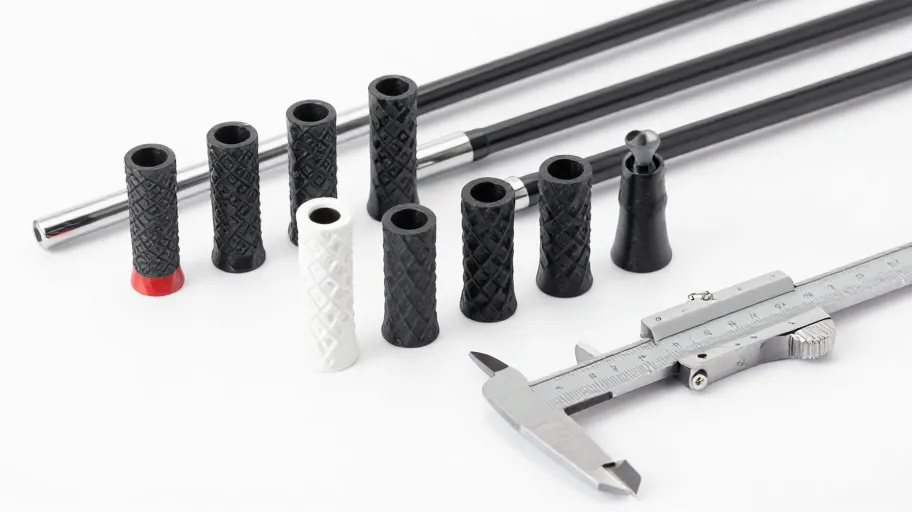
Golf grip size is not one number on a package — it is a bundle of specifications you should be able to verify before a single grip ships: core diameter as built, the finished diameter at the butt and mid-section once installed, and how any build-up or taper was achieved. Golfers who treat grip size as a single label are the ones who end up with a set that feels different from the demo club they tried. This guide gives you a framework — the Three-Spec Rule — plus a decision table and a list of approval questions so your next regrip is specified, not guessed.
The Three-Spec Rule: size, surface, supply
When you replace grips, you are making three separate decisions that listings tend to blur together. Separate them and document each one.
Spec 1 — Size. The stated golf grip size (undersize, standard, midsize, oversize, or a stated diameter) tells you less than you think. What matters for your hands and your ball flight is the finished diameter on your shaft, which depends on the grip's core construction and on anything layered underneath it. Ask what the stated size corresponds to, and ask how the measurement was taken. Two grips labelled the same size can finish differently once tape and solvent are involved, so your specification should be written in terms of the installed result, not just the label.
Spec 3 — Supply. This is the part buyers skip and later regret: how the grips reach you, in what packaging, in what quantity per order, and on what terms if something arrives damaged or mislabelled. None of those terms can be assumed from a product page. Confirm them directly with the store before you order, and get the confirmation in writing.
Matching grip size to your club: a decision table
Use this table to convert your club and goal into a concrete specification to verify. It is a thinking tool, not a fitment verdict — final sizing should come from the fitting process linked at the end of this article.
| Your situation | What to specify | What to verify before ordering |
|---|---|---|
| Regripping a full set from one brand and family | One stated size across the set; consistent core specification across all shafts in the set | That every shaft in the set takes the same core; any butt-diameter differences between woods, irons and wedges |
| Adding a single replacement to an existing set | The size and surface of the installed grips; the installation method used originally | A stated match to the remaining grips, or acceptance that a close-but-not-identical replacement may feel different |
| Switching size up or down deliberately | Your target installed diameter and whether it should be achieved by grip choice, build-up, or both | How the seller documents the finished diameter and whether build-up methods are described on the listing |
| Tuning one club (e.g. a putter or driver) | A size intent for that club plus surface for the conditions you play in | Whether the finish offered suits your climate and practice frequency, and how wear is described by the seller |
| Building for a fitter or client | Written specification for size, surface and packaging, agreed in advance | That the seller can confirm order composition and packaging in writing before dispatch |
Approval questions to settle before you order
A thoughtful sourcing approach means approving the product on paper before it ships. Put these questions to the product page or to DIY-Golf directly — the answers are exactly what a professional builder would demand:
- What does the stated golf grip size correspond to on the finished, installed club, and how is that measured?
- Is the size achieved by the grip alone, by build-up tape, or both — and is the method documented on the listing?
- What surface and finish does this specific model carry, and what maintenance or wear characteristics does the seller describe?
- How are grips packaged for transit, and what does the buyer do if a grip arrives damaged, mislabelled or inconsistent with the listing?
- If I want to verify before committing to a full set, what is the current process for that, and what does it cost? (Confirm the current sample policy, any fees and shipping terms directly with DIY-Golf — this article does not state them.)
- What documentation comes with the order so I can record the specification against my club model?
If a listing cannot answer these, treat that as decision information in itself: you are choosing between a seller who can document the product and one who asks you to hope.
Finish and packaging: the details that decide repeat purchases
Finish. The word "finish" covers more than colour. It includes surface texture, the compound used, and how the grip behaves wet versus dry. Because you are buying for a specific club and a specific player, the finish should be chosen against the conditions you actually play in — not against how the grip photographed on the listing. Ask the seller to describe the finish in functional terms, and record that description with your order.
Packaging. For a components order, packaging is a specification, not an afterthought. Grips arrive in different configurations depending on the seller, and transit damage or mixed batches are the classic regrip headaches. Before ordering, confirm how the grips are packed, how quantity is counted, and what the seller's stated process is for raising a problem on receipt. Store the packaging details with your order record; if you ever reorder for the same club, you want the same specification, not a memory.
Verification on arrival. Whatever the listing promises, check the delivery against your written specification: count, stated size, finish, and any documentation supplied. Note any discrepancy immediately and raise it with the seller while the order is fresh. This is the habit that separates a one-off buyer from a builder with a repeatable process.
FAQ
Does a bigger grip automatically change my ball flight? Any change in installed diameter changes how your hands interact with the club, and individual outcomes vary by player. Do not buy on the promise of a flight change; work from a sizing process — start with the fitting guide linked below — and treat flight claims as something to verify on your own clubs.
Can I mix grip sizes across a set? Some players do, but mixing means the set no longer feels uniform from club to club. If you intend a mix, specify it deliberately and record which size is on which club, so future replacements are exact.
How do I know which size I currently have? Measure and describe what is installed — the seller may be able to help you match it — but treat any match as something to confirm against the specific product listing rather than assume from a size name alone.
Should I order a sample before a full set? Verification before commitment is sensible for any component purchase. DIY-Golf's current sample policy, including any fee and shipping arrangement, is not stated in this article — confirm it directly with the store before ordering.
Does grip size matter more for one club type than another? Every club's grip affects the hands, but players weight the priorities differently — a putter grip is judged on very different criteria from an iron grip. Decide your priority per club type and specify accordingly, rather than applying one rule across the bag.
Ready to lock in your size?
Read the fitting guide. It walks you through determining the correct golf grip size for your hands, your clubs and your model — so the specification you take to the product page is one you can defend.
Pre-order checklist (save this)
Before you click buy, confirm you have:
- Written down your target installed size for each club in the order
- Checked the stated size against your target, including any build-up method
- Chosen a finish suited to your playing conditions, not the product photo
- Confirmed packaging, quantity counting and the process for reporting a problem on receipt
- Confirmed the current sample and order-verification policy directly with DIY-Golf
- Agreed how the specification will be documented with the order
A regrip is a small project. Specify it like one, and the grips that arrive will be the grips you approved.
Master Your Swing, DIY Your Fit. DIY Golf is the premier destination for the technical golfer. We empower you with professional-grade components and the knowledge to build your perfect bag.


