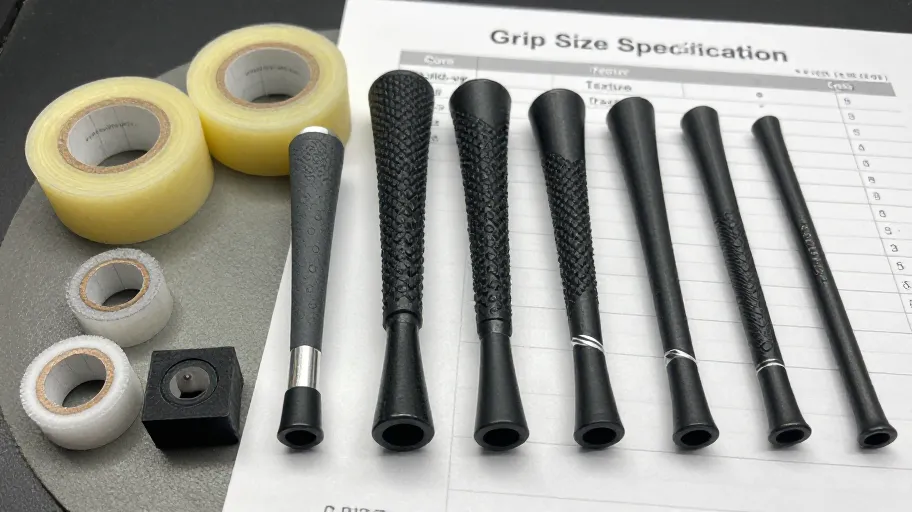
Golf grip size is the combination of the grip's core construction, its installed diameter after build-up, its texture and its taper profile — and if any one of those four fields is left undefined before you order, a regrip project frequently ends in rework: peeling off fresh grips, re-taping and buying a second set. This article gives you a Grip Size Specification Sheet — Core, Build-up, Texture, Taper — plus a symptom-to-sizing decision table and the exact questions to put to the seller before you approve the order. Work through it, then read the fitting guide to verify the match against your specific club model.
The Grip Size Specification Sheet: four fields, decided in order
Treat your regrip like a small procurement project. Before any money moves, you want a one-line specification that reads, in effect: core matches my shaft, build-up decided, texture chosen, taper profile understood. Each field is a separate decision, and skipping one is what causes the second order.
1. Core. The grip's core construction must match the shaft's butt section. Club builders confirm this by checking the grip's stated core configuration against the shaft specification — not by eye, and not by assuming that a grip sold for a driver will suit an iron shaft or a putter shaft. If the listing for the exact grip model does not state its core configuration, that is your first approval question to the seller, not an assumption to fill in yourself.
2. Build-up. Build-up is how installed diameter is adjusted: by choosing a larger grip category, by adding tape wraps under the grip, or by a combination. The direction of the adjustment comes from the decision table below; the exact number of wraps and their interaction with a specific grip's inherent thickness is a question for the fitter or the seller's fitting documentation — never a guess typed into the order notes.
3. Texture. Texture and surface pattern sit alongside size, and they change how large a grip feels in the hands. A firmer or smoother surface can read differently than a tackier one even at the same installed diameter. Decide texture after size, with hands on the club where possible, and record the choice on your spec sheet so a re-order reproduces it exactly.
4. Taper. Taper describes how the grip's diameter changes from the top of the grip down toward the lower hand. Taper profile affects how the lower hand engages the club, and it is the field most regrip orders never mention. Ask whether the grip you are considering is a conventional taper or a reduced-taper design, and whether that matches what you are replacing.
Four fields, four decisions, one line of documentation. If your specification sheet has a blank, you are not ready to order.
Symptom-to-sizing decision table
Use this table to translate what you notice on the course into a sizing direction to discuss with the fitter or the seller's fitting guide. It is a starting direction, not a prescription — the final call should be verified against your hands, your clubs and the fitting guide.
| What you notice | Sizing direction to investigate | Why it matters |
|---|---|---|
| Grip feels too thin; fingers dig into the palm | Move toward a larger installed diameter (midsize/oversize or build-up) | Excess finger wrap can add hand action you did not intend |
| Grip feels bulky; wrists lock up through impact | Move toward a smaller installed diameter | Oversizing can restrict release and raise tension |
| Tendency to turn the club over too quickly | Larger diameter or reduced taper, to be verified with the fitter | A thicker lower hand connection can quiet hand rotation |
| Difficulty releasing the club | Smaller diameter or different taper, to be verified with the fitter | The opposite lever, applied with the same caution |
| Grip feels fine in gloves, unstable without | Re-examine texture and taper before changing size | Feel is multi-variable; do not fix a texture problem with size |
| Sizing differs between hands or clubs (split sizing) | Confirm each grip's core and build-up separately per club | Split specs must be documented club by club to avoid mix-ups |
Approval questions before you order
Send these to the seller — or verify each one against the product page and the fitting guide — before approving the regrip:
- For the exact grip model and variant I am buying: what is its stated core configuration, and does it match the butt specification of my shaft?
- Does the listed golf grip size describe the grip alone, or the installed diameter with standard tape? Which one am I comparing against my current grips?
- If I need build-up, is that something the product supports, and is the method documented?
- Is this grip round or ribbed, and can I confirm which one I am replacing?
- What is the taper profile of this model, and is there a reduced-taper variant?
- If the fit is wrong once installed, what are the current options for exchange or correction? Please confirm the current policy directly — I will not assume it from the product page.
That last question matters. Correction policies, costs and conditions are seller-specific and changeable, and this article deliberately does not state them. Confirm them in writing as part of the approval step, the same way you would confirm any other commercial term on a component order.
Why specification gaps — not bad grips — cause rework
Most regrip do-overs trace back to a blank field on the spec sheet, not to a defective product. The pattern is consistent: the buyer compared grip size categories instead of installed diameter, or matched a grip to the wrong shaft type, or forgot that an overgrip changes the effective size of everything underneath it. The grip itself was fine; the specification was incomplete.
The practical defense is documentation. Write down the four fields before checkout, verify each against the product listing and the fitting guide, and keep the sheet with your club records. The next time you regrip a different set or a different model in the same family, you are reordering against a known specification instead of rediscovering it. Club builders work this way for the same reason: a written spec survives memory, staff changes and product-line updates.
An overgrip deserves its own line on the sheet. It adds material over the grip and effectively changes the installed diameter, so a golfer who adds an overgrip to a midsize grip has, in effect, chosen a larger size than the label says. Decide whether an overgrip is part of your finished specification before you select the base grip — not after.
FAQ
Does golf grip size affect ball flight? It can influence how your hands deliver the club, which is why sizing direction belongs in a fitting conversation rather than a checkout decision. This article does not make a performance claim for any specific grip or model. Verify any flight-related expectation against your own testing and the seller's fitting documentation for the exact product.
How do I know whether to go up or down a size? Start with the symptom table above, then verify the direction with the fitting guide and, where possible, hands-on testing. Record the decision on your spec sheet. If your symptoms pull in opposite directions, that is a signal to involve a fitter rather than to split the difference by guesswork.
Can I mix grip sizes across my set? Split sizing — for example, a different installed diameter on the putter or wedges — is a legitimate approach, but every grip in the set needs its own confirmed core match and documented build-up. The more the specification varies club to club, the more important the written sheet becomes.
Do I need to match the grip size the club came with? Not necessarily, but you should know what you are replacing: its category, its taper character and whether build-up was present. A club model's original specification is a reference point, and your decision to change it should be recorded rather than accidental.
What should I confirm with the seller before ordering? The approval questions above: core match to your shaft, what the stated size describes, build-up support, round versus ribbed, taper profile, and the current correction policy — confirmed directly, not assumed.
Ready to lock in your specification
Read the fitting guide to verify the core match, build-up method and taper profile for your specific club brand, family and model before you approve the order.
Low-friction step: before you order anything, complete the regrip preparation checklist — shaft butt specification, current grip details, sizing direction, texture and taper preference, overgrip decision, and confirmation of the seller's current correction policy. One page, five minutes, and it is the document that prevents the rework described above.
Master Your Swing, DIY Your Fit. DIY Golf is the premier destination for the technical golfer. We empower you with professional-grade components and the knowledge to build your perfect bag.


