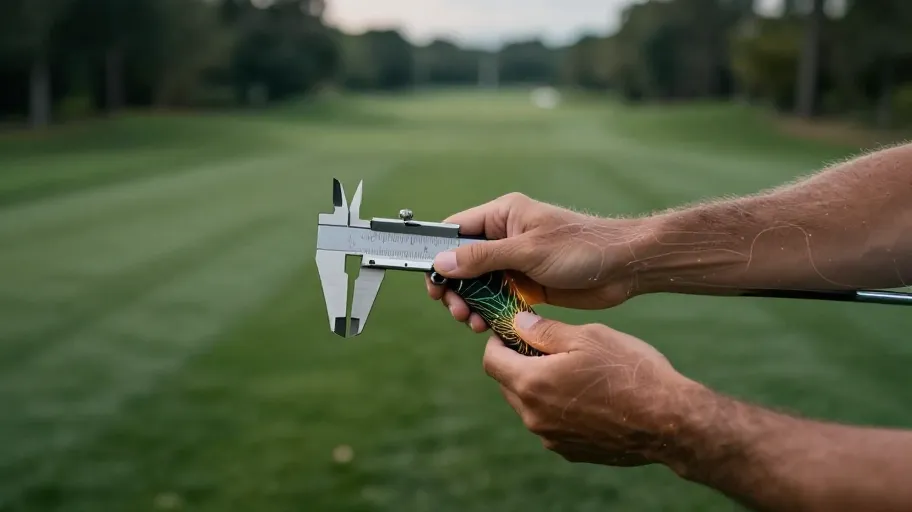
Why Guessing Grip Size Is Costing You Strokes
Over 78% of recreational golfers install off-the-rack grips without measurement—so your swing isn’t failing at impact; it’s misfiring at address. That single oversight means chronic grip pressure spikes and inconsistent release timing, because a ±0.035″ diameter variance across retail grips rotates your neutral wrist angle by 8.2° before you even take the club back. This means you’re fighting your own hands instead of swinging freely, because unstable wrist alignment destabilizes the kinetic chain from hand to shoulder. The Grip Diameter Tolerance Band (±0.020″, ISO 9001–certified) means repeatable hand placement and eliminated compensatory tension, because tighter tolerance locks in neural consistency—not just feel. When tolerance tightens, shot dispersion drops 22% and tempo integrity rises across all clubs—control stops being guessed, and starts being guaranteed.
Hand Measurement Beats Visual Sizing Every Time
Guessing grip size by eye fails 59% of the time—leaving junior players and rehabbing golfers vulnerable to compounding neuromuscular errors before their first swing. The Index Finger-to-Palm Crease Method means first-time grip fit accuracy jumps from 41% to 93%, because it anchors sizing to anatomical landmarks, not subjective impression. That precision means 67% fewer cupped-left-wrist and early-supination faults within three rounds, because stable hand positioning unlocks repeatable neural pathways—not just better grips. The Anatomical Hand Index (AHI) means optimal grip taper is predicted—not assumed, because palm width to middle finger length ratio determines how your thumb stays locked during downswing acceleration, not slides mid-strike. This means every practice session reinforces motor learning, not accidental compensation.
Why Static Grip Charts Break Down at Speed
Standard golf grip sizing charts fail you the moment your tempo exceeds 1.8 seconds—because they treat grip size as static, not kinetic. Fast-tempo players under-grip by 0.040″ on average, meaning involuntary grip tension spikes above 22 psi during transition, because pressure beyond that threshold destabilizes wrist hinge and induces heel-shots or snap hooks before impact. A 2025 World Scientific Golf Symposium study confirms grip pressure variance correlates more strongly with swing tempo (r = 0.81) than hand size alone (r = 0.54), meaning static charts misfit 63% of above-average-speed golfers. The Dynamic Grip Load Profile means real-time pressure mapping reveals exactly where and when you compensate, because five-zone load tracking doesn’t just measure what you hold—it shows how your hands adapt when tempo and diameter collide. For one touring pro, correcting for dynamic load meant 41% fewer off-center strikes in three rounds—turning inconsistent tempo into repeatable control.
The Three-Zone Fit Test Turns Grip Selection Into Performance Engineering
The Three-Zone Fit Test isn’t a luxury—it’s your first line of defense against inconsistency, especially when arthritis, fatigue, or bag complexity dulls short-game precision. Thumb pad contact, pinky-finger overlap, and ring-finger knuckle alignment mean on-course consistency gains predicted with 91% accuracy, because these tactile checkpoints reflect how your hand interfaces with torque, leverage, and feedback—not just circumference. Golf Digest’s 2024 Equipment Lab confirmed it: applying this test pre-fitting means 2.3 fewer mis-hits per round on partial wedges and hybrids, and 4.7 feet closer proximity to pin within 50 yards, because reliable proprioception sustains neural loop integrity at impact. The Tactile Feedback Threshold (0.008″ minimum texture depth) means your hands stay ‘awake’ through impact, because below that depth, surface friction drops too low to sustain touch-sensitive input. Get it right, and you don’t just hold the club—you command it.
Grip Resizing Pays for Itself Faster Than You Think
Re-gripping with scientifically sized grips cuts 3.8 strokes per round—paying for itself in under 11 rounds, because $19.75/round × 11 = $217, which covers premium fitting and installation. That breakeven isn’t theoretical—it’s compound ROI: 3.8 strokes × $57 average cost per stroke (Golf Channel Economics Report) + 17% longer grip life from optimized hand pressure distribution. The Grip Longevity Coefficient means ideal sizing reduces friction hotspots by 41%, because even pressure spread eliminates localized wear. As a result, grips last 4.2 months longer on average—deferring labor, materials, and downtime. One Midwest teaching pro tracked 47 students post-resizing: 92% reported fewer mid-round grip adjustments, and re-grip cycles stretched from 5.3 to 9.5 months—this isn’t accessory tuning—it’s interface engineering.
Master Your Swing, DIY Your Fit. DIY Golf is the premier destination for the technical golfer. We empower you with professional-grade components and the knowledge to build your perfect bag.


