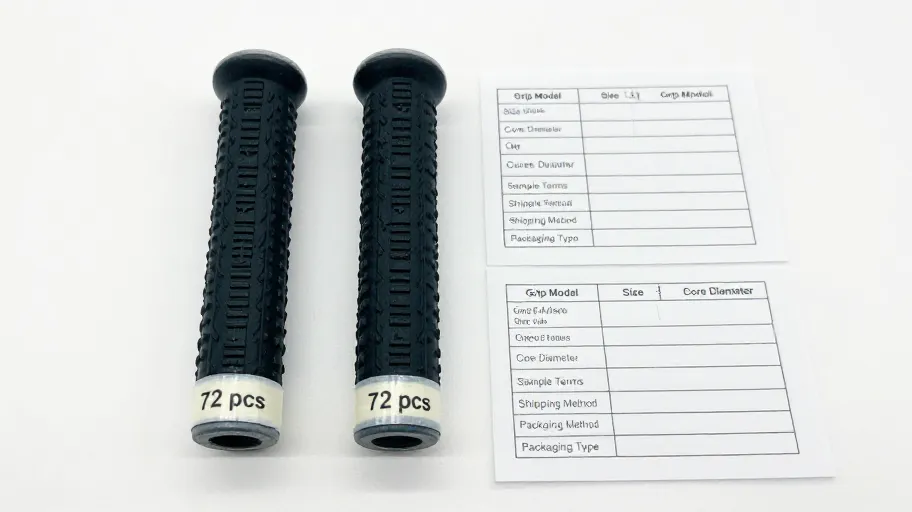
Comparing two supplier quotes for golf grips starts by locking one written specification — exact grip model, stated golf grip size, core diameter, quantity and any build-up requirement — then walking both quotes through the same five-pass review. Judge no price line until both documents describe identical goods and services. Confirm sample, shipping and packaging terms directly with each supplier, and approve only after every line is matched and documented.
Start with one specification, not two quotes
Most quote comparisons go wrong before any number is read. Two suppliers answering an informal enquiry will each make assumptions about the golf grip size, the core diameter, the quantity, and whether ancillary items are included. The result is two documents that look comparable but describe different orders.
Before comparing anything, send both suppliers the same written specification sheet:
- Grip model and brand family, stated exactly
- Stated golf grip size (for example, standard, undersized or oversized as described by the manufacturer)
- Core diameter as you require it, expressed in the supplier's own terms
- Quantity per size
- Any build-up tape requirement and who supplies it
- Destination, packaging expectation and requested quote validity window
Ask each supplier to quote against that sheet and to flag in writing any point they cannot meet. This single step removes most of the ambiguity that makes quote comparison frustrating.
The LINE-COMPARE framework
Use five passes, in order, on both quotes. Do not skip ahead to prices.
L — List every line. Transcribe each line item from both quotes into one comparison sheet, including freight, packaging, tape, solvent (if supplied) and any minimum-order or set-up line. If a line is unclear, mark it "to confirm" rather than guessing.
I — Identify inclusions and exclusions. For each line, note whether it appears in quote A, quote B, or both. A missing line is not a saving; it is an unanswered question.
N — Normalise to per-unit, fully-included terms. For each quote, ask: if every excluded item were added at the supplier's own quoted rate, what would the fully-included per-grip figure be? Only a normalised comparison is honest. Do this arithmetic yourself and keep the working.
E — Expose conditions. Quote validity window, minimum order quantity, packaging assumptions and payment terms all shape the real decision. These are project-specific facts; ask each supplier to state them in writing rather than inferring them from either document.
COMP — Compare and document. Only now compare the two normalised figures side by side, and record the reason for your choice in writing. The record protects you if a dispute arises later.
Decision table: judging each line
| Line item | What to check | Question to confirm with supplier | Risk if unconfirmed |
|---|---|---|---|
| Grip model and size | Does the line name the exact model and stated golf grip size you specified? | "Confirm this line covers [model] in [size] as written." | You receive a substitute model or a different size designation. |
| Core diameter | Is the core expressed the way you specified, with no alternative offered? | "Confirm core diameter matches my specification sheet exactly." | Grips that do not sit correctly on your shafts. |
| Quantity | Does the unit count match, and is there any minimum order attached? | "Confirm total quantity and state any minimum order requirement." | A quantity condition changes your real cost per grip. |
| Ancillary items | Are tape, solvent or packaging separate lines, bundled, or absent? | "List every item included in your quoted figure and every item billed separately." | Hidden lines appear after approval. |
| Freight and packaging | Is delivery quoted, and on what terms to your destination? | "Confirm your current shipping arrangement and packaging policy in writing." | Freight assumptions differ between quotes, breaking the comparison. |
| Quote validity | How long does each figure hold? | "State the validity window for this quote." | A figure expires before you approve. |
| Samples | Is a sample available, and on what terms? | "Confirm your current sample policy directly, including any conditions." | You approve unseen goods. |
Approval questions to send both suppliers
Before approving either quote, send this short set and keep the replies:
- "Confirm in writing that the quoted item is [exact model] in [stated golf grip size] with the core diameter on my specification sheet."
- "Confirm any minimum order quantity attached to this quote."
- "Itemise everything included in your figure and everything billed separately."
- "Confirm your current shipping arrangement and packaging policy for this destination."
- "Confirm your current sample policy, including any conditions I should know before approving."
- "State the validity window of this quote."
- "Confirm what happens if the delivered goods do not match this written specification."
If a supplier will not answer in writing, treat that silence as part of the comparison. An unanswered question is a documented risk, and you are entitled to weigh it.
A short regrip quote checklist
- One written specification sheet sent to both suppliers
- Every quote line transcribed into a single comparison table
- Inclusions and exclusions marked line by line
- Both quotes normalised to fully-included per-grip figures
- Sample, shipping, packaging and validity terms confirmed in writing
- Approval decision recorded, with the reason, before ordering
Frequently asked questions
How do I make sure both quotes are for the same golf grip size? Anchor both quotes to one written specification sheet and require each supplier to confirm the stated size and core diameter in writing. If either quote paraphrases your spec, ask for a corrected document before comparing anything.
What if one quote is missing lines the other includes? Treat the missing lines as open questions, not savings. Ask the supplier to itemise everything included and billed separately, then rebuild both quotes to a fully-included basis before comparing figures.
Should I ask for samples before approving a grip quote? Confirm each supplier's current sample policy directly and in writing, including any conditions. This article does not describe what any sample policy includes, because none was supplied; the policy is the supplier's to state, and yours to verify before approval.
How many quotes should I compare? Two is enough to expose structural differences; three can confirm a pattern. The value comes from the like-for-like method, not the count. One disciplined LINE-COMPARE of two aligned quotes beats an informal scan of five mismatched ones.
Where does grip fitting knowledge fit into the comparison? The specification sheet is where fitting knowledge pays off: choosing the right stated size, core and build-up plan is a fitting decision, and the quote comparison only verifies that both suppliers can deliver that decision. If the spec is wrong, no price comparison fixes it.
Next step
Read the fitting guide to lock down your grip size, core and build-up specification before you send it to any supplier — the comparison is only as good as the spec behind it.
And if you want the low-friction version first, save the regrip quote checklist above and use it on your next enquiry; it works with any two quotes, from any suppliers.
Master Your Swing, DIY Your Fit. DIY Golf is the premier destination for the technical golfer. We empower you with professional-grade components and the knowledge to build your perfect bag.


