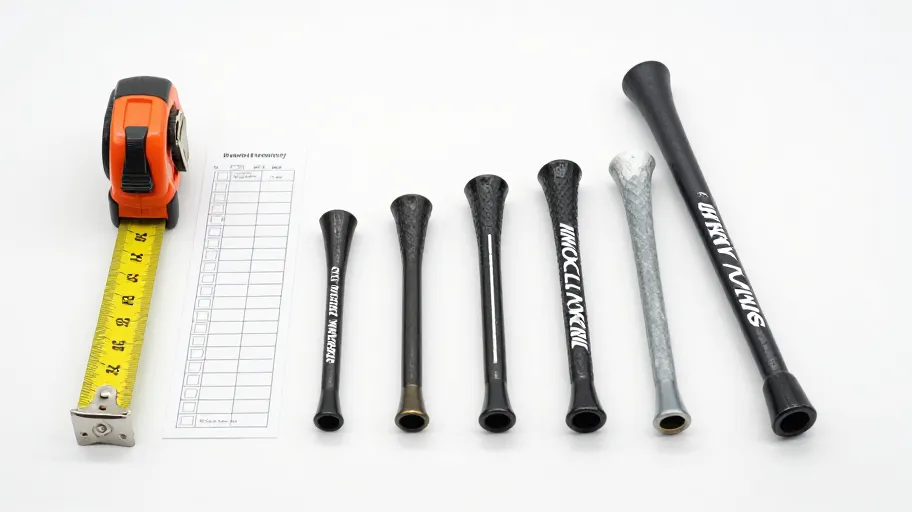
Golf grip size is the dimension category of the grip you install — standard, midsize, oversize or undersize — and the fastest way to get it wrong is to approve a sample and assume production will match it. Use the Measure → Match → Approve → Document framework: measure your hands, match a candidate size by feel and shot tendency, approve a physical sample against a written checklist, and document exactly what was approved so the installed grips carry over every characteristic you signed off on.
Grip size matters for a simple reason: the grip is the only part of the club your hands touch, and small differences in how a grip sits in your fingers change how you hold and release the club. A grip that feels too thin can push you toward stronger hand action; one that feels too thick can limit your release. That is why experienced builders treat grip size as a fitting decision, not an afterthought.
The Sample-to-Production Handoff Framework
Step 1 — Measure. Start with your hand: measure from the wrist crease to the tip of your longest finger, and note your glove size as a cross-check. This gives you a starting category, not a verdict. Two golfers with the same hand measurement can prefer different sizes depending on swing feel and how they release the club.
Step 2 — Match. Test candidate sizes against how you actually strike the ball. Use the decision table below to narrow the direction, then confirm by feel on real swings, not by squeezing a grip in a shop.
Step 3 — Approve. Do not approve a golf grip size from a product photo or a spec sheet. Approve a physical sample. Before you sign off, work through the approval questions in the next section and record your answers.
Step 4 — Document. Write down what you approved: the size category, the grip model, any build-up layers under the grip, the tape method used, and the feel notes that made you choose it. If the installed grips differ from this record, you have something concrete to raise with your supplier.
Choosing a size direction: a decision table
| Your situation | Size direction to test first | Why it might fit | What to confirm before approving |
|---|---|---|---|
| Large hands relative to standard grips | Oversize or midsize | Fingers should wrap, not overlap uncomfortably | That the sample's actual dimension matches what your hands prefer |
| Grip feels like it twists or you over-release | Midsize or oversize | A larger grip can quiet hand action | Feel on real swings, not just static hold |
| Grip feels bulky, you fight a stuck release | Undersize or standard | A smaller grip can let hands work more freely | Whether adding build-up tape changes the feel you want |
| Arthritis or hand discomfort | Oversize or soft-compound options | Comfort becomes a priority over convention | Material and compound on the actual sample |
| Midway between two sizes | Both candidates side by side | Feel varies more between models than between size labels | Which model-size pair you will document as the approved reference |
This table is a starting filter, not a fitting verdict. If you want the full walkthrough of how size interacts with your clubs, read the fitting guide.
Approval questions to ask before production
Once a sample feels right, your job as a buyer is to convert "I like this" into a verifiable handoff. Put these questions to DIY-Golf directly and record the answers:
- Is the sample in hand the exact model, size category and compound that production will install? Confirm the model and size labels on the sample against the production specification, in writing.
- How will the grip size be achieved — grip design alone, or build-up tape under the grip? The same nominal size can be reached in different ways, and the installed feel can differ. Confirm which method applies to your order.
- What installation method will be used, and how does it affect the final installed dimension? Ask how tape layers and installation technique are specified for your build.
- What documentation will accompany the production run? Ask what record confirms that the grips installed match the sample you approved.
- What is your recourse if the installed grips do not match the approved sample? Ask about the current inspection and remediation policy and confirm it in writing before approving.
- Are there any current variations between the sample you hold and current stock of the same model? Product revisions happen; confirm that what you approved is what ships today.
None of the answers to these questions should be assumed. No product-specific sample, cost, shipping or production policy was supplied for this article; you must confirm every one of these points directly with DIY-Golf before approving production.
What "approved" should mean
An approval is not a nod in a fitting bay. It is a documented decision. Before you hand off a sample to production, your written approval should contain:
- The exact grip model and size category you tested.
- Whether build-up material was part of the tested feel, and if so, how it was described.
- The feel notes that justified the choice, in your own words — for example, "wraps to the middle two fingers, quiet hand action on half-wedge swings."
- The date and the person who approved.
- The questions above, with the supplier's written answers attached.
With that document in place, the transition from sample to production becomes checkable rather than hopeful. If you are still choosing between sizes, read the fitting guide first; if you already have a sample in hand, use the checklist below.
Ready to move from sample to sign-off? Read the fitting guide for the full component selection and fitment walkthrough before you approve anything for production.
FAQ
How do I know which golf grip size I need? Start with a hand measurement from wrist crease to longest fingertip and your glove size, then test candidate sizes on real swings. Size labels are a starting point; the decision should rest on how the grip sits in your fingers and how your release feels. Work through the fitting guide to structure the comparison.
Can I change my mind after the sample is approved? That depends on where the project stands when you change your mind, and on the supplier's current policy. DIY-Golf has not published a blanket answer in the materials for this article, so confirm directly what happens to an order if you revise your approval before and after production begins.
Does a bigger grip always reduce a hook? No. Some golfers find a larger grip quiets hand rotation; others lose the release they need and see the opposite tendency. Treat size as a fitting variable to test, not a guaranteed correction, and verify any shot-tendency outcome on your own swings rather than assuming it.
Why does my installed grip feel different from the sample I tried? Several variables can differ: build-up layers, the tape and installation method, how the grip was seated, and whether the sample matched the model actually supplied. This is exactly why the Document step exists — if you have a written approval record, you can compare the installed result against it and raise a specific discrepancy rather than a vague complaint.
Should I match grip size across every club in the bag? Consistency is easier to adjust to, but some players prefer a different feel on the putter. If you intend to vary sizes by club, document that per club in your approval record so the production instruction is unambiguous.
Before you approve production, run the low-friction pre-sign-off checklist: - [ ] Hand measurement and glove size noted - [ ] Both candidate sizes tested on real swings, if you were between two - [ ] Exact grip model and size category written down - [ ] Build-up and installation method confirmed with the supplier in writing - [ ] All six approval questions answered and filed - [ ] Feel notes recorded in your own words, with date and approver named
If any box is unchecked, pause the handoff. Read the fitting guide, close the gap, then approve.
Master Your Swing, DIY Your Fit. DIY Golf is the premier destination for the technical golfer. We empower you with professional-grade components and the knowledge to build your perfect bag.


