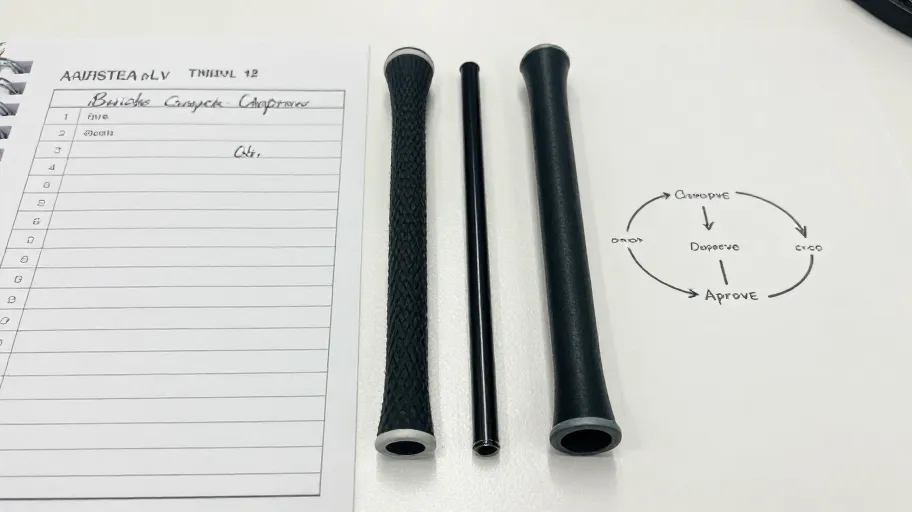
Reviewing a revised golf grip size sample does not require starting over: hold one reference constant, change one variable at a time, and approve or log each revision against a written record. That controlled sequence — the Build–Check–Approve loop — turns a frustrating back-and-forth into a short, documented decision, and it is the same discipline you would apply to any other component you tune on a specific club.
Why revised grip samples drift
Most revision cycles go wrong for one reason: the specification is not pinned down. The first sample felt close but slightly thin through the lower hand, so a revision was requested — and the revised sample arrives with a different taper, a different texture, or a different core build. Now you are comparing two grips that differ in three ways, and neither comparison tells you anything useful.
The fix is unglamorous but effective. Before you request any revision, write down what the current sample does right and what it does wrong. Specify exactly which variable you want changed — butt diameter, taper profile, core construction, surface texture — and nothing else. Then, when the revision arrives, you can evaluate it against the one thing you asked to change, rather than against a vague memory of "better."
The Build–Check–Approve loop
The loop has three steps, and each one produces a document, not just an opinion.
Build. Request the revision as a single-variable change. "Same construction as sample one, revised only in the lower-hand diameter" is a build instruction. "Something a bit more comfortable" is not. If the supplier proposes changing more than one thing, ask which change addresses your noted issue and confirm the rest stays untouched — and put that confirmation in writing before the sample is made. What a revision request costs, who arranges shipping, and how the process is handled are matters you must confirm directly with DIY-Golf; this article makes no claim about those terms.
Check. Compare the revision against a fixed reference: one unmodified grip from the first round, kept aside precisely for this purpose, plus your original written measurement sheet. Evaluate only the variable you changed. If the lower-hand diameter now feels right but the texture changed, that is a flagged deviation — not a new opinion to form.
Approve or log. Either approve the revision as the final specification, or log the remaining deviation and return to the Build step with one new variable. Never approve "close enough" on the diameter variable itself, because golf grip size is the one parameter that changes how your hands act on every swing. Texture and appearance can be traded off; size should not be.
Does this revision need another sample, or can you approve it?
Use this table after your first Check pass:
| What you observe on the revised sample | What it means | Action |
|---|---|---|
| Only the requested variable changed, and it now matches your target | Clean revision | Approve and record the final spec |
| The requested variable changed, but a second property changed too | Specification drift | Log the deviation; ask for written confirmation of the full spec before deciding |
| The requested variable did not change in a measurable way | Revision did not land | Return to Build with a more specific instruction |
| Size now feels right, but you are tempted to also adjust texture | Scope creep risk | Approve the size spec; raise texture as a separate, later decision |
| You cannot tell whether the size changed at all | Missing reference | Compare directly against the unmodified first-round grip; if still unclear, request measurement confirmation in writing |
Approval questions to put in writing
Before you approve any revised sample, ask these questions and keep the answers with your project notes:
- Which specific dimension was changed in this revision, and which properties were deliberately held constant?
- Can you confirm in writing the full specification of the approved grip, so the production description matches what I reviewed?
- Does this revised golf grip size apply identically across every grip I order, or does anything vary between club types in my set?
- Is there any property of the revision I should know about that was not part of my original request?
- What is the current process — and any applicable terms — for requesting one further revision if my Check pass flags a deviation?
That last question is where you confirm current policy directly with DIY-Golf. This article does not describe sample fees, shipping arrangements, or any other commercial terms, because those are supplied by the seller at the time of your enquiry, not assumed in advance.
One revised size, a full set of clubs
A common approval trap: the revised sample is reviewed on a single grip, then applied to a whole set where the hands interact with each club differently. Work through the set deliberately:
| Club role | Question to resolve before ordering |
|---|---|
| Driver and fairway woods | Does the approved size still allow the hand action you want on the longest clubs, where your grip pressure tends to be lightest? |
| Irons | Does one uniform size serve the set, or do you want the build spec reviewed per club? Confirm what configurations DIY-Golf offers for your exact model before deciding. |
| Wedges | If your hands get more active on touch shots, does the approved size support that, or would a separate spec for these clubs serve you better? |
| Putter | Treat the putter grip as its own specification entirely; a revision approved for swing grips says nothing about it. |
The fitting guide is where these per-club decisions get resolved properly — it walks through matching grip choices to a specific club brand, family and model rather than treating the set as one unit.
FAQ
How do I verify the revised grip's size without specialist tools? Compare it directly against the unmodified first-round grip under consistent conditions — same hand, same position, same amount of grip pressure. Perceptual comparison is reliable for detecting whether a change landed; for a formal measurement confirmation, ask DIY-Golf to confirm the specification in writing as part of your approval questions.
Can I request a second revision without losing the work from the first round? Yes, provided you keep the loop intact. The first approved properties remain your reference; the second revision changes one new variable. Do not restate your requirements from scratch, and do not accept a revised sample that silently alters properties you already approved. Commercial terms for further revisions are something to confirm directly with DIY-Golf.
Should I approve a revision based on feel alone, or wait for written specifications? Both. Feel decides whether the revision achieved your goal; the written specification decides whether what you felt can be reproduced on the grips you actually order. Approving on feel without a written spec leaves a gap between the sample and the production run.
Does grip size interact with shaft installation at regrip time? The approved grip specification and the club it is installed on are separate matters. Confirm the fitment details for your exact club model before ordering — the fitment pages exist precisely so you can verify compatibility for the specific brand, family and model rather than assume it.
What if the revised size feels right on the sample but different once installed? Log the deviation rather than overriding your approval. Installation changes the reference conditions, not the specification. Raise it as a new Build–Check–Approve cycle with a precise description of what changed between the loose sample and the installed club.
Before you finalise your order
Work through this checklist and keep it with your project notes:
- One unmodified first-round grip kept aside as a fixed reference
- Original written measurement sheet on file
- Revision requested as a single-variable change, in writing
- Any additional changes proposed by the supplier flagged and confirmed or declined
- Revised sample checked only against the changed variable
- Full final specification confirmed in writing
- Per-club decisions resolved against the fitting guide
- Current ordering terms confirmed directly with DIY-Golf
Read the fitting guide to match your approved golf grip size to your exact club brand, family and model before you place the order.
Master Your Swing, DIY Your Fit. DIY Golf is the premier destination for the technical golfer. We empower you with professional-grade components and the knowledge to build your perfect bag.


