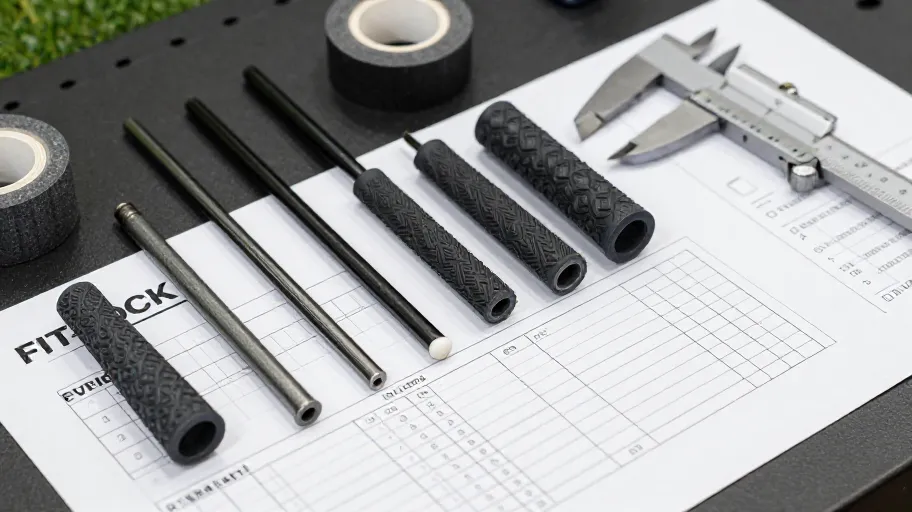
Grip size is the finished outside diameter of the installed grip, driven by the grip's core, the shaft's butt diameter, and the tape wraps applied. Before approving any bulk grip order, work through the FIT-LOCK sequence: confirm Feel target, check Interference from butt diameter variation, decide Tape layers, document every club's Outer measurement, and keep Origin documentation for the specification you approved. Get those five resolved in writing and the bulk decision becomes an administrative step, not a gamble.
Treat golf grip size as a specification, not a preference
When you buy grips one at a time, a size mistake costs you one grip. When you approve a bulk quantity, the same mistake multiplies across the set — and across every set you build afterward. That asymmetry is why grip size deserves the same documentation discipline you would apply to any component specification.
Three variables determine the final installed size:
- The grip's core size — the inside diameter of the grip before installation.
- The shaft's butt diameter — the outside diameter of the shaft at the grip end. This varies between brands and can vary within a single set if shafts have been replaced individually over time.
- Tape build-up — the number and thickness of tape layers applied under the grip.
Because labels like "standard," "midsize" and "undersize" are naming conventions rather than controlled dimensions, do not treat them as interchangeable across manufacturers. Verify the actual stated core diameter and, where the supplier provides it, the expected installed outside diameter for your butt diameter and tape configuration. If the supplier does not publish that pairing, ask directly and record the answer.
The FIT-LOCK framework: five checks before approval
FIT-LOCK is a sequence you run in order. Each check either resolves a question or produces a documented question for the supplier. You approve bulk quantity only when all five are closed.
F — Feel target. Decide what you are trying to achieve: a larger feel in the hands, a smaller feel, or a match to a grip you already know works. Define it as a measurable outcome — a target installed outside diameter or a match to a reference grip — not as an adjective.
I — Interference check. Measure the butt diameter of every club in the set. Mixed shafts mean one grip model can produce different final sizes across the same set. Any club whose butt diameter differs from the rest needs its own entry in your documentation.
T — Tape layers. Decide your tape strategy per club: base wrap only, or build-up layers to reach the target diameter. Document the tape thickness you will use, because build-up layers are part of the specification, not an afterthought.
L — Layers-to-diameter log. For each club, write down: butt diameter measured, tape layers planned, grip model and core size, and the expected installed outside diameter. This is the record the supplier's answer is checked against.
O — Origin documentation. Keep the supplier's written confirmation of the grip model, core size and any stated dimensional information, plus your approval date and quantity. If a delivered batch does not match the log, this is what you escalate with.
C — Confirm sample first. Where the supplier offers samples, request confirmation of the current sample policy, cost and availability directly — none of that is assumed here — and verify at least one installed grip against your log before releasing the full quantity.
K — Keep the audit trail. Store the measurement log, supplier confirmations and approval notes together so a future regrip reproduces the same specification without re-deriving it.
Decision table: goal to documented approach
| Your goal | Sizing approach | Questions to document before approval |
|---|---|---|
| Match the feel of a grip you already like | Measure the reference grip's installed outside diameter; replicate via core size plus tape | Is the model still produced to the same stated core diameter? What does the supplier state about current dimensions? |
| Slightly larger feel across the set | Standard core with defined build-up layers per club | What tape thickness will you standardise on? Which clubs have larger butt diameters that reduce the effect of build-up? |
| Smaller feel | Verify whether a smaller-core model is offered and confirm stated dimensions | Does the supplier confirm current availability and core diameter for the exact model? |
| Mixed-shaft set, uniform final feel | Per-club measurement log with individual tape plans | Which clubs deviate from the nominal butt diameter? Does the supplier offer guidance for the model at those diameters? |
| Bulk purchase for future builds | Specification sheet plus retained supplier confirmation | What is the current sample policy? How are dimensional specifications confirmed in writing per batch? |
Approval questions to resolve before signing off
Put these to the supplier — or to your own documentation — and keep the answers in writing:
- What core diameter does the current production of this grip model carry, and where is that stated?
- What installed outside diameter does the supplier expect for the model on the butt diameter you measured, with your tape configuration?
- What is the current sample policy — availability, cost, and any conditions — confirmed directly and in writing?
- What is the current policy on returns or exchanges for uninstalled grips, and what documentation does it require?
- If dimensions on a delivered batch appear inconsistent with the stated specification, what is the escalation path?
- Are there batch or lot identifiers on packaging that let you tie delivered grips to the specification you approved?
None of these has a universal answer, and none should be assumed. The point of asking is that the answers become part of your audit trail.
Per-club documentation checklist
Before approving quantity, complete one row per club:
- Club, brand family and model recorded
- Shaft butt diameter measured and logged
- Grip model and stated core size recorded
- Tape configuration (base wrap plus build-up layers) written down
- Expected installed outside diameter calculated or supplier-confirmed
- Any supplier statements saved with dates
- Sample (if policy allows) installed and compared against the log
- Approval quantity and date recorded
This checklist is what turns "I think standard will be fine" into a defensible specification.
Frequently asked questions
How do I know which golf grip size suits my hands? Hand measurement and glove size are starting points, but the reliable method is a reference grip whose installed feel you already know, then matching its measured outside diameter. For a structured approach, read the fitting guide linked below.
Does grip core size alone determine the final size? No. The shaft's butt diameter and the tape layers under the grip both change the installed outside diameter. A grip that measures one way on one shaft can measure differently on another, which is why the FIT-LOCK log records all three inputs per club.
How many wraps of tape equal one grip size step? That depends on tape thickness and the butt diameter involved, and no universal figure applies. Compute the effect from your actual tape thickness and measured butt diameter, or ask the supplier whether they publish guidance for the specific model.
Should I order grips for the whole set at once? Only after the FIT-LOCK checks are closed and, where the sample policy permits, at least one grip has been installed and verified against your log. Approve quantity against evidence, not against intention.
Can I mix grip models within one set? You can, if each club's log entry is complete and the final installed diameters match your target. Mixing adds measurement work, not impossibility — the log is what keeps it coherent.
Next step
Before you commit any quantity, read the fitting guide and complete the per-club log it walks you through. Then return to the approval questions above with measurements in hand.
If you are not ready for that, take the smallest useful step: download or copy the per-club documentation checklist above and measure just your driver and one iron tonight. Two completed rows will tell you whether your set is uniform or mixed — and that single fact changes what you should approve.
Master Your Swing, DIY Your Fit. DIY Golf is the premier destination for the technical golfer. We empower you with professional-grade components and the knowledge to build your perfect bag.


