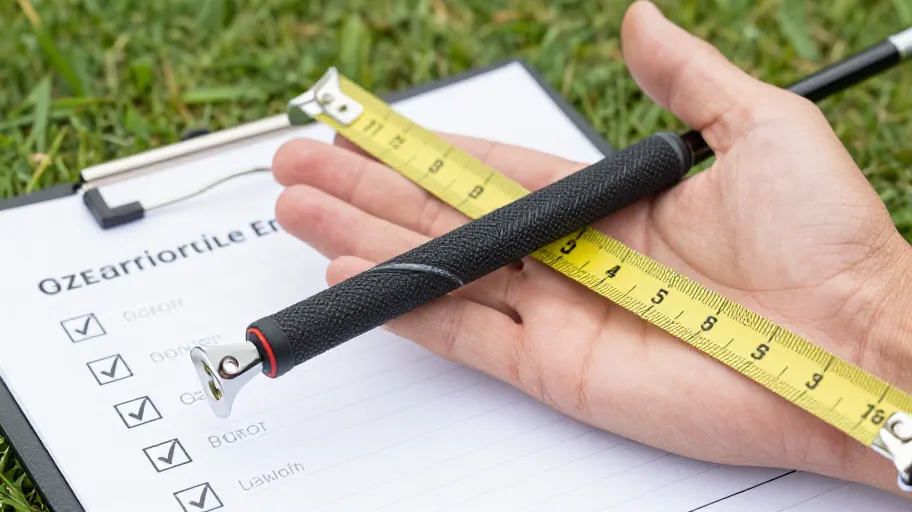
Choosing a golf grip size is not a preference call you make once and hope for — it is a build decision you should document, verify and approve before the order is confirmed. This article gives you the Four-Point Sign-Off: hand measurement, shot-pattern evidence, a build tolerance check, and a written sample confirmation. Work through all four, keep the record, and you will have defensible evidence behind every grip size you approve.
Why grip size decisions stall
Most regrips stall for the same reason: the golfer has two signals that appear to disagree. A hand measurement suggests one size; a shot pattern — misses to one side, or a feel that the club turns over too readily — suggests another. Without a documented way to weigh those signals, the order sits in the cart.
The second stall point is verification. Unlike shafts or heads, grip size is hard to audit after the fact. If the grip that arrives measures differently from what you approved, you need a record of the approved spec to compare against. That record is what this article helps you build.
The Four-Point Sign-Off
Point 1 — Hand measurement. Measure hand length from the wrist crease to the tip of the middle finger, and middle-finger length from the crease at the base of the finger to its tip. Record both figures. They give you the conventional starting point for grip size categories. They are a starting point, not a verdict — the other three points can override them.
Point 2 — Shot-pattern evidence. Note what the ball has been doing with your current grips. If your misses cluster to one side and you describe the club as hard to release, that is evidence worth recording alongside the hand numbers. If the club feels like it turns over too easily, that is also evidence. Do not treat feel as trivia; it is the most personal data you have.
Point 3 — Build tolerance check. Before sign-off, confirm with DIY-Golf how the size you are ordering is built: whether it is achieved by the core construction, by build-up layers under the grip, or by tape wraps, and what the brand and model of the grip will be for your club family. Ask how the finished assembly can be verified on receipt — for example, whether the spec is marked on the order confirmation. You are not asking for a tolerance promise; you are asking what you can check and compare when the parts arrive.
Decision table: what each piece of evidence can and cannot tell you
| Evidence type | What it tells you | What it cannot tell you | Action before sign-off |
|---|---|---|---|
| Hand measurement | A conventional starting size category | Whether your release pattern agrees with it | Record the two figures in your build note |
| Shot-pattern note with current grips | Which direction your current setup is pushing the club | Which alternative size will fix it — that must be verified | Describe the miss and the feel in one written sentence |
| Build construction answer from DIY-Golf | How the approved size is physically achieved on your model | Any outcome promise | Ask what can be verified on receipt and how |
| Sample confirmation from DIY-Golf | Whether you can check size and feel before a full order | Anything about cost or shipping until DIY-Golf confirms current policy | Request written confirmation of the current sample terms |
Read the table left to right and you have the logic of the sign-off: every piece of evidence either moves the decision forward or tells you exactly which question to ask next. Nothing in it relies on assumption.
Approval questions to put to DIY-Golf before you confirm
Bring these questions to DIY-Golf before checkout. They are deliberately specific, because vague questions get vague answers, and a grip size you cannot verify is a grip size you should not approve.
- For my club brand, family and model, which grip and which size construction would fulfill the size I have selected — core sizing, build-up, or tape wraps?
- Can the finished size on my order be verified on receipt, and what should I measure to compare it against my approved spec?
- What is the current sample policy for the exact grip model I am considering, including any fee and shipping arrangement?
- Which fitting guide page should I follow to reconcile my hand measurement with my shot-pattern note before finalising the size?
- If the size that arrives differs from my approved spec, what is the current process for raising it — and can that process be confirmed in writing before I order?
Question five is the one most buyers skip, and the one that matters most when something goes wrong. Asking it before payment is a different position from asking it after.
Documented sign-off checklist
Use this before you click confirm. It takes a few minutes and it is the difference between a decision and a guess:
- Hand length and middle-finger length recorded as figures.
- One written sentence describing your current miss pattern and feel.
- Build construction for your chosen size confirmed with DIY-Golf for your exact club family and model.
- Verification method for the finished assembly agreed — what you will measure and against which spec.
- Current sample policy requested and received in writing, if you want a sample first.
- Process for raising a size discrepancy confirmed before ordering.
- Fitting guide reviewed and the final size chosen with all four points in agreement.
If any box is unticked, you are not ready to approve — you are ready to ask one more question.
FAQ
Does a larger grip automatically fix a certain miss direction? No article should promise that outcome for your swing. Larger and smaller sizes change how the club sits in your hands, but the direction and size of the effect must be verified on your own clubs. Record your current pattern, choose a size through the Four-Point Sign-Off, and check the result on the course rather than trusting a general rule.
Can I rely on hand measurement alone? Treat it as the starting point, not the whole answer. The shot-pattern note exists precisely because hands and swings do not always agree. If the two signals conflict, work through the fitting guide and, where possible, confirm feel on a sample before committing to a full set.
How do I know the size that arrives matches what I approved? Ask before ordering how the finished assembly can be verified, and what you should measure to compare it against your approved spec. Keep your build note with the figures and the DIY-Golf confirmation together. That pairing is your audit trail.
Do I need a sample, or can I order the full set directly? That is your risk call, and it depends on how confident points one to three leave you. If hand measurement, shot pattern and build construction all point the same way, many builders proceed directly. If they conflict, request the current sample terms from DIY-Golf in writing and confirm feel first. DIY-Golf can tell you what is currently available; only you can weigh the confidence you have.
Does grip size affect club specs I already matched? Changing grip size can alter how the club sits and feels in your hands, which is exactly why the decision belongs before final sign-off rather than after. If you have already matched other components for your model, confirm with DIY-Golf how your chosen grip size construction interacts with that build before you approve the order.
Your next step
The single most useful thing you can do now is work through the fitting guide with your two recorded figures and your one-sentence miss note in front of you. It is the page that turns your evidence into a size decision.
Read the fitting guide
And if you want to keep the process itself: copy the checklist above into your build note, tick it off as you go, and file your DIY-Golf confirmations alongside it. Sign-off is only as strong as the record behind it.
Master Your Swing, DIY Your Fit. DIY Golf is the premier destination for the technical golfer. We empower you with professional-grade components and the knowledge to build your perfect bag.


