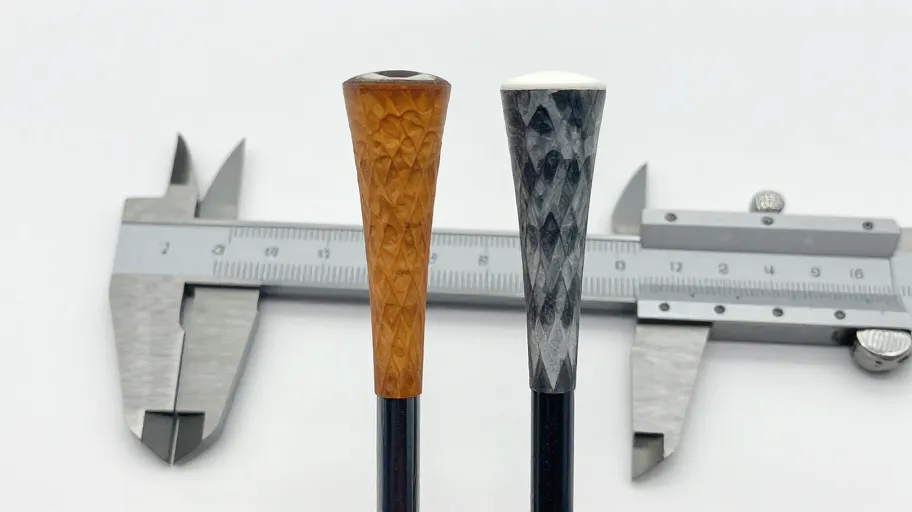
When a supplier suggests changing your grip material, treat golf grip size as a written specification rather than an assumption — compare the proposed material's stated core size and build-up against your current setup, ask for documentation in writing, and approve the change only after verifying how size, instruction, feel and test criteria line up with the exact club model you are regripping.
Why size and material cannot be evaluated separately
That is why a supplier's suggestion to "try a different material" deserves a structured response, not an instant yes. You are not judging the material in the abstract; you are judging whether a specific material, in a specific size, suits a specific club — your driver, irons, wedges or putter, from a particular brand family and model. The questions below exist so you can document that judgment before you order, not after.
The SIFT framework for approving a material change
Use four checkpoints — Size, Instruction, Feel, Test — before approving any supplier suggestion.
1. Size. Confirm the labelled size of the proposed grip and how it relates to the grip you are replacing. Ask what "size" means for that material line: core size, any built-in build-up, and whether the supplier offers sizing adjustments. Do not accept a verbal "it will feel about the same" — ask for the specification in writing.
2. Instruction. Check whether the manufacturer or DIY-Golf's current component pages state how the material should be installed, whether it suits your club types, and whether any fitment note applies to your club family. If the documentation does not mention your model family, that is a question to raise, not a gap to fill with guesswork.
3. Feel. Decide in advance what feel outcome you want from the change — drier, tackier, firmer, lighter — and write it down. A material change approved without a stated feel goal cannot be evaluated afterwards.
4. Test. Agree on how you will evaluate the change once installed: hand position, shot feedback on your own clubs, and whether the size still matches your hand measurements. Whatever evaluation method you choose, define it before the order, and confirm any sample or trial options directly with the supplier — this article does not describe any supplier's sample or trial policy.
Decision table: comparing material options against size goals
Use this table to compare any proposed material against your current grip before approving the change.
| Checkpoint | What to verify | What to document before ordering | Red flag to raise with the supplier |
|---|---|---|---|
| Size | Labelled size of proposed grip vs. current grip; any build-up differences | Both specifications in writing, tied to your club model | Supplier cannot state the size in a written reply |
| Instruction | Documented suitability for your club types and model family | The fitment note or page reference you relied on | No written guidance for your club family |
| Feel | Whether the material supports your stated feel goal | One sentence describing the desired feel outcome | Feel claims with no supporting description of the material |
| Test | How you will evaluate the installed grip | Your evaluation criteria, agreed before ordering | Supplier discourages you from defining success criteria |
| Logistics | Availability for your size and quantity | Current stock and delivery terms confirmed directly | Terms quoted verbally only, with no written confirmation |
Concrete approval questions to send in writing
Before you approve a material change, send these questions and keep the replies:
- What is the exact labelled size of the proposed grip, and how does it compare with the grip I am replacing on my [club brand / family / model]?
- Does the material have any documented build-up or sizing characteristic that would change how that labelled size plays in hand?
- Is there written guidance confirming suitability for my club type and model family?
- What is the current availability for the size and quantity I need, and what are the current delivery terms? (Confirm directly — this article does not state any supplier's stock, shipping or lead-time terms.)
- If I want to evaluate before committing to a full set, what are your current sample or trial options, and who bears any associated cost or shipping? (Ask directly; do not rely on assumptions, and note that any answer about fees or returns must come from the supplier's current policy, which this article does not describe.)
- What documentation will accompany the order so I can verify the delivered grips match the approved specification?
If a supplier answers all six in writing, you have a documented basis to approve or decline. If answers are vague, treat that as a decision input too.
Pre-order checklist
- Current grip's labelled size recorded
- Proposed grip's labelled size and build-up notes received in writing
- Fitment guidance for your club model family checked on DIY-Golf's current component pages
- Written feel goal for the change defined
- Evaluation criteria agreed before ordering
- Availability, sample options and delivery terms confirmed directly with the supplier
- Documentation requirement for the delivered order agreed
FAQ
Does changing grip material change golf grip size? It can change how a given size plays in hand, because construction and build-up differ between materials. That is exactly why you should request the proposed grip's size specification in writing and compare it against your current grip before approving the change. This article does not make material-specific size claims; verify against the supplier's documentation.
Should I replace all grips at once when trying a new material? Define your own evaluation approach before ordering and confirm any trial options directly with the supplier. This article does not describe any supplier's sample or trial policy, so treat that as one of the six written questions above.
How do I know the size is right for my hands? Start with the fitment guidance on DIY-Golf's fitting guide, then confirm the proposed grip's stated size and any build-up differences in writing. If the documentation does not address your club model, ask the supplier directly rather than assuming.
What if the supplier cannot provide written specifications? A missing written specification is a legitimate reason to pause. You can still proceed if you can verify the specification from the manufacturer's published component data on DIY-Golf's current pages, but do not approve a change based on verbal descriptions alone.
Do I need to consider grip size differently for different clubs in my bag? Size interacts with club type — a size that suits your irons may not be the choice you want on your putter or wedges. Check the fitment guidance per club type and document your size decision per club, not per bag.
Read the fitting guide
Before you approve or decline any material change, read the fitting guide to map grip size to your exact club brand, family and model, then send the six approval questions above in writing. Verify, compare, document, approve — in that order.
Quick low-friction step: copy the pre-order checklist into your notes, tick off each item as you receive written answers, and only place the order when every box is ticked.
Master Your Swing, DIY Your Fit. DIY Golf is the premier destination for the technical golfer. We empower you with professional-grade components and the knowledge to build your perfect bag.


