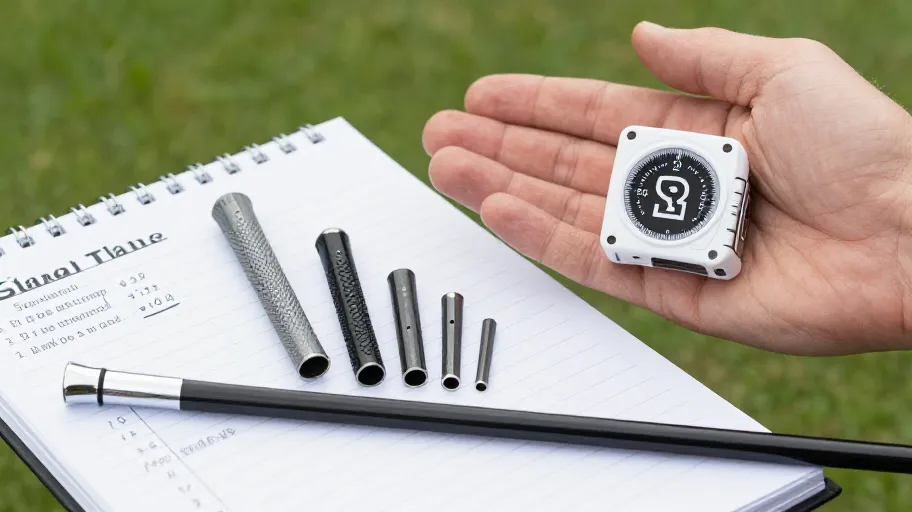
Golf grip size is the combination of the grip's nominal size class and the effective diameter it produces on your specific shaft — and the only reliable way to choose it is to record four things before you buy: a hand measurement, an audit of your current grips, a written sizing note for the club in question, and the butt diameter of the shaft you are regripping. Grip size affects how securely the club sits in your hands at address and through impact, so a regrip planned without records is a regrip planned twice. The framework below turns that into a short, repeatable documentation routine you can use on any brand, family and model, and it ends with the exact questions to confirm with DIY-Golf before you place the order.
The Grip Size Documentation Framework
The framework has four steps. Each step produces one record. Together, the records become your specification for the order — and your baseline if you later want to tune the fit.
Step 1 — Hand measurement. Measure glove hand length from the crease of the wrist to the tip of the middle finger, and middle-finger length from the crease where the finger meets the palm to the fingertip. Write both numbers down with the date. Do not rely on memory or on a size chart screenshot; record the actual measurement, because it is the anchor for every later comparison.
Step 2 — Current-grip audit. Before removing the old grip, note what is currently on the club: the grip's stated size class if it is still legible, any visible model markings, whether tape layers or build-up were visibly added, and how the grip feels in your hands today — too small, too large, or close to right. The current grip is your only first-hand evidence of what has already worked or failed on this exact club.
Step 3 — Written sizing note. Combine the first two records into a single note per club: measurement, current grip description, feel verdict, and the outcome you want (same feel, larger, or smaller). If you regrip a full set, one note per club type is enough; if you are tuning a single wedge or putter, keep the note per club.
Step 4 — Butt-diameter check. Grip size is not a property of the grip alone. The grip is installed over the shaft's butt end, so the same grip can deliver a different effective diameter on different shafts. Before ordering, record the shaft model and, where you can obtain it from your own club or the shaft manufacturer's published specifications for that exact model, the butt diameter. If you cannot obtain it, that becomes an explicit question for DIY-Golf rather than an assumption.
Decision table: what to record and why it changes the order
| Record | What to write down | How it changes what you order |
|---|---|---|
| Hand measurement | Glove-hand length and middle-finger length, with date | Determines which size class you shortlist; prevents guessing between adjacent sizes |
| Current-grip audit | Grip model/size marking, visible tape or build-up, feel verdict | Tells you whether to repeat the current setup or adjust away from it |
| Sizing note | Per-club desired outcome (same / larger / smaller feel) | Turns "a new grip" into a specific size target per club |
| Butt-diameter check | Shaft model and published butt diameter, or "unconfirmed" | Determines whether the grip as listed will deliver the intended effective diameter on your shaft |
| Installation variables | Core size listed on the grip, tape method you plan to use | Confirms grip core and shaft are matched; documents what you intend to do before checkout |
The table is deliberately boring. Its value is that every row is checkable, and a checkable order is one you can approve with confidence.
Approval questions to confirm before ordering
Because this article covers selection method rather than any specific listing, treat the following as questions to put to DIY-Golf — not as statements about their current products or policies. Confirm the answers for the exact grip and shaft combination you intend to buy:
- For this specific grip model and size, what core size does the listing state, and does DIY-Golf confirm it is intended for my shaft's butt diameter?
- Can DIY-Golf confirm in writing which size class the listed grip corresponds to, so I can match it against my hand measurement and sizing note?
- If I send my records (measurement, current-grip audit, shaft model), can DIY-Golf review them against the listing before I order?
- What does DIY-Golf's current page say about returns or exchanges if the installed feel does not match my note — and is there anything about grip installation that changes that?
- Does DIY-Golf document any installation guidance for the grip I have shortlisted, and if I am building the club myself, what do they ask me to verify first?
These are verification questions, not negotiations. A seller who can answer them from current, first-party evidence is one you can document as verified for your build.
Where golf grip size actually goes wrong
Most regrip mistakes trace back to a missing record rather than a missing product. Two patterns account for nearly all of them. The first is choosing a size from a hand measurement alone and ignoring the shaft: the grip arrives, installs cleanly, and feels different from the previous setup because the effective diameter on that shaft is not what the measurement implied. The second is upgrading grips across a set without a per-club note, so any club that felt wrong has no documented baseline to compare against. The framework prevents both by making the record come before the order.
A related discipline: when you move between brands or grip families, re-run the audit from Step 1. A size class is a label, and labels are not a substitute for the recorded measurement plus the listed core size and shaft data. Verify each combination on its own terms.
Checklist: before you click order
- Hand measurement recorded with date
- Current grip described (model/size marking, tape or build-up, feel verdict)
- Sizing note written for the club or set
- Shaft model identified and butt diameter obtained or flagged "unconfirmed"
- Grip listing's stated size and core size captured
- Approval questions above sent to and answered by DIY-Golf
- Return/exchange terms for grips confirmed on the current DIY-Golf pages
- Order note saved alongside your sizing note
FAQ
How do I measure my hand for golf grip size? Measure the glove-hand length from the wrist crease to the tip of the middle finger, and the middle finger from its palm crease to the fingertip. Write both down. Use these numbers as your record against any size chart the seller publishes, rather than relying on a general chart alone.
Can I just copy the size of my current grips? You can use the current grip as your baseline, which is exactly what Step 2 does — but only if you record it. Also note any tape or build-up, because a larger-feeling grip may be a standard grip over added tape rather than a larger grip. Your sizing note should state whether you want to repeat that setup or change it.
Does golf grip size change between brands? Labels such as size classes are applied by manufacturers, and the effective diameter also depends on the shaft's butt diameter and installation method. Treat a size label as a starting point: verify the specific grip's stated dimensions and, where available, published shaft data for your exact shaft model before ordering.
What if I cannot find my shaft's butt diameter? Record it as unconfirmed and ask DIY-Golf directly whether the grip you shortlisted is intended for your shaft model. Do not guess; the butt-diameter row in the decision table exists precisely so that unknowns become questions rather than assumptions.
Should all clubs in my bag have the same grip size? Not necessarily. Many golfers choose a size per club type based on how each is held and used. What matters for your records is consistency of method: a sizing note per club type, so any later adjustment has a documented baseline.
Read the fitting guide
Before you order, read the fitting guide. It walks through component selection and golf club fitment for your exact club brand, family and model, and it pairs directly with the records you have just created. [Read the fitting guide] — then bring your sizing note to the listings and order against a documented specification rather than a guess.
Low-friction checklist CTA
If you are not ready to read the full guide, start with the checklist above. Copy it, fill in the rows for one club, and keep it with your club records. When every box is ticked, your regrip decision is already made — all that remains is to confirm the listing details with DIY-Golf.
Master Your Swing, DIY Your Fit. DIY Golf is the premier destination for the technical golfer. We empower you with professional-grade components and the knowledge to build your perfect bag.


