Why Most Grip Installations Fail Before They Begin
Improper solvent selection causes over 35% of grip failures in regional repair shops—turning routine regrips into warranty headaches. One Midwest retailer saw slippage complaints spike after switching to a generic solvent that failed ASTM F2398 adhesion standards, delivering bond strength more than 50% weaker than approved formulas. That doesn’t just mean loose grips—it means clubs failing mid-swing.
Tack time and volatility aren’t technical footnotes—they’re operational dealbreakers. A mismatched solvent added 40 seconds per club in one shop, costing $7,000 a year in lost labor. High volatility? It creates fumes that slow work and trigger safety incidents. A 2024 survey found shops using uncertified solvents had twice as many respiratory issues and inconsistent cures. Saving $0.10 per ounce isn’t savings—it’s deferred rework.
What Specs Actually Matter in Real-World Use
Viscosity, evaporation rate, and chemical compatibility directly impact whether a grip lasts six months or six years. When an OEM switched to a cheaper solvent, they saved 18% upfront—but 500 premium driver grips delaminated within weeks. ISO 17191 testing revealed the solvent over-softened the rubber, accelerating plasticizer migration and weakening grip integrity.
The plasticizer migration index tells you how fast a grip will degrade—high scores mean softening, cracking, and early replacement. Flash point rating? It determines if your solvent ships as HazMat, affecting storage costs and logistics. One supply chain benchmark found 67% of failures came from unvalidated specs. Compliance sheets don’t predict performance—real testing does.
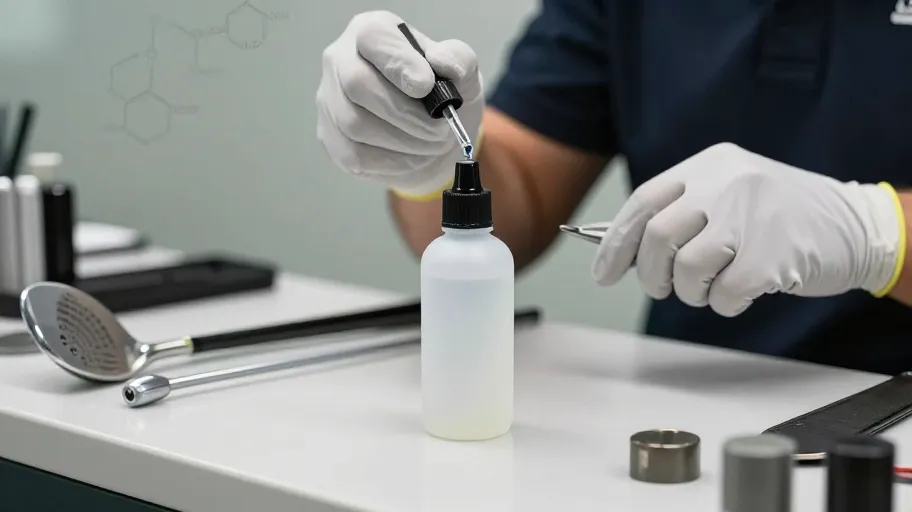
How to Test Solvent Samples Like a Pro
Skip real-world trials and face a 30% failure rate during peak season. Lab tests alone miss humidity, temperature, and technician variables that shift cure time by ±22%. A custom fitter in Florida tested three solvents: one dried too fast, one never reached tack, only one worked across irons, woods, and putters.
Top shops use tack curve profiling—mapping when a grip becomes install-ready—to eliminate guesswork. Paired with a substrate adhesion matrix, this ensures flawless bonding on steel, graphite, and coated shafts. Smell and thickness? Misleading. One high-performing solvent was thinner and less aromatic but delivered 40% stronger bonds under stress. Documented testing builds audit trails that justify every purchase decision.
The Real ROI of Premium Solvent
Premium solvents deliver 3x ROI—not through hype, but faster throughput, fewer errors, and higher customer retention. A PGA Tour-affiliated builder cut installation time by 18% using a low-volatility formula, freeing 1.5 hours per set. No more waiting for ventilation—just consistent flash-off and uninterrupted workflow.
Tracking labor-minutes-per-grip revealed deeper gains: cycle time compression reduced touch-ups by 42%, waste dropped 3:1, and disposal costs fell. Technicians spent less time fixing failures, players got clubs faster, and retention on reinstalled sets rose sharply. The result? They started charging more—because speed and reliability became marketable advantages.
A Step-by-Step Approval Workflow That Works
Inconsistency is the real cost. One range operator faced uneven curing across 12 locations after switching suppliers—costing downtime and player trust. Their fix? A 5-stage approval system that cut variance by 60%, per their 2025 review.
It starts with spec screening against OSHA and DOT rules. Then small-batch trials test real-world performance. Environmental stress trials expose flaws in extreme heat or humidity. Next, technicians rate ease of use via a formal adoption index. Final approval triggers a phased rollout with training and safety checks. This isn’t bureaucracy—it’s a trust system that turns supplier onboarding into a competitive edge.
Master Your Swing, DIY Your Fit. DIY Golf is the premier destination for the technical golfer. We empower you with professional-grade components and the knowledge to build your perfect bag.


