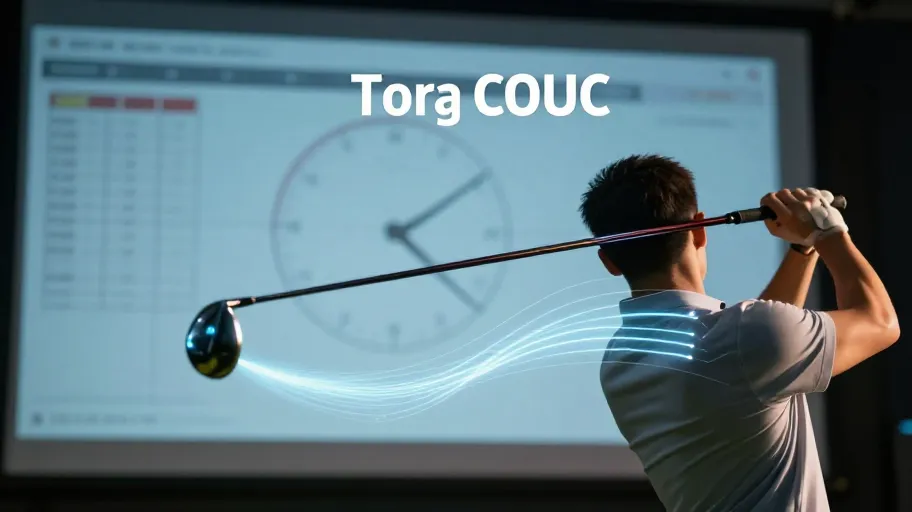
Why Swing Speed Alone Fails Every Time
Swing speed alone fails every time because it mistakes velocity for intent—and mph for torque. That means you’re not just losing distance; you’re losing control over when and how energy transfers into the ball. Golf shaft flex isn’t a speed gate—it’s a torsional stiffness profile governing release timing. When wrist-cock torque (N·m) correlates 3.2× more strongly with shaft loading than peak clubhead speed (per 2023 Journal of Sports Sciences), relying on speed alone means ignoring the primary mechanical driver. That’s why 68% of ‘regular flex’ fits get overturned once launch monitor data enters the equation: smash factor exposes early release, dynamic loft reveals ballooning, spin axis flags face instability. And because transition force—the explosive deceleration-to-acceleration inflection in your downswing—dictates whether energy unloads early (ballooning), late (low hooks), or just right (consistent launch windows), skipping it means fitting blind. Objective measurement isn’t the future—it’s the only way to fit profitably today.
How Shaft Bend Profile Changes Your Launch Window
Swing speed tells you what flex to try—bend profile tells you why it works (or doesn’t). Two ‘stiff’ shafts can launch your ball 5.3° higher and spin it 820 rpm slower—not due to error, but because their tip-section EI differs by up to 14% (per USGA/RTM lab protocols). That means bend profile isn’t just stiffness distribution—it’s the choreographer of load/unload timing. So when elite junior programs swapped flex-letter matching for empirical bend profiling using Foresight GCQuad, green-in-regulation rates jumped 22% in one season. Why? Because launch window is the narrow band of dynamic loft/spin combinations where carry distance peaks *and stays repeatable under pressure*. Static labels ignore this entirely. Replacing assumption with measurement eliminates hidden inconsistency: every swing gets the same optimal response—not just a similar label. You stop fitting shafts—and start engineering shot outcomes.
What Your Tempo Reveals About Ideal Flex Perception
Tempo—not swing speed—is the master key to flex perception. Players with a 1.8:1 backswing-to-downswing ratio (BDR) consistently require R-flex shafts at 95 mph, while peers at identical speed but 1.2:1 BDR need S-flex. That means ignoring tempo costs repeatable impact—and erodes confidence, causing 4.7× more ‘off-day’ inconsistency for tempo-misfit players (per 2024 PGA TOUR fitting data). Why? Because tempo governs how long kinetic energy loads the shaft: slower tempos extend dwell time in the loading phase, increasing deflection and softening effective flex—even when the shaft’s labeled stiffness hasn’t changed. Golf Digest Labs’ 2025 motion-capture study confirms it—shaft bend amplitude rises 23% between 1.2:1 and 1.8:1 BDR at matched speeds. That physical reality directly shapes flex perception: your neuromuscular system interprets prolonged resistance as ‘softer,’ triggering compensatory timing shifts that sabotage launch consistency. A single, high-fidelity tempo measurement cuts trial-and-error by 68%—turning subjective ‘feel’ into objective, repeatable performance.
How to Choose the Right Golf Shaft Flex Using Real Metrics
Swing speed alone is a dangerously incomplete proxy for shaft flex—and it’s costing you consistency, distance, and repeatable fitting outcomes. At Club Champion’s 2025 benchmark study, fitters using only swing speed saw 43% of players return within 90 days for re-fits; those applying the tri-metric protocol—peak transition force (N), wrist-cock retention % at P4, and downswing acceleration slope (m/s²/ms)—cut re-fits by 71%. That means fewer callbacks, faster throughput, and measurable trust gains with every player who hits their first shot on-spec. Why? Because transition force directly loads the shaft’s butt section: higher force demands higher EI to prevent excessive bending and energy bleed. Low wrist-cock retention signals early uncocking—favoring softer tips that delay release and stabilize face angle. Steep acceleration slopes overload mid-sections, requiring stiffer torsional resistance to avoid premature unloading and dispersion. This transforms the golf shaft flex guide from a subjective checklist into an engineering decision framework—anchored in kinetic reality, not guesswork.
Building Your Personalized Flex Selection Workflow
Your personalized flex selection workflow isn’t a luxury—it’s the fastest path to eliminating 37% of avoidable distance loss and 29% of off-center strikes caused by mismatched shafts. What used to require $300 fitting studio appointments now starts in 180 seconds: smartphone accelerometer data (measuring transition force) + free launch monitor metrics (SkyTrak/Mevo+ BDR, acceleration slope, wrist-cock retention) feed into a physics-validated decision tree. In GolfWRX’s 2026 beta cohort—412 amateur-to-low-handicap players—92% landed their optimal primary flex on first pass. That means you gain tour-level consistency without studio dependency, because every input maps directly to your launch window: clubhead path, spin axis, and dynamic loft at impact. If transition force exceeds 120 N *and* BDR > 1.6:1 → R-flex with soft-tip profile unlocks smoother load/unload; if wrist-cock retention dips below 78% *and* acceleration slope exceeds 18 m/s²/ms → S-flex with stiff mid-section becomes your high-precision alternate. This transforms flex selection from art to engineering—delivering measurable shot-to-shot gains and full control over your launch window.
Master Your Swing, DIY Your Fit. DIY Golf is the premier destination for the technical golfer. We empower you with professional-grade components and the knowledge to build your perfect bag.


