A revised golf shaft sleeve adapter sample does not demand a full re-evaluation — it demands a disciplined delta review. Compare the new sample against your documented findings from the previous one, confirm exactly which features changed, re-test only the affected items, and record the approval decision. Everything hinges on matching the adapter to your exact club brand, family, model and hosel generation, which you should confirm before the sample is even produced.
The Delta Review Method
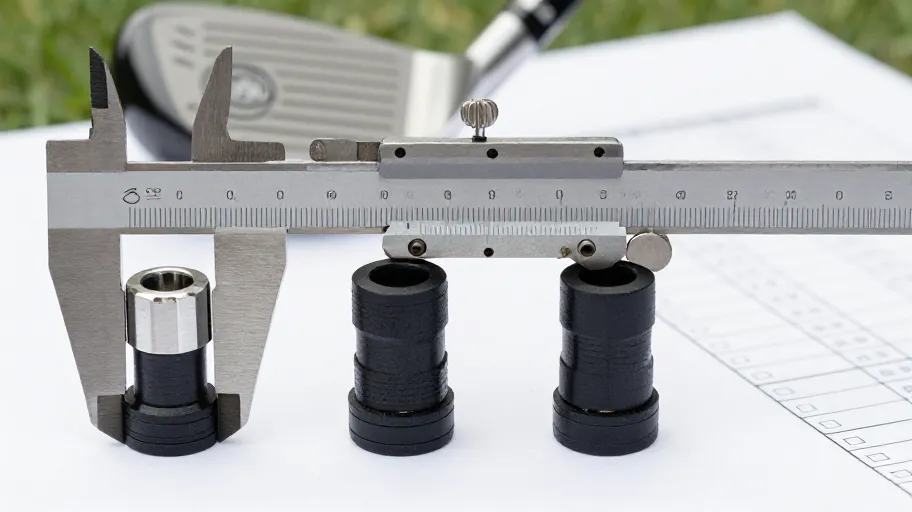
When a revised shaft sleeve adapter arrives, the temptation is to either eyeball it and approve, or panic and restart the whole evaluation. Both waste effort. The Delta Review Method gives you a third path:
- Recover the record. Open the notes, measurements and photos from the previous sample review. If none exist, this revision cycle is where you start documenting — see the checklist below.
- Request a written change statement. Ask the supplier to list what changed between revision one and revision two, and why. A revision without a stated reason is a red flag worth pausing on.
- Classify every item. Sort each reviewed attribute — tip fit, hosel engagement, sleeve geometry relevant to your model, surface finish, screw seating — into carry over, re-check, or reject using the decision table below.
- Approve against the record, not the feeling. Sign off only on items you can trace to evidence: your own inspection notes plus the supplier's change statement.
The point is not to test less. It is to test differently — concentrating effort where the revision actually touched the adapter, and where your documented baseline says risk lives.
Carry over, re-check, or reject: the decision table
| Reviewed item | Carry over unchanged | Re-check on revised sample | Reject or escalate |
|---|---|---|---|
| Tip fit to shaft | Prior sample verified and supplier confirms no change to tip spec | Any change statement touching the tip bore, collar or bonding surface | New sample fits differently with no stated change |
| Hosel engagement to clubhead | Documented correct engagement for your exact model, unchanged in revision | Any change affecting sleeve outer profile or seating depth | Engagement differs from documented baseline without explanation |
| Adapter-to-model matching | Fitment selector and supplier both confirm the same model mapping across revisions | Supplier revised part naming, numbering or claimed compatibility scope | Model mapping changed silently between samples |
| Screw and wrench interface | No change declared; prior sample seated cleanly | Threads, torque feel or head recess altered in revision | Screw seating inconsistent between samples |
| Finish and marking | Cosmetic-only change, explicitly declared | Marking or laser content changed (may affect identification) | Undeclared differences in markings that affect traceability |
| Documentation | Change statement provided and consistent | Change statement vague or partially complete | No change statement provided at all |
Escalation does not mean starting over. It means the supplier owes you a clear answer before the item moves out of the reject column.
Concrete approval questions for the supplier
Before approving any revised golf shaft sleeve adapter, send these questions in writing and keep the answers on file:
- Which specific features changed between the previous sample and this one, and what drove each change?
- Which dimensions or features were deliberately left unchanged, and can that be confirmed in writing?
- Which club brand, family, model and hosel generation does this adapter revision map to, and is that mapping identical to the previous sample?
- What inspection did the supplier perform on this revision before shipping it, and what did it document?
- What is the current policy on further samples if this revision still fails an item — including any fees, shipping responsibility, and whether fees are credited toward orders? Do not assume; ask for the current written policy.
- If a future revision changes the tip interface, will that be flagged as a functional change rather than a cosmetic one?
Question 5 matters because sample policies vary by supplier and change over time. Nothing about fees or shipping terms should be inferred from past dealings or from anything you have read elsewhere — confirm the current position directly, in writing, each cycle.
What you must never carry over
Even in a delta review, three things deserve fresh confirmation every single time, regardless of the change statement:
- Model mapping. A sleeve adapter that fit a driver family last cycle may not fit a revised head generation of the same family. Confirm the mapping against your exact club model every time.
- Physical verification on the actual parts. A written statement is evidence of intent, not of outcome. Seat the adapter, engage the screw, inspect the finish.
- The revision trail itself. If sample two and sample three arrive with conflicting stories about what changed, treat the whole record as unreliable and re-baseline.
Revised sample review checklist
Use this checklist for each revision cycle:
- Previous sample review notes, measurements and photos recovered
- Written change statement received from supplier, item by item
- Every attribute classified: carry over / re-check / reject
- Adapter mapped to exact club brand, family, model and hosel generation
- Tip fit physically verified on the actual shaft and head
- Screw seating and wrench engagement tested
- Markings and identification checked for traceability
- Current sample fee, shipping and re-sample policy confirmed in writing
- Approval decision recorded with date, evidence and signature
Frequently asked questions
Does a revised sample mean the previous approval is void? No. The previous approval stands for the attributes you verified and that the supplier confirms are unchanged. What is void is your confidence in anything touched by the revision — those items move to re-check.
Should I re-measure everything anyway, just to be safe? You can, but a delta review targets effort better. The exception is the model mapping and physical seating: those are cheap to verify and expensive to get wrong, so re-confirm them every cycle regardless of the change statement.
What if the supplier won't provide a change statement? Pause the approval. Without a stated delta, you cannot distinguish a cosmetic revision from a functional one, and any future dispute about the adapter's behaviour becomes your word against theirs.
Can I approve a revised adapter for multiple club models at once? Only if the supplier's written mapping covers each model explicitly and you verify seating on each head. Compatibility is per model and hosel generation — never assume a family-wide fit.
How do I keep this manageable across many revisions? The checklist above doubles as your archive. One completed checklist per sample, filed together, gives you a running revision history that makes every future delta review faster.
Before anything else, confirm your club model in the fitment selector. Every delta review, change statement and approval decision is only as good as the model mapping underneath it.
Low-friction next step: copy the revised sample review checklist above into your build file now, before your next sample arrives — so the delta review starts with a record, not a memory.
Master Your Swing, DIY Your Fit. DIY Golf is the premier destination for the technical golfer. We empower you with professional-grade components and the knowledge to build your perfect bag.