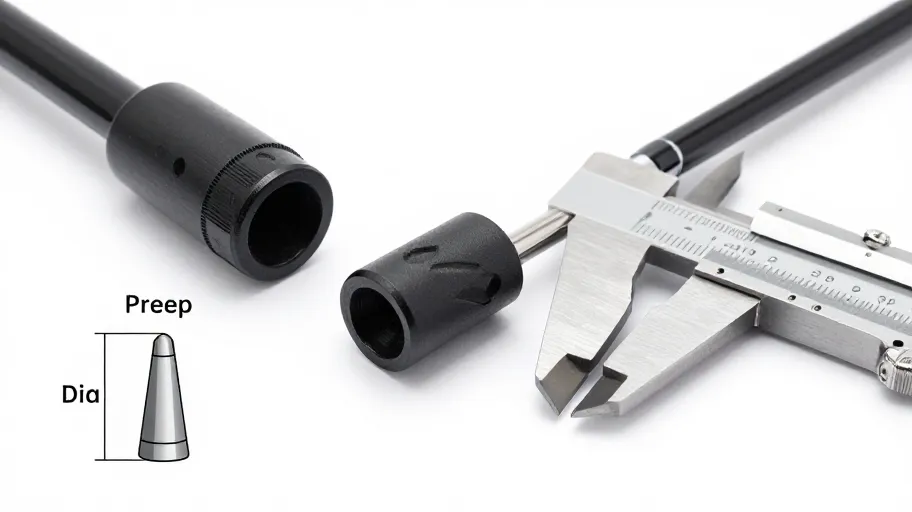
A golf shaft sleeve adapter is confirmed compatible only when it matches the club head's hosel interface and the shaft's tip dimensions — a club name by itself is an incomplete brief. Before ordering, document the club's exact model, generation and adapter markings, plus the shaft's tip diameter and prep style, and confirm each item against the fitment selector or the seller's stated specifications. A correct brief prevents the two failure modes buyers hit most: a sleeve that will not seat in the head, or one that will not accept the shaft.
Why the first brief goes wrong
Most replacement projects start with a single sentence: "I need an adapter for a [brand] driver." That sentence is the beginning of a sourcing brief, not the brief itself. Adapter families can differ between generations of the same model line, and the shaft side of the interface is a separate question from the head side. A complete brief answers both sides with evidence, not recall.
This is where the MATCH-6 framework helps. It splits the compatibility question into six checks you can document before contacting a seller, which shortens verification and reduces the chance of ordering the wrong component.
The MATCH-6 framework
| Letter | Check | What to document | Why it matters |
|---|---|---|---|
| M — Model identity | Exact club model, generation and release year if known | Head markings, model name in full | Model names repeat across generations with different adapters |
| A — Adapter marking | Code, colour band or notch pattern on the existing sleeve | Photo of the installed adapter | Markings distinguish adapters that look alike |
| T — Tip diameter | Shaft tip diameter as stated by the shaft manufacturer | Spec sheet or printed shaft label | Determines whether the sleeve accepts the shaft at all |
| C — Collar and seating | How the sleeve seats and rotates in the hosel | Photo of the hosel cavity and old sleeve position | Seating geometry differs between adapter families |
| H — Hosel depth and prep | Shaft insertion depth and tip preparation required | Shaft manufacturer prep guidance | Prep mismatch affects install, not just fit |
| 6 — Six-sided confirmation | Verify all five above against the seller's stated fitment list | Fitment selector result or written spec confirmation | Closes the loop with first-party evidence for the exact product |
Each check is a gate, not a guess. If any one of the six cannot be documented, treat the brief as incomplete and resolve that item before purchase.
Decision table: match your situation to the checks that matter most
| Buyer situation | Priority checks | Risk if skipped |
|---|---|---|
| Replacing a broken adapter, original shaft intact | Model identity, adapter marking, six-sided confirmation | Ordering a visually similar but wrong-generation sleeve |
| New shaft into an existing head | Tip diameter, hosel depth and prep, six-sided confirmation | Sleeve that does not accept the shaft or seats incorrectly |
| Head bought second-hand, no adapter | Model identity, adapter marking, collar and seating | Ambiguous head markings lead to a guessed generation |
| Adapter markings worn or absent | Model identity, collar and seating, six-sided confirmation | No physical reference left; seller confirmation becomes essential |
| Building from components for a client | All six, documented in writing per club | No audit trail for the fitment decision |
Head-side versus shaft-side: the distinction buyers blur
The head side asks: does this sleeve match the hosel of this club model and generation? The shaft side asks: does this sleeve's internal geometry accept this shaft's tip diameter and preparation? A sleeve can pass one test and fail the other. When you brief a seller, present both sides explicitly — "head is X with adapter marking Y; shaft is Z with tip diameter W" — rather than mixing them into a single club description.
For any numerical dimension, whether tip diameter, insertion depth or collar height, source the figure from the shaft or head manufacturer's stated specification rather than from memory or a forum claim. Where a published figure is not available, ask the seller to confirm the sleeve's accepted range for your exact shaft model. Do not rely on a measurement you cannot trace.
Approval questions to send before purchase
- Does this golf shaft sleeve adapter fit the exact club model, generation and adapter marking I have documented — yes or no, in writing?
- Which shaft tip diameters does this sleeve accept, and does my shaft fall within them?
- Does this sleeve require any shaft tip preparation before install, and where is that documented?
- Is the adapter currently in stock, and what is the current price including any options I need?
- What is your current returns policy if the sleeve does not fit the documented club and shaft?
- If markings on my head are ambiguous, can you verify the generation from photos before I order?
These questions convert unknowns — stock, price, returns, fitment — into project-specific confirmations. Do not assume any of them; policies and specifications change, and only the seller's current written answer counts.
Documentation checklist before you order
- Full club model name and generation recorded
- Photo of the existing adapter's markings or code
- Photo of the hosel cavity (if the adapter is missing)
- Shaft tip diameter sourced from the manufacturer's specification
- Shaft prep requirement noted
- Fitment selector result or written seller confirmation saved
- Stock, price and returns confirmed in the current exchange
Frequently asked questions
Is a club model name enough to identify the right golf shaft sleeve adapter? No. Model names can span generations with different hosel interfaces. Add the generation, the adapter's markings and the shaft's tip diameter to complete the brief.
What if the adapter markings are worn off? Document the head's model identity and photograph the hosel cavity, then ask the seller to verify the generation from those photos before ordering. Without markings, written confirmation becomes the deciding evidence.
Do I need the shaft specification if I'm only replacing the sleeve? Yes. The sleeve interfaces with the shaft tip as well as the head, so tip diameter and any prep requirement remain part of the brief even when the shaft is unchanged.
How do I confirm compatibility rather than assume it? Run the six MATCH-6 checks, then verify the result in the fitment selector or with a written seller confirmation naming your exact club model and shaft. Save that confirmation with your build records.
Can I reuse an adapter from a different model in the same brand family? Only if the documented head-side and shaft-side checks pass for both clubs. Brand family alone does not establish compatibility; the generation and markings do.
Next step
Confirm your club model in the fitment selector — it is the fastest way to close the MATCH-6 loop and move from a club name to a documented, order-ready brief.
If you are not ready to select yet, run the documentation checklist above first and return with all six items captured. A complete brief saves a round of clarification and lets you approve the order on evidence.
Master Your Swing, DIY Your Fit. DIY Golf is the premier destination for the technical golfer. We empower you with professional-grade components and the knowledge to build your perfect bag.


