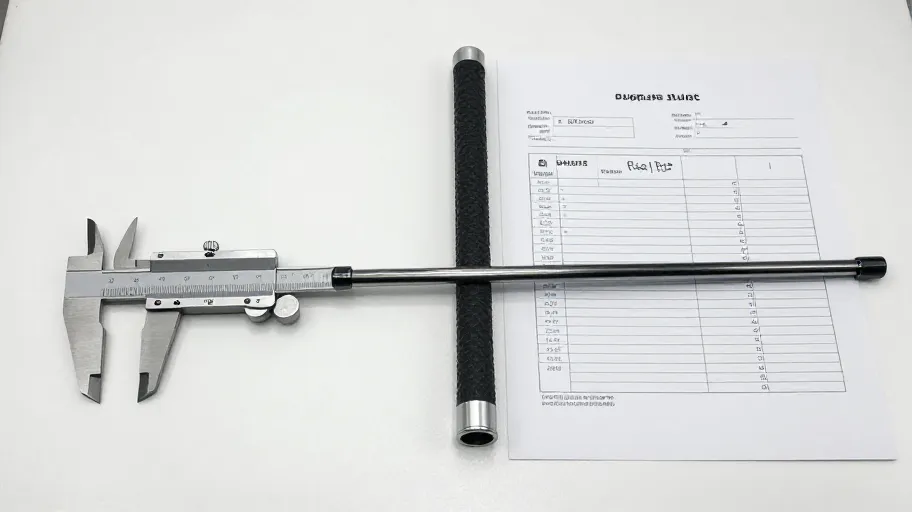
How buyers can evaluate Rory grip size without relying on sales claims: treat "rory grip size" as a verification task, not a purchase decision. Ignore any listing that does not state which dimension the size label refers to — core diameter, butt diameter, or a built-up final size. Measure the shaft butt of the exact club model you service with calipers, request the supplier's stated dimension in writing, and approve only when the two figures match your documented build spec. That is the whole method; the rest of this article turns it into a repeatable gate process.
Why sales claims are not evidence
A size label on a product page is a claim. Evidence is a dimension, stated in writing, attached to the exact model and batch you intend to buy, and confirmed against your own measurement. The gap between those two things is where sourcing errors happen: a listing can carry the right label and the wrong dimension, reuse catalog copy from a different model, or omit whether the stated size assumes build-up tape underneath.
None of that means any supplier is dishonest. It means a professional buyer's job is to convert claims into checkable numbers before approving a component. For grip sizing specifically, three numbers matter:
- Core size — the inside diameter of the grip, which determines fit on a bare shaft butt.
- Butt diameter of the shaft — your measured reference from the club you are servicing.
- Final installed size — what the grip measures after installation, including any build-up tape.
Ask the supplier which of these their listing refers to. If the answer is not written down, that is your first gate failure.
The FITS framework: a named gate process for grip sizing
Use FITS to structure every grip-size evaluation:
- F — Flag the ambiguity. Write down every unstated element: which dimension the size label means, which model it applies to, whether build-up is assumed, what the stated tolerance is (ask; do not assume a number).
- I — Inspect the listing and the part. Compare the written claims against a physical sample if one is available, and against your caliper measurement of the target shaft butt.
- T — Test the fit on the bench. Dry-check and, if policy allows, install on a scrap or test shaft of the same model family. Document what you observe. Do not generalise one test into a batch conclusion without the supplier's written confirmation.
- S — Sign off or stop. Approve only when the written dimension, your measurement, and your bench result agree, and when sample, cost, shipping and return policies have been confirmed directly in writing.
FITS is deliberately sequential. Skipping the "Flag" step is what turns a sizing question into a returns dispute later.
Decision table: evaluation gates
| Gate | What to check | Pass condition | Fail action |
|---|---|---|---|
| 1. Label definition | Which dimension does "size" refer to? | Supplier states core, butt or final size in writing. | Request clarification; do not proceed on assumption. |
| 2. Model match | Does the spec apply to the exact club model you service? | Model and family named explicitly in the supplier's answer. | Reject or re-scope the enquiry to the correct model. |
| 3. Measurement agreement | Your caliper reading vs supplier's stated dimension. | Figures agree within the tolerance the supplier states in writing. | Ask the supplier to reconcile the discrepancy in writing. |
| 4. Build-up disclosure | Is build-up tape assumed in the stated size? | Stated explicitly, either assumed or not. | Treat the listing as incomplete; re-open gate 1. |
| 5. Policy confirmation | Sample, cost, shipping, return terms for this item. | Current policy confirmed directly for this exact product. | Confirm with the supplier before any commitment; policy details are not asserted here. |
| 6. Batch consistency plan | How will later deliveries match the approved item? | Supplier agrees to a documented spec reference for reorders. | Note the risk in your file; approve only if acceptable to your workflow. |
Approval questions to put to the supplier
Send these before approving any quantity:
- Does the listed size for this item refer to the core diameter, the butt diameter, or a final installed size including build-up?
- Which club model, family and generation does this specification apply to?
- What dimensional tolerance do you state for this item, and is it published or supplied on request?
- Can you supply the specification sheet for the exact batch I would receive?
- What is your current sample policy, cost, shipping arrangement and return policy for this item? (Confirm directly — these are not stated in this article.)
- If a delivered batch does not match the approved specification, what is your documented remediation path?
Record the answers verbatim. A paraphrased answer is a weaker document than a quoted one.
Bench-side checklist for grip-size verification
- Measure the shaft butt of the exact target club with calipers; record the figure and date.
- Obtain the supplier's written statement of which dimension their size label means.
- Confirm the exact model, family and generation in writing.
- Ask for the stated tolerance and record it as supplied, not assumed.
- Clarify whether build-up tape is included in the stated size.
- Bench-test on the target or an equivalent test shaft; document observations.
- Confirm sample, cost, shipping and return policy directly for this item.
- Save all correspondence as your approval record.
- Sign off, or stop and escalate the ambiguity.
FAQ
Does "rory grip size" refer to one standard dimension? Treat it as undefined until the supplier states which dimension their label refers to. Core size, butt diameter and final installed size are three different numbers, and listings do not always distinguish them. Confirm in writing for the exact item.
Can I approve a grip size from the listing alone? No. A listing is a claim. Approval requires the written dimension, your own measurement of the target shaft, and a bench check that the two agree for the model you service.
How does build-up tape change the evaluation? It changes which number you are comparing. If the stated size assumes build-up tape, your bare-shaft measurement is not the right comparison figure. Ask the supplier to state whether build-up is included before you compare anything.
What if my measurement and the supplier's stated size disagree? Stop and ask the supplier to reconcile the two figures in writing. Do not proceed on the assumption that one of them is close enough — you have not verified a tolerance unless the supplier stated one.
Where do sample, shipping and return terms fit in? They are gate items, not afterthoughts. No sample, cost, shipping or production policy details are asserted in this article; confirm the current terms directly with the supplier for the exact item and record them before approval.
Before your next bench session
Run every grip-size purchase through FITS once and the process becomes routine: flag the ambiguity, inspect against your own caliper, test on the bench, sign off only with written confirmation. To make that repeatable, 下载核对清单 — the checklist version of the gates and approval questions above, formatted for bench-side use.
If you want the shorter working version first, use the bench-side checklist in this article as your interim gate sheet until the full download is in your file.
Master Your Swing, DIY Your Fit. DIY Golf is the premier destination for the technical golfer. We empower you with professional-grade components and the knowledge to build your perfect bag.


