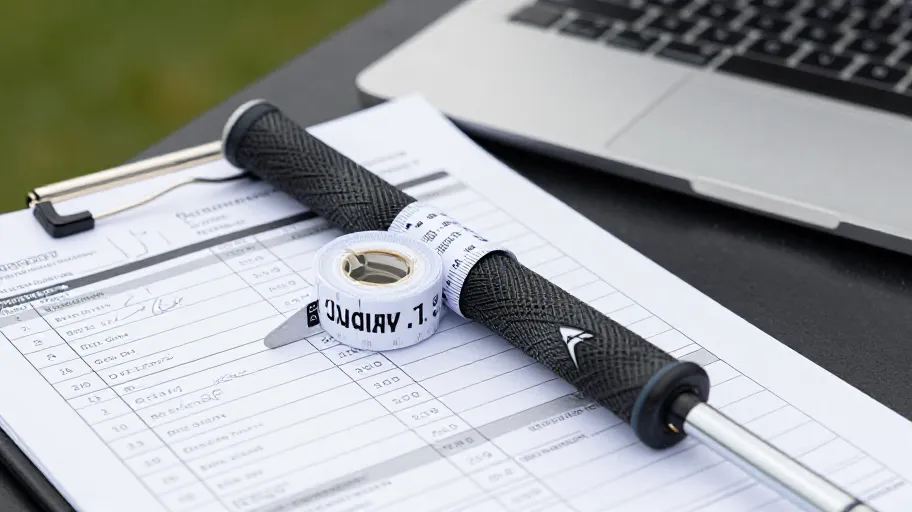
Evaluating a grip setup against a named player reference does not require trusting a product page — it requires documented specifications, a repeatable comparison method, and written supplier confirmation before you order. This article walks buyers through the SPEC Loop (Source → Proof → Evaluate → Confirm), a decision table covering the grip parameters that matter, and the exact approval questions to send before committing to a purchase.
Why sales claims are not evidence
Product copy that references a tour player's grip configuration is, at best, a starting point for research. It tells you what to investigate — grip model, size, installed wraps or builds, and alignment of the setup across the bag — but it does not tell you whether a specific replacement component in front of you matches that configuration. Claims about a player's setup change over time, and public descriptions rarely document the measurement method, the date of observation, or the exact build details. A buyer who treats the claim as a specification inherits every gap in that claim.
The practical alternative is to treat the player reference as a hypothesis and test it with your own documented evidence. That is what the SPEC Loop is for.
The SPEC Loop: a four-step evaluation framework
Source. Establish what you actually know about the reference setup. Separate three tiers of evidence: (1) documented first-party information — spec sheets, build sheets, or written confirmation from a supplier or fitter; (2) internal planning evidence — notes your own team has compiled from prior builds or comparison work; (3) public claims — marketing copy, commentary, or player-setup references that no one in your chain can verify. Only tier 1 should drive a purchase decision. Tiers 2 and 3 can shape the questions you ask.
Proof. For each grip parameter you intend to match, demand documentation rather than description. "Played on tour" is description. A written specification — core size, grip weight, installed diameter at a stated point, taper profile, material composition — is proof. If a supplier cannot document a parameter, record it as unverified and price the risk accordingly.
Evaluate. Compare documented specifications against your build requirement for the specific club brand, family and model you are working on. The decision table below organises this step.
Confirm. Get written confirmation of anything that will affect the order: availability of the exact component, the current sample and return policy, and the build tolerance the supplier will commit to. Confirm — do not assume. Policies change, and this article carries no first-party data on any supplier's current terms.
Decision table: grip parameters and how to verify each
| Parameter | Why it matters to fitment | What to demand as evidence | If documentation is missing |
|---|---|---|---|
| Core size | Determines fit on the specific shaft; a mismatch changes installation behaviour | Written core diameter specification matched to your shaft specification | Ask the supplier to state the core size in writing before ordering |
| Grip weight | Affects swingweight and feel of the finished club | Stated weight per grip, with the weighing method if tolerance is critical | Request a sample and weigh it yourself; document the result |
| Installed / built-up diameter | Changes hand action and shot shape tendencies | Written build-up specification in wraps or diameter terms | Specify your target build in the purchase documents |
| Taper profile | Influences how the grip feels through the hands | Profile specification or a physical sample | Compare a sample against a reference grip you trust |
| Material and texture | Affects traction, wear, and all-weather behaviour | Material composition statement | Confirm composition and care expectations directly with the supplier |
| Model availability | Determines whether the order can be filled as specified | Written confirmation that the exact model and variant are in stock | Do not order on an assumption of availability |
Every "if documentation is missing" action is a question for the supplier, not a guess. That is the point of the framework: unknowns become written questions, and written answers become the approval record.
Approval questions to send before you commit
Before any purchase order, put these questions in writing:
- Can you provide the written specification — core size, weight, and installed diameter — for the exact grip model and variant I am considering?
- Can you confirm in writing that this exact model and variant is currently available for my quantity?
- What is your current sample policy for this component, including who covers shipping and whether any sample fee applies? Please state the policy as it stands today.
- What build tolerance will you commit to for installed diameter on my specified shaft?
- What is your current return or exchange process if the delivered component does not match the documented specification?
- Can you provide a build sheet or specification document I can attach to my order record?
Note what these questions do not assume. They do not presume a sample is free, that the buyer or supplier covers shipping, or that any fee is returned. They simply require the supplier to state the current policy. That written statement becomes part of your approval file.
Pre-order checklist
Use this checklist — the same one behind the download CTA below — as your gate before releasing an order:
- Reference setup separated into documented fact vs. public claim
- Written specification received for core size, weight, installed diameter, taper, and material
- Exact model and variant availability confirmed in writing
- Sample obtained or sample policy confirmed directly with the supplier
- Sample measured against your own reference and the measurement documented
- Build tolerance for your specified shaft agreed in writing
- Current return/exchange process confirmed in writing for this order
- Order record attaches the specification documents and confirmation emails
- Internal sign-off recorded by the person accountable for the build
A checklist is only as good as the honesty of its unchecked boxes. If a line cannot be ticked, the order waits.
FAQ
Can I rely on public information about a tour player's grip setup when ordering components? Treat it as research context, not specification. Player setups change, and public descriptions rarely document build details or measurement methods. Use the reference to form questions, then require written specifications from the supplier for the exact component you would buy.
What if a supplier's specification sheet and my own measurement disagree? Document both, identify the difference in measurement method or point of measurement, and ask the supplier to reconcile it in writing before ordering. An unresolved disagreement is a stop condition, not a rounding issue.
Is a sample necessary for every grip order? For a build where feel, taper, or built-up diameter is critical, a sample measured against your own reference is the strongest evidence available. Whether a sample is offered, what it costs, and who covers shipping are policies you must confirm directly with the supplier — this article carries no data on any supplier's current terms.
How do I match a grip to a specific shaft from a specific club family? Match core size and installation method to the shaft's written specification, not to the club's marketing family name. If the shaft specification is not in your records, obtain it first; ordering a grip against an undocumented shaft is the most common avoidable error in replacement work.
What belongs in the order record? The written specification, the supplier's written confirmations on availability, sample policy and tolerance, your own sample measurements, and the internal sign-off. If a dispute arises later, the order record is the only evidence that counts.
CTA — 下载核对清单: Download the pre-order verification checklist and run every grip purchase through the SPEC Loop before you release the order.
Master Your Swing, DIY Your Fit. DIY Golf is the premier destination for the technical golfer. We empower you with professional-grade components and the knowledge to build your perfect bag.


