Why most golf club repairs don’t last
Over 60% of DIY golf club repairs fail within months because of improper epoxy use—not poor craftsmanship. A 2025 survey of repair technicians found that wrong mixing ratios and poor curing conditions caused nearly two-thirds of shaft separations during play. At swing speeds over 90 mph, even tiny flaws in epoxy golf club assembly lead to sudden failure.
Mistakes like skipping degreasing or using hardware-store adhesives create micro-voids that grow under repeated stress. The problem isn’t your golf club components—it’s the bond between them. Epoxy isn’t just glue; it’s engineered to transfer energy across materials. Wrong viscosity, cure time, or flex modulus? That’s a weak link waiting to snap.
One builder replaced three driver heads in a year, spending $320—40% more than a pro re-shaft—and still had wobble. Getting the chemistry right means reliable performance, fewer rebuilds, and confidence in every swing.
Temperature and humidity are silently killing your bond strength
You could be losing 40% of your epoxy’s strength before you even apply it—all because of room conditions. Testing from MasterBond and Henkel shows that curing outside 70–80°F (21–27°C) with humidity above 45% cuts cross-link density nearly in half. That means weaker joints, even with perfect mixing.
The hidden issue is induction time—the window between mixing and applying. At 60°F, it can double, causing the epoxy to thicken too soon. That leads to poor wetting on shafts or hosels, trapping air and creating micro-failures. Those invisible voids become cracks under swing torque.
A Midwest club fitter cut rework by 68% just by climate-controlling his workspace. Stable conditions mean predictable cures. For engineers: consistent environment enables full polymerization. For managers: it reduces callbacks. For players: it means no head flying off mid-round.
What really happens when resin meets hardener
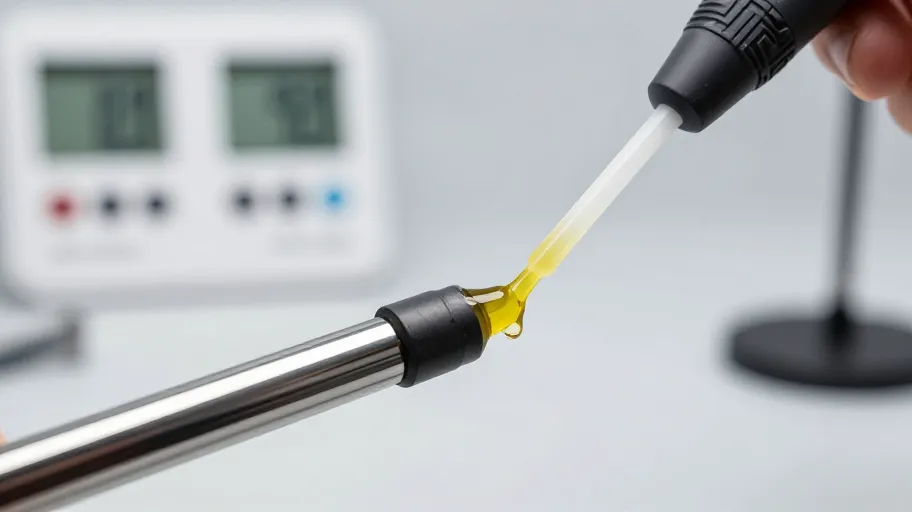
The strength of epoxy golf club assembly depends on complete molecular cross-linking at the exact ratio—usually 10:1 or 1:1. Deviate by 5%, and unreacted chemicals weaken the matrix. Material science confirms: optimal cure isn’t fast, it’s complete. Fast-cure epoxies increase rework by up to 22% in custom builds because they don’t allow time for alignment (2024 composites reliability study).
Instead, slow-cure formulations with 30–45 minutes of work time let fitters adjust lie angle and face position before the gel sets. That delay isn’t downtime—it’s precision insurance. One boutique builder saw a 40% drop in post-bond corrections after switching to a high-flex-tolerance epoxy designed for dynamic loads.
Complete reaction means fewer returns, better resale value, and bonds that survive 1,000+ swings. It’s not just chemistry—it’s long-term reliability built into every joint.
How precise epoxy saves you money over time
A well-bonded club lasts three times longer, cutting rework costs by over 75%. For DIYers, this is where technical skill becomes financial sense. Professional re-shafting runs $25–$40 per club, and with average bond failures every 18 months, costs add up fast. In contrast, a precision epoxy job costs under $5 in materials and, done right, lasts five years or more.
Premium parts like titanium heads and graphite shafts lose up to 40% of their resale value in two years if rebuilt with inconsistent epoxy—buyers assume structural risk. Lifecycle costing shows that proper bonding isn’t a step—it’s an investment. One amateur cut annual repair costs from $320 to $60 by mastering mix ratios and cure conditions.
Consistency compounds: each accurate bond protects your gear and builds confidence. That’s ROI you feel in your wallet and your swing.
The technician’s checklist for perfect epoxy every time
Tournament-level reliability starts with the bond. After proving the ROI, the real difference is execution. DIY-Golf.com’s lab-tested method identifies four non-negotiables: exact ratio, full mixing, stable environment, and correct clamp time.
Use digital scales (0.1g accuracy) and composite sticks to hit the 10:1 ratio—eyeballing creates joints 23% weaker. Mix for at least 90 seconds, scraping cup walls to eliminate streaks. Then wait two minutes: microbubbles rise and pop, boosting bond density by up to 17%. Monitor humidity—above 60% RH during cure introduces voids that undermine shaft-to-head integrity.
Nail this process, and you’re not assembling clubs—you’re engineering performance. Every drive reflects a system perfected.
Master Your Swing, DIY Your Fit. DIY Golf is the premier destination for the technical golfer. We empower you with professional-grade components and the knowledge to build your perfect bag.