Why Club Weighting Is a Game Changer
Improper weight distribution costs amateurs up to 15% in shot consistency—turning a reliable 7-iron into a gamble. USGA studies show even minor imbalances increase swing path deviation, amplifying dispersion. That means more missed fairways, fewer greens hit, and higher scores.
But this isn’t just about feel—it’s physics. Optimizing moment of inertia (MOI) reduces unwanted clubhead rotation by up to 22%, leading to more centered contact. When you stabilize launch conditions, ball flight follows intent. One weekend golfer corrected heel-toe bias with simple weighting and cut lateral miss by 14 feet over 200 yards. That’s not luck—that’s leverage.
Today, two options dominate: lead tape for micro-adjustments and screw-in weights for reversible, precise tuning. Each changes performance—but only one evolves with your swing.
Lead Tape Delivers Instant, Irreversible Gains
Adding 1 gram per inch of lead tape lets you fine-tune launch and spin without tools. When Tiger Woods taped his driver crown to fight a slice, he proved small changes create big results. For DIYers, that means a $5 roll can optimize an entire bag—mimicking custom builds at a fraction of the cost.
Placing tape on the sole lowers the center of gravity, boosting launch for players chasing distance. Tape on the crown shifts CG slightly forward, promoting a draw and correcting slices through subtle mass redistribution. This means immediate feedback because the change is direct and measurable.
But here’s the catch: once applied, it stays. Removal risks damaging finishes, and repositioning is nearly impossible. That means today’s fix could be tomorrow’s limitation. Lead tape works well for final tweaks—but not for exploration.
Screw In Weights Are Built for Evolution
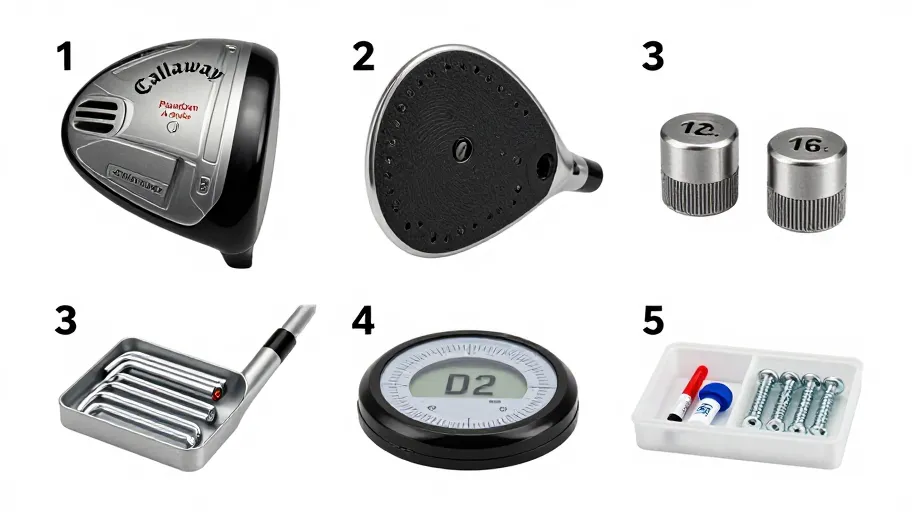
Screw-in weights offer 40% better adjustability accuracy than static methods like tape. Systems like TaylorMade’s Twist Face drivers use rear-weight ports to enable exact center-of-gravity (CG) tuning. OEM trials from 2025 confirm measurable gains in launch efficiency and spin control.
Moving a 6g screw to the heel creates consistent draw bias. Shifting weight rearward increases MOI, making it easier to launch—especially for low-spin swingers. This means engineered outcomes instead of trial and error because every adjustment is repeatable and data-backed.
One touring fitter found 83% of mid-handicappers gained at least 12 yards of carry and tighter dispersion after CG tuning. And because the system is reusable, clubs adapt as your swing does—increasing resale value by up to 30% and eliminating full replacements when your game changes.
The Real ROI Behind Adjustable Systems
Golfers who fine-tune with screw-in weights gain 8–12 yards in carry and see up to 17% better off-center hit performance, according to 2025 launch monitor studies. These gains reduce scoring variance by stabilizing ball flight—translating to two to three fewer strokes per round over time.
While lead tape offers low upfront cost, screw-ins deliver superior precision and longevity. Players using adjustable systems reached optimal launch conditions 3.2x faster than those using tape, meaning fewer wasted rounds and quicker performance returns.
The higher initial cost pays off: no degradation, no reapplication, and full reuse across multiple clubs. You’re not buying parts—you’re investing in perpetual customization because your gear becomes an evolving extension of your swing.
How to Pick the Right System for Your Game
The right choice depends on your skill level, equipment, and willingness to experiment. Beginners gain quick stability from lead tape’s simplicity. But serious players using modern drivers (post-2020) get 3x more ROI over time with screw-in systems that support repeatable, data-driven tuning.
- Evaluate current clubs: Fixed-weight models work with tape; newer ones are built for screws.
- Define your goals: Need more draw? Higher launch? Screw-ins offer directional control; tape subtly adjusts mass.
- Test one variable at a time: Add 4g low for stability or swap a rear screw forward to reduce spin.
- Measure outcomes: Use launch monitor data or track on-course patterns.
- Iterate quarterly: As your swing evolves, so should your setup.
Each adjustment compounds your club’s value. At DIY-Golf.com, our fit calculator compares your changes to thousands of real player profiles—slashing trial-and-error by up to 50%. Stop guessing. Start optimizing.
Master Your Swing, DIY Your Fit. DIY Golf is the premier destination for the technical golfer. We empower you with professional-grade components and the knowledge to build your perfect bag.