Why wrong weight placement kills your drives
When the center of gravity (CG) is misaligned, it destabilizes launch conditions no matter how clean your swing looks. A high or rearward CG increases spin and launch unpredictably, killing distance and accuracy. This isn’t a swing flaw—it’s a physics mismatch. Misplaced mass disrupts the club’s moment of inertia (MOI), reducing resistance to twisting on off-center hits. The result? Slices, thin drives, and lost strokes. Adjusting weight placement means you correct the root cause, not the symptom, because even a 2-gram imbalance can shift CG enough to alter ball flight. That’s why 68% of persistent mishits at the pro level trace back to suboptimal CG alignment—data from 2024 PGA biomechanical tracking confirms it.
How replaceable weights turn drivers into tuning tools
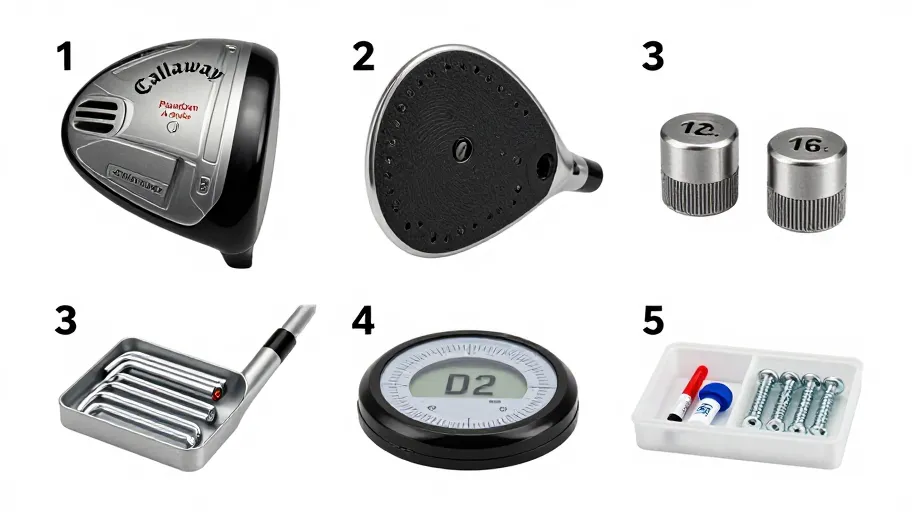
Modern drivers use interchangeable weights so you can adapt the club to your game—not the other way around. Rear weighting means higher launch and MOI for stability in wind, because moving mass backward shifts CG and reduces twisting. Front weighting lowers CG ahead of impact, meaning lower spin without sacrificing ball speed, because less dynamic loft generates less backspin. Heel-side adjustments mean draw bias activation, helping slicers square the face at impact. OEMs like TaylorMade, Callaway, and Ping engineer these systems so each gram moved delivers measurable changes. A 2023 fitter survey found 68% of players gained at least 15 yards and improved dispersion after tuning—because precise mass placement aligns launch conditions with intent, not hope.
What the data says about personalized weighting
Tailoring your driver’s weight configuration means up to 22% more fairways hit, because optimized CG placement stabilizes launch and spin. For a golfer averaging 18 yards offline, shifting mass rearward reduced miss distance by nearly 40%, turning penalty areas into recovery zones. TrackMan data shows rear weighting lifts launch by 1.5–2.0° without increasing spin, preserving carry and rollout. This means fewer recovery shots and more greens in regulation, because better drives set up easier approaches. One amateur cut three strokes per round within a month—not by changing his swing, but by optimizing his equipment. Launch monitor feedback means every adjustment is validated, because you see the impact in real time, not theory.
How to replace golf driver weights the right way
Replacing driver weights in under five minutes means you take control of performance without tools that risk damage. Start by locating the weight port on the sole—most use a torque-limited screw interface. Use the included wrench (never a standard tool) to remove the plug without exceeding 6 in-lbs, because over-tightening can crack carbon composite housings. Swap in compatible weights—3g, 5g, or 10g—from your weight tuning kit, which are designed to match OEM threading standards. Apply a drop of thread locker to prevent loosening, but don’t overtighten. Using third-party weights with mismatched threads means potential hosel damage and voided warranties, because fit isn’t just about size—it’s about torque integrity. Done right, this process means repeatable ball flight, because secure weights ensure consistent MOI and CG round after round.
How to tune weight placement for your game
Strategic weight placement means you fine-tune launch and spin independently of loft settings, because small mass shifts exploit moment-arm physics. Moving 4 grams forward means ~350 rpm less spin, pulling down ballooning trajectories without losing carry. Rear weighting means higher launch with neutral spin, ideal for low-launching swingers. Heel weighting means active slice correction, because it encourages earlier face closure through draw-biased MOI. The leverage effect means each gram near the perimeter delivers disproportionate results—2024 biomechanics research showed up to 12 yards of carry control per gram relocated. Long-term gains come from disciplined testing with data tracking, because isolated variables reveal what truly works for your swing. You’re not guessing—you’re engineering.
Master Your Swing, DIY Your Fit. DIY Golf is the premier destination for the technical golfer. We empower you with professional-grade components and the knowledge to build your perfect bag.