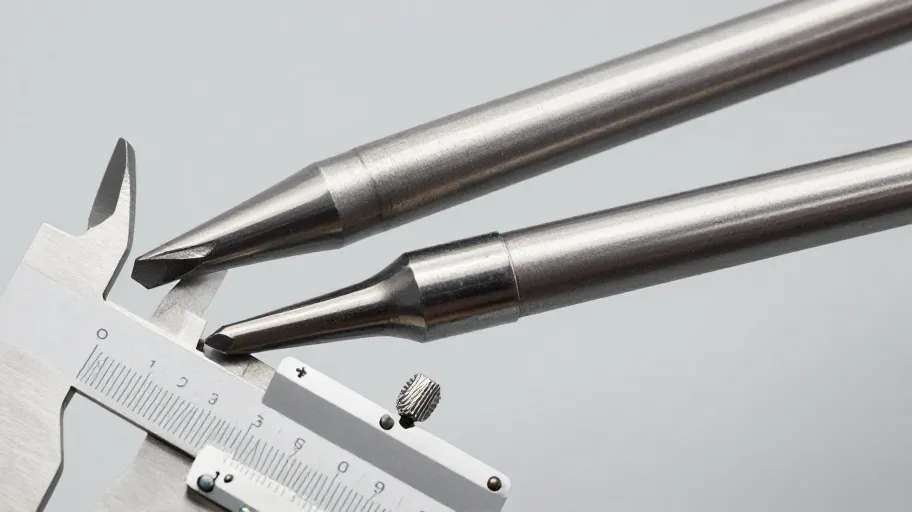
Choosing between a parallel vs taper tip shaft comes down to one question: does the lower section of the shaft match the inside geometry of your club's hosel? Parallel-tip shafts have a constant-diameter tip section over the portion that enters the hosel, while taper-tip shafts reduce in diameter toward the very end. Because manufacturers handle this differently across brands, families and even individual models, the reliable path is the Tip-Verification Loop: Identify the hosel, Measure and document, Match to the component record, and Confirm before ordering.
Why tip configuration matters for your exact club model
A shaft that is otherwise identical in flex, weight and material can still be the wrong part if the tip geometry does not match the hosel it must seat in. This is where many replacement projects stall: the golfer knows the brand, has a model name on the club, and assumes any shaft described for that brand will work. That assumption is exactly what a careful club builder avoids.
Tip configuration is determined by the hosel bore of the specific club head — not by the shaft brand, not by the club category, and not by what worked on a different club in the same bag. Two drivers from the same family released in different generations can differ. An iron and a hybrid from the same line can differ. The only evidence that settles the question is the specification for the exact club brand, family and model you are working on.
That is also why this article avoids telling you which configuration "your" club uses. Without the exact model in front of us, any such claim would be a guess — and a guess at the wrong dimension is the most expensive kind of mistake in component replacement.
The Tip-Verification Loop
Use these four steps for every component decision, not just the first one.
Step 1 — Identify the hosel. Establish the club brand, the family (the product line name) and the specific model, including any generation or version marking. This information is printed or engraved on most club heads; where it is worn or ambiguous, photograph it and record exactly what you can read. If the club has been reshafted or modified before, note that too, because the current hosel may not match the original factory specification.
Step 2 — Measure and document. With the shaft removed (or before removing it), document everything relevant to the tip: the visible tip section, any markings printed on the shaft, and where the shaft meets the hosel. If the shaft is already out, measure the tip section and record the numbers in writing rather than trusting memory. Photographs plus written notes give you something to compare against a component record later.
Step 3 — Match to the component record. Take your documented model and measurements to the component listing. Read the manufacturer's stated tip specification for the component, and read the stated hosel requirement for your club head. These two records must agree. Do not rely on a product photo, a forum description or a remembered specification — rely on the written record for the specific part and the specific club.
Step 4 — Confirm before ordering. Use the fitment selector to cross-check the club brand, family and model against the component you have shortlisted. If the selector cannot confirm the pairing, treat that as an open question, not a reason to proceed anyway.
Decision table: what to check before choosing a replacement shaft
| Check | What to look for | Red flag | Action |
|---|---|---|---|
| Club identity | Brand, family and model recorded in writing, including generation | Model name recalled from memory with no photo or marking | Photograph the head markings before ordering |
| Hosel requirement for that model | Written specification stating the tip configuration the head accepts | Only verbal or forum-level advice available | Stop and verify through the fitment selector or the manufacturer |
| Component tip specification | The shaft listing states its tip configuration in writing | Listing shows only a photo or a generic description | Request written specification before purchase |
| Prior modifications | Record of any previous reshaft or hosel work | Unknown service history on a second-hand head | Document what you find and confirm the current state, not the factory state |
| Adhesive/bore preparation plan | You know how the new shaft will be secured per the manufacturer's instructions | No documented installation method | Confirm installation requirements before buying |
Approval questions to resolve before you order
Work through these as yes/no questions. Any "no" is a sign the decision is not ready.
- Can I state the exact club brand, family and model — in writing — for the head this shaft will go into?
- Does the manufacturer's record for that model state which tip configuration the hosel accepts?
- Does the component listing state its tip configuration in writing, in terms that match the hosel record?
- If the club has been reshafted before, have I verified the current hosel rather than the original factory spec?
- Have I confirmed current availability, pricing and any returns policy directly with the seller rather than assuming them?
Primary CTA
Use the on-site fitment selector now, and verify the club brand, family and model before choosing a component. Take your documented model and tip measurements with you. If the selector confirms the pairing, you have a documented match; if it does not, you have saved yourself from an unsupported purchase. Either way, record what the selector tells you and keep it with your project notes.
FAQ
How do I tell whether my current shaft is parallel tip or taper tip? Inspect and measure the tip section rather than inferring from the shaft model name. A parallel tip maintains a constant diameter through the section that inserts into the hosel; a taper reduces toward the end. Document your measurement and compare it against the written specification for the club model. If the shaft is still installed and you cannot measure the buried portion, note any printed shaft markings and verify through the fitment selector.
Can I convert one tip type to the other? Do not assume so. Any tip conversion involves modifying either the shaft or the hosel, and whether that is appropriate depends entirely on the specific components involved. This article cannot state that a conversion is possible or advisable for your club. Confirm with the manufacturer's documentation for both the shaft and the club head, and consult a qualified club builder before attempting any modification.
Does the tip configuration change how the club plays? Any claim about how a component affects on-course performance would need current first-party evidence for the exact product and model, and no such evidence is supplied here. What this article can say is this: a shaft whose tip does not match the hosel cannot be properly installed at all. Verify the mechanical match first; evaluate performance characteristics separately, using manufacturer documentation.
Why does the same brand use different tip configurations across its range? That is a question about manufacturer design choices, and the answer varies by brand, family and model. The practical takeaway is not to generalize from one club to another. Verify each model individually through the fitment selector and the written component records.
What if I buy the wrong tip? Returns and exchange terms differ by seller and product, and no policy details were supplied for this article. Read the current policy on the product page before ordering, and if anything is unclear, confirm directly with the seller before purchase. This is one more reason the pre-order checklist below matters.
Low-friction checklist CTA
Before checkout, run the five-point pre-purchase checklist:
- Club brand, family and model recorded in writing
- Hosel requirement for that model verified from a written source
- Component tip specification stated in writing on the listing
- Prior reshaft or modification history noted
- Current price, availability and returns policy confirmed on the product page
Print it, screenshot it, or copy it into your build notes. Five minutes of verification is the cheapest part of any component project.
The single most useful habit in component replacement is verification before purchase. Use the fitment selector, verify the club brand, family and model, and order only what the written record supports.
Master Your Swing, DIY Your Fit. DIY Golf is the premier destination for the technical golfer. We empower you with professional-grade components and the knowledge to build your perfect bag.


