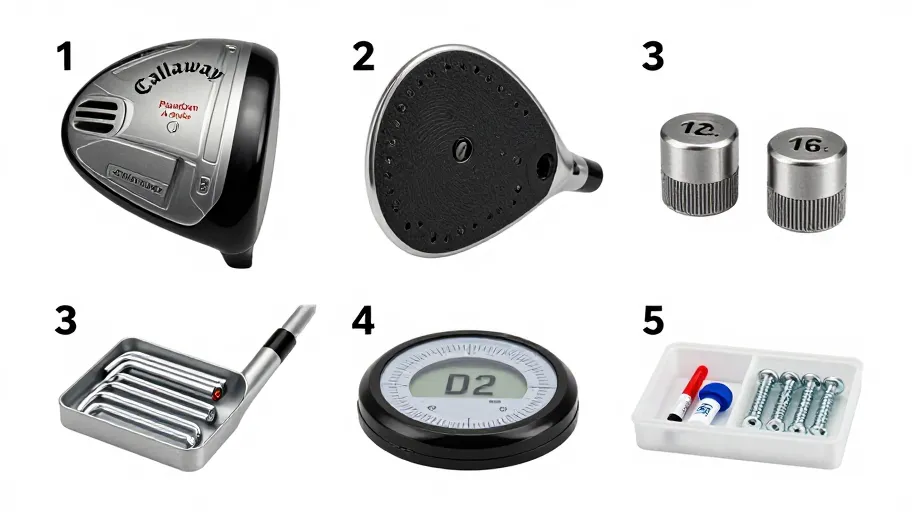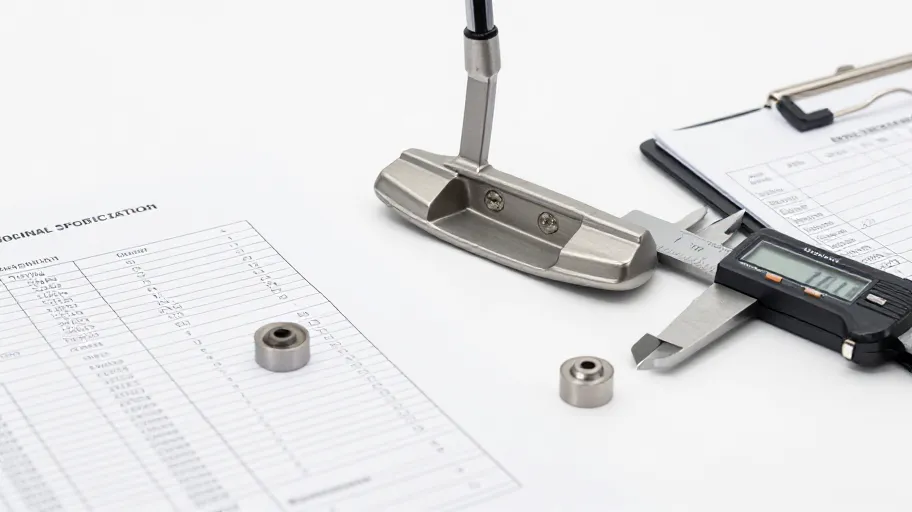
When a revised putter-weight sample arrives, you do not need to restart your comparison from zero — and you should not. A proper review is a structured diff: you freeze the original specification, compare the revised sample against it change by change, verify that each requested fix landed without shifting anything else, and approve or reject against criteria you wrote down before the sample shipped. Restarting discards the learning embedded in the first iteration; diffing converts it into documentation.
The FDVA framework for revised samples
Freeze. Before the revised sample exists in your hands, capture the baseline: the specification you sent, the deviations you reported on the first sample, and the changes the supplier confirmed. If this record lives only in an email thread, condense it into a single dated sheet. A frozen baseline is what turns the next review from an argument into a measurement.
Diff. On receipt, compare the revised sample against the frozen sheet, not against your memory and not against a different product. List every observable difference: mass as weighed on your own scale, finish, thread engagement, marking, packaging, and anything else relevant to your build. Note differences you requested, differences you did not request, and requested changes that did not appear.
Verify. For each diff line, verify with your own measurement where possible and with supplier documentation where it is not. Questions about dimensional tolerances, material certification or test results must go to the supplier as explicit questions — this article does not assert any tolerance, material claim or certification for any product, and you should not accept unstated ones.
Approve. Approval is a written decision against your pre-set criteria. "Looks better" is not approval. Record the decision, the date, and any conditions.
Decision table: classify every deviation on the revised sample
| Deviation observed | Classify as | Action | Restart the sourcing cycle? |
|---|---|---|---|
| Requested change landed exactly; no new deviations found | Approve | Document sign-off, record the approved spec as the new frozen baseline | No |
| Requested change landed; minor unrequested cosmetic difference you can accept | Conditional approve | Note the accepted deviation in writing so it is not disputed later | No |
| Requested change landed; second-order shift in another attribute (see below) | Rework — targeted | Request revision of only the affected attribute against the same baseline | No |
| Requested change partially landed; measurable gap remains | Rework — targeted | Quantify the gap, resend with reference to the frozen sheet | No |
| Requested change did not land; no explanation of why | Clarify first | Ask what constrained the change before requesting another round | Only if the answer reveals a capability mismatch |
| Change landed but the sample no longer suits the putter model you are building for | Re-specify | Revisit your own specification before blaming execution — your requirement may have moved | Possibly, and that is a spec problem, not a sample problem |
| Supplier cannot or will not document what changed between samples | Reject process, not product | A second sample without documentation is unverifiable | Yes, or change supplier |
The core principle: a revised sample fails only when the diff shows the supplier cannot execute or document your specification. A partially corrected sample with a clear paper trail is progress, and rejecting it forces you to repay the learning cost you have already spent.
Second-order checks: what a revision can silently shift
A revision to putter weights is a small part with coupled attributes. Changing one can move another:
- Total mass and distribution. A machining or material change intended to fix fitment can alter mass, which shifts swing weight and feel. Weigh it yourself; do not rely on a marked value.
- Thread engagement. A fix to outer geometry can alter thread depth or fit. Test engagement on the actual port of your putter model — fitment must be verified on the exact club, not inferred from a part number.
- Finish and marking. Re-machined surfaces can carry different finish or re-marked values. Confirm markings match your own measurement, not just each other.
- Set consistency. If you are evaluating multiple weights for one putter, diff each unit in the set, not one exemplar. Variation within the set matters as much as the average.
- Interface cleanliness. Confirm the seating surface, thread and any tool interface came back in the condition you specified.
For any of these you cannot measure yourself — material composition, internal tolerances, plating spec — ask the supplier to confirm in writing. Do not assume a previous answer still applies after a revision; a revision is, by definition, a change to something.
Concrete approval questions to send with the revision request
Copy these into your next sample round and record the answers:
- Which specific attributes were changed between sample one and sample two, stated against our frozen specification sheet?
- What is the current dimensional tolerance for the attributes we flagged, and can it be supplied in writing for this revised part?
- Does the revision affect total mass, and what is the measured mass of this exact sample as shipped?
- Are the revised weights confirmed to fit the [brand, family, model] port we specified, and what evidence supports that fitment for this exact revision?
- What is your current policy on further sample rounds — cost, who covers shipping, and any fee treatment — for this project? (Confirm current terms directly; no policy is assumed here.)
- If we approve this sample, what guarantees that production parts will match the approved sample, and how will that be documented?
Revised-sample review checklist
Before you approve any revised putter-weight sample, complete every line:
- Frozen specification sheet exists and is dated
- Deviations from sample one were listed in writing before the revision was requested
- Revised sample weighed on your own scale; value recorded
- Fitment tested on the actual putter model, not inferred
- Every observable difference classified in the decision table above
- Unrequested differences flagged to the supplier in writing
- Approval decision recorded with date and conditions, or targeted rework requested against the same baseline
- Policy questions (cost, shipping, further rounds) confirmed directly with the supplier — not assumed from this or any article
FAQ
Q: When does a revised sample mean I should restart with a different supplier? When the diff shows an execution or documentation failure you cannot work around: the change never lands, explanations contradict the physical part, or the supplier cannot state what changed between samples. A sample that improves against a documented baseline is not a failure, even if it needs one more round.
Q: Should I re-test fitment on every revision, even a cosmetic one? Verify fitment on the exact putter model after any revision, because coupled attributes can shift when a single one is changed. Fitment claims must be confirmed against the physical part and club, not inherited from the previous sample.
Q: How many revision rounds are reasonable? No number can be stated here. Set your own limit in advance based on your project timeline and tolerance for iteration, state it to the supplier, and treat exceeding it as a decision point rather than a surprise. Sample-round terms, including any fees and shipping responsibility, must be confirmed directly with the supplier.
Q: How do I keep two samples from being confused later? Label and retain both physical samples, and keep one dated sheet per sample. The paper trail is what lets you diff a third sample, audit a production batch, or hand the project to another builder without re-explaining everything.
Q: Does a heavier or lighter revised weight change what else I need to check? A mass change shifts swing weight, which changes feel and your evaluation of the whole build. That is why the final approval step for putter weights belongs inside a swing-weight framework rather than a standalone part check.
Next step
Approval of a putter-weight sample is only meaningful inside a build you can measure. Review the swing-weight guide to connect your approved weight to the feel and balance outcome you are actually tuning for.
Low-friction option: if you are not ready for another supplier round, just run the checklist above against the sample you already have. Even one documented diff line puts you ahead of a restart.
Master Your Swing, DIY Your Fit. DIY Golf is the premier destination for the technical golfer. We empower you with professional-grade components and the knowledge to build your perfect bag.