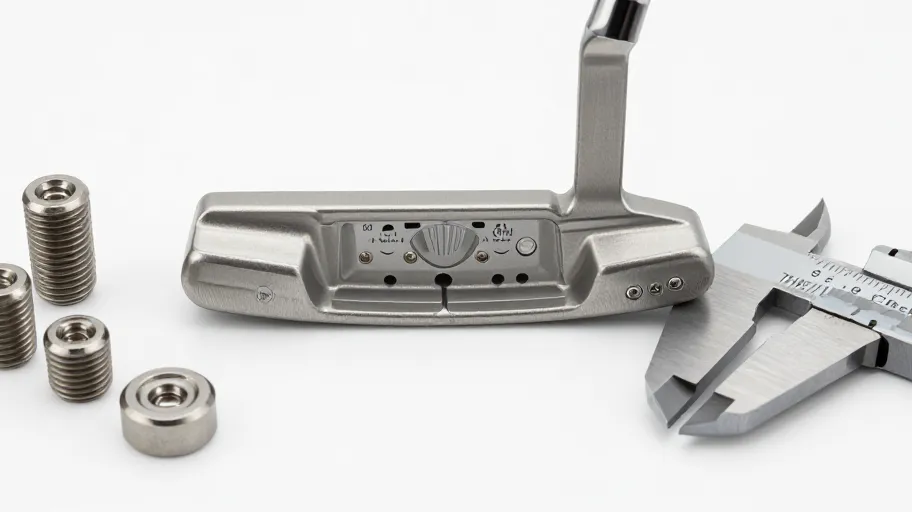
When buyers source replacement putter weights, the first brief tends to include a gram value and a thread pitch — and very little else. The measurements that decide whether a weight seats flush, aligns correctly and produces the intended swing-weight change are the ones left out: recess depth, port diameter, wrench interface, port orientation and multi-port layout. Use the THREAD Check below, document every figure against your exact putter model, and confirm fitment in writing before approving the order.
Why the gram value is not a specification
A weight labelled "20 g" tells you mass and nothing about fitment. Two weights of identical mass can differ in thread diameter, thread pitch, body length, head diameter, recess shape and drive type. Any one of those mismatches means the weight will not seat, will protrude proud of the sole, or will damage the port.
For club builders and putter owners sourcing tuning components, the productive habit is to treat each putter model as a unique fitment case. Build a short spec record for the head in front of you, and send that record with every enquiry.
The THREAD Check: five measurements to capture before you order
T — Threads. Record the thread diameter and pitch of the port, not just a nominal label such as "M5". If the manufacturer publishes a service drawing for your putter family, verify your measured figures against it. Ask the seller to confirm the thread specification of the weight in writing, including whether the thread is a proprietary pattern.
H — Head style of the weight. Weights differ in head shape, flange diameter and whether they sit flush, recessed or proud. A head that is too large for the recess will not seat; one too small will rotate loosely or leave a visible gap. Measure the existing weight's head and the port's counterbore separately.
R — Reach and depth. Capture the full engaged length of the thread and the total recess depth. A weight with a longer body than the recess depth will stand proud; a shorter one may not clamp. Record both figures in your brief, since neither can be inferred from the gram value.
E — Engagement interface (wrench type). The drive — Torx, hex, slot or a proprietary tool — must match the tool you hold. Ask the seller which wrench size the weight requires and whether a tool is supplied. Do not assume the tool from your previous set transfers across models or brands.
A — Arrangement of ports. If the head uses two or more sole ports, record each port's size and position. On some models the front and rear ports take different weights. Confirm whether the replacement weights you are comparing are sold individually or as a set, and which positions they suit.
D — Documented spec. Write everything into a one-page record per putter model: thread, head, reach, wrench, port layout, current weights, measured total head mass, and the swing-weight reading before any change. This record becomes the brief you send to any supplier.
Decision table: matching replacement weights to your documented spec
| Your documented finding | Weight option A | Weight option B | Action before ordering |
|---|---|---|---|
| Thread measured and matching option A's published spec | Proceed to check recess depth | Park | Request written confirmation of recess fit from seller |
| Thread nominal matches, pitch unverified | Do not order yet | Do not order yet | Ask seller to state diameter and pitch explicitly |
| Recess depth differs from weight body length | Reject for this model | Compare alternative | Ask which body length suits your measured depth |
| Wrench drive not stated in listing | Hold | Hold | Ask seller to confirm drive type and tool availability |
| Two-port head, positions differ in size | Single-weight order insufficient | Matched set required | Confirm which weight suits front and rear ports |
| Swing-weight target undefined | Any mass change is uncontrolled | Same | Set target and calculate mass delta before selecting grams |
| Seller cannot confirm model compatibility in writing | Do not approve | Do not approve | Seek verification for your exact head model |
Approval questions to send before ordering
- Can you confirm in writing that this weight fits the [brand, family, model, year] head, based on the port spec I have documented?
- What are the thread diameter, pitch, body length, head diameter and drive type of this weight?
- Which wrench does it require, and is the tool supplied with the order?
- Are the weights sold individually or as a set, and which sole positions do they suit on my model?
- What is your current policy on samples, returns and exchanges for this component? (Confirm directly — no policy details were supplied for this article.)
- What is the current price, availability and delivery arrangement for the quantity I need?
None of these can be answered generically; each is project-specific and must be answered for your exact putter model and the exact listing.
Connect weight choice to a swing-weight plan
Mass changes at the sole move swing weight in a way that depends on head design, shaft length and grip mass. Before choosing grams, take a baseline reading or measurement, define the target feel, and work out the mass delta the sole ports must deliver. That calculation is what turns a weight purchase into a tuning decision rather than a guess.
Sourcing checklist: before you approve any putter-weight order
- Thread diameter and pitch measured and matched to listing
- Recess depth and weight body length compared
- Head/flange diameter checked against counterbore
- Wrench drive confirmed and tool sourced
- Port arrangement (single, twin, differing sizes) documented
- Model name, family and year recorded in the brief
- Swing-weight baseline and target written down
- Written fitment confirmation from seller received
- Price, availability, sample and returns policy confirmed directly with the seller
- All figures saved into a per-model spec record
Frequently asked questions
Are putter weight threads interchangeable across brands? Not safely assumed. Threads vary in diameter, pitch and pattern, including proprietary designs, even where gram values match. Measure your port and confirm the seller's stated thread specification in writing before ordering.
How do I know which gram value will hit my target swing weight? Start from a baseline measurement, define the target, and calculate the required mass change at the port position. Then verify the calculation empirically after installation and record the result in your spec sheet.
Can I mix weights of different masses in a twin-port head? On many models the ports are designed to accept matched or deliberately split masses, but the correct arrangement depends on the exact head design. Confirm with the seller which positions the listed weights suit.
Do I need the manufacturer's wrench? You need the wrench that matches the weight's drive type, whatever its source. Ask the seller to confirm the drive and whether a tool is included, since drives differ across models and brands.
Where do I record all this? One page per putter model: threads, head, reach, wrench, arrangement, baseline readings and seller confirmations. That document is your brief for every future weight or component enquiry.
Next step: Review the swing-weight guide and set your target before selecting a gram value. Then run the sourcing checklist above and send your documented brief to the seller for written fitment confirmation.
Master Your Swing, DIY Your Fit. DIY Golf is the premier destination for the technical golfer. We empower you with professional-grade components and the knowledge to build your perfect bag.


