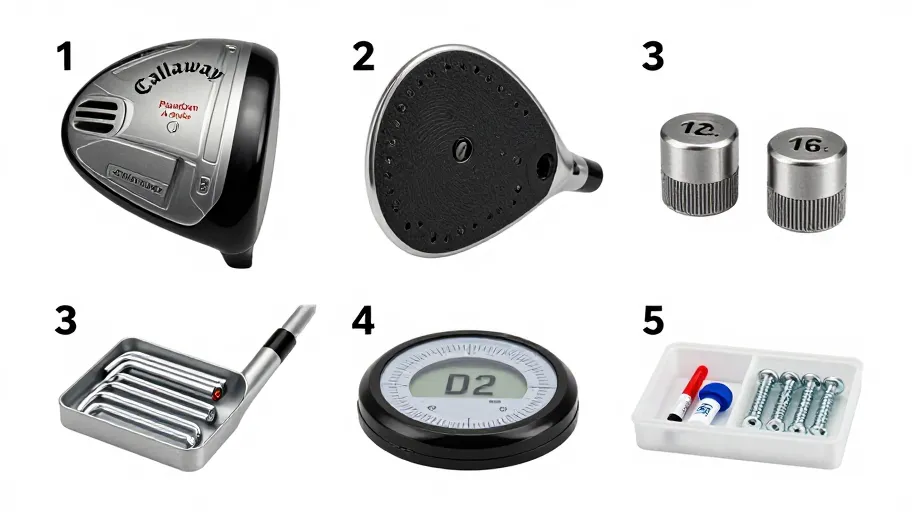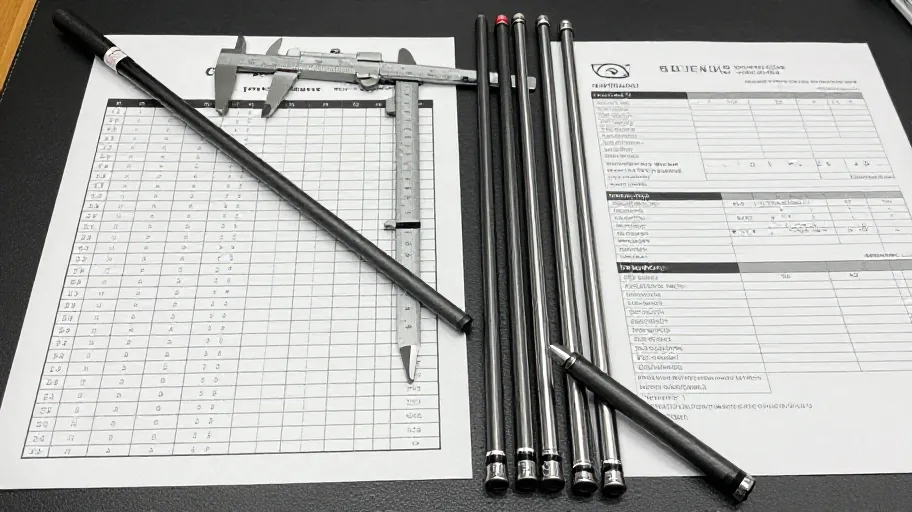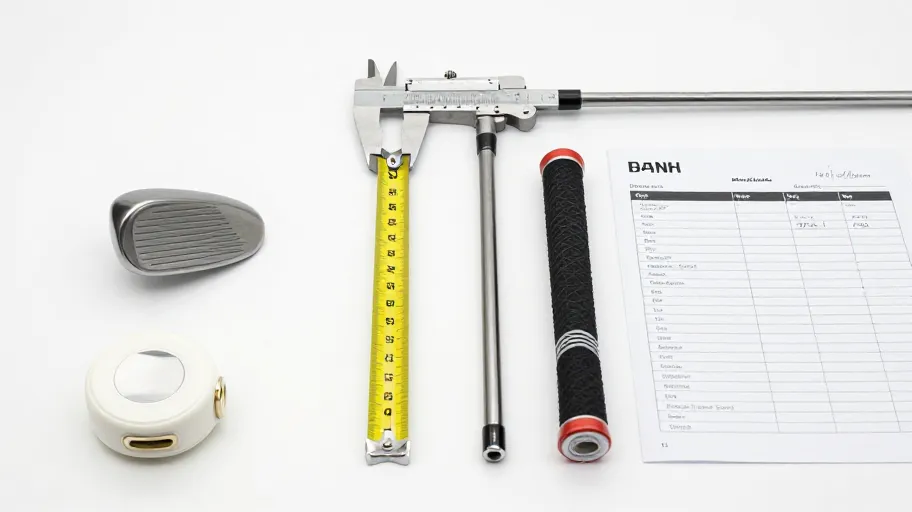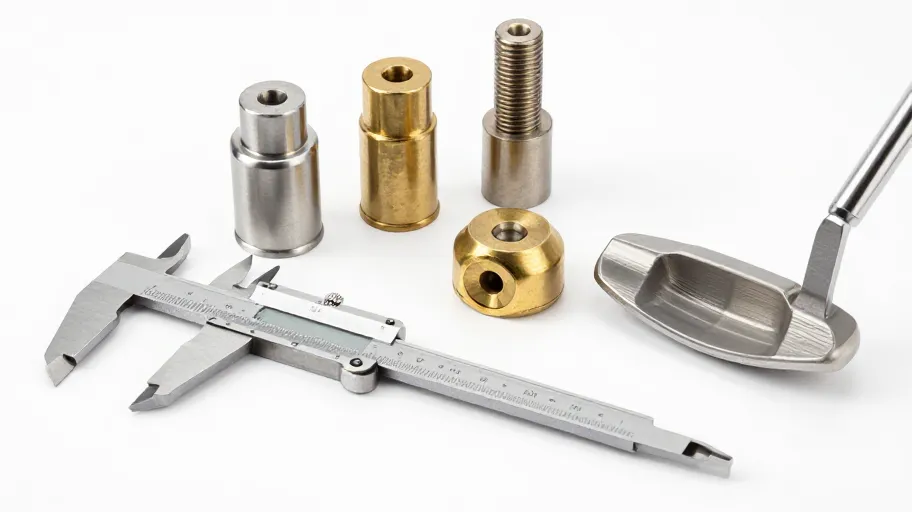
When a supplier proposes replacing your putter's original weight material, ask one question first: can they document, for your exact model, that the substitute preserves head weight, thread fitment and finish behaviour? Approve nothing until measured weights, fitment confirmation and current sample and pricing policy are verified in writing.
Why material swaps come up in putter-weight sourcing
Replacement putter weights are machined from a small set of candidate materials — stainless steels, tungsten alloys, brass and aluminium among them. Each material packs a different density into the same physical volume. That single fact is why a material change is never cosmetic: two weights with identical dimensions can differ in mass enough to shift swing weight, alter feel at impact, and change how the head sits at address.
A supplier may propose a substitute for reasons that are legitimate and project-specific — availability of stock, machining constraints, finish requirements, or a running change in their own supply. The problem is not the proposal. The problem is approving it on assertion alone. This guide gives you a framework and a question set so the decision rests on documentation, not on a description that reads like a listing.
The MATCH-5 framework for approving a material change
Use MATCH-5 as a gate. A proposed substitute should not pass until each of the five elements is answered in writing for your exact putter brand, family and model.
M — Material properties. Request the material specification and, where relevant, the density figure for both the original weight and the proposed substitute. Ask the supplier to state the expected finished mass of the replacement weight in the same housing. Without a stated mass, "same material class" tells you nothing usable.
A — Assembly fitment. Ask for written confirmation that the replacement weight fits your specific model's weight ports, including thread specification, seating depth, torque requirement and tool interface. Ask the supplier what fastening method they recommend and whether it differs from the original.
T — Tolerance to deviation. Ask what dimensional and mass variation the supplier will accept on the finished part, and how they verify it. Do not assume a stated tolerance — require it on the quotation or order confirmation. Also ask what happens if a delivered weight falls outside it; the reader must confirm the current remedy and return policy directly.
C — Confirmation of evidence. Separate claims from evidence. "Fits most models in this family" is a claim. A written fitment confirmation naming your model, plus a photo or drawing of the part, is evidence. Ask whether any measured mass or fitment data exists for your model, and request it.
H — History of the model. Putter families change weight configurations between generations. Two putters with similar names can use different thread patterns, weight counts or port geometry. Confirm with the supplier which exact generation their weight matches, and verify against your own club before ordering.
Decision table: screening a proposed substitute
| Approval question | Original-spec weight | Proposed substitute — ask for this before approving | Do not proceed if |
|---|---|---|---|
| Documented mass of finished weight | Supplier states measured mass | Stated measured mass for the substitute, same housing | Mass is "estimated" or unstated |
| Model-specific fitment confirmation | Written confirmation naming your model | Written confirmation for the substitute naming your model | Fitment is described as universal or assumed |
| Thread and tool interface | Specified thread and torque | Same specification stated for the substitute | Any change to thread or tool is unmentioned |
| Finish and corrosion behaviour | Finish type stated | Finish type and care guidance for the substitute | No finish information offered |
| Tolerance and verification method | Stated on quotation | Same statement extended to the substitute | No tolerance or verification method exists |
| Sample, price, shipping and return terms | Confirmed directly with supplier | Confirmed directly for the substitute before ordering | Terms are described as fixed, guaranteed or assumed |
Copy-ready supplier approval questions
Send these before approving any material change:
- What material do you propose, and what is the stated density compared with the original weight's material?
- What will the finished weight measure, in mass, for my exact model — and how do you verify that figure?
- Will the thread specification, seating depth and torque requirement match my putter's weight ports? Please confirm in writing, naming the model and generation.
- What dimensional and mass tolerance will you state on the order confirmation, and what remedy applies if a part falls outside it? Please confirm your current return and exchange policy directly.
- What is the current sample policy, price and shipping arrangement for this item? I understand these are confirmed per order.
- What finish does the substitute carry, and what care does it need compared with the original?
- Do you have fitment or mass data, photos or drawings specific to my model that you can share before I order?
Document the answers. An email trail naming your model, the proposed material, the stated mass and the tolerance turns a verbal assurance into an approvable specification.
Red flags worth pausing on
- Fitment described in family-wide language when you asked about one model.
- A proposed material with no stated finished mass.
- Tolerances that appear nowhere on the quotation.
- Any suggestion that a substitute is interchangeable without written confirmation for your exact club.
- Reluctance to put sample, price, shipping or return terms in writing — confirm all of these directly each time.
None of these observations implies anything about any specific supplier. They are screening criteria: each converts an unknown into a documented answer.
Frequently asked questions
Does a heavier material automatically improve my putter? No material change should be treated as an upgrade by default. What matters is the resulting head weight and swing weight for your build. Model the change yourself before approving it — see the swing-weight guide linked below.
How much mass difference does it take to change swing weight? Small mass changes at the head can move swing weight perceptibly, which is why a stated, verified finished mass for the replacement weight matters more than the material name. Ask the supplier for the measured figure and calculate the effect for your club.
Can I verify fitment myself before installing? Yes, and you should. Compare thread, seating depth and port geometry against your putter's existing weights, and confirm the generation of your model with the supplier before ordering. Do not rely on visual similarity alone.
What if the supplier cannot supply measured mass data? Treat that as an open question, not a dealbreaker. Ask them to confirm the finished mass on the order confirmation, and plan to weigh the part on receipt before installing it.
Should I ask for a sample before committing to a full set? Sample policy, price, shipping and any fees are confirmed directly with the supplier per order — this guide does not state them. Asking the question above, in writing, is the correct step.
Before you approve anything
Review the swing-weight guide to model how a proposed weight change affects your build before you commit — it turns the supplier's mass figures into a decision you can verify yourself.
Or start lighter: copy the seven approval questions above into your next supplier email, and work through the checklist as the answers arrive. Confirm, compare, document — then approve.
Master Your Swing, DIY Your Fit. DIY Golf is the premier destination for the technical golfer. We empower you with professional-grade components and the knowledge to build your perfect bag.