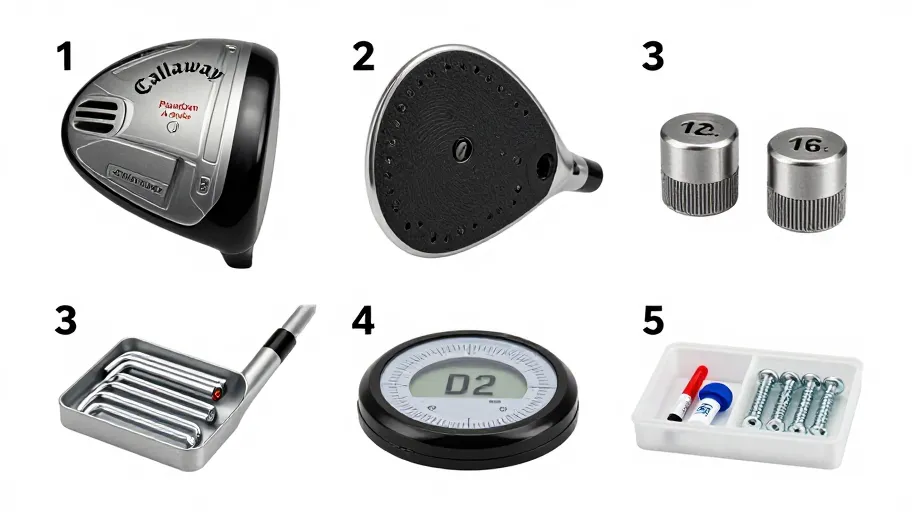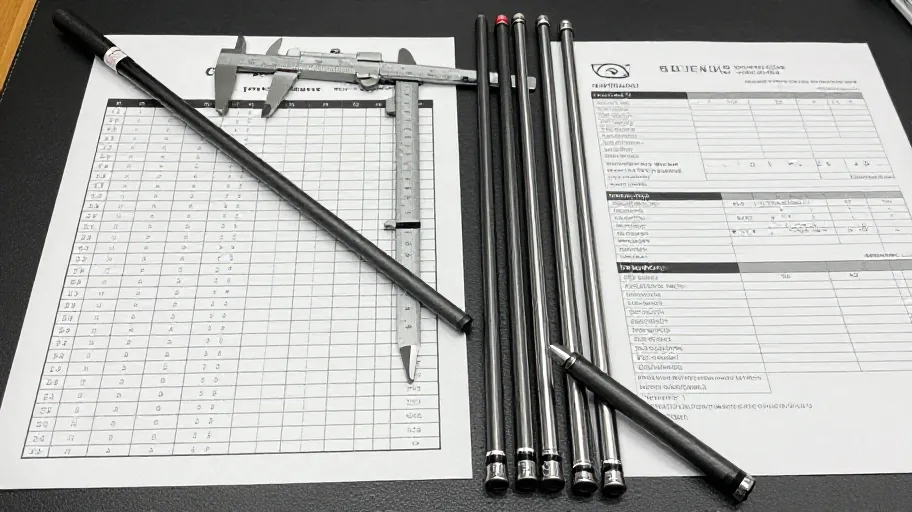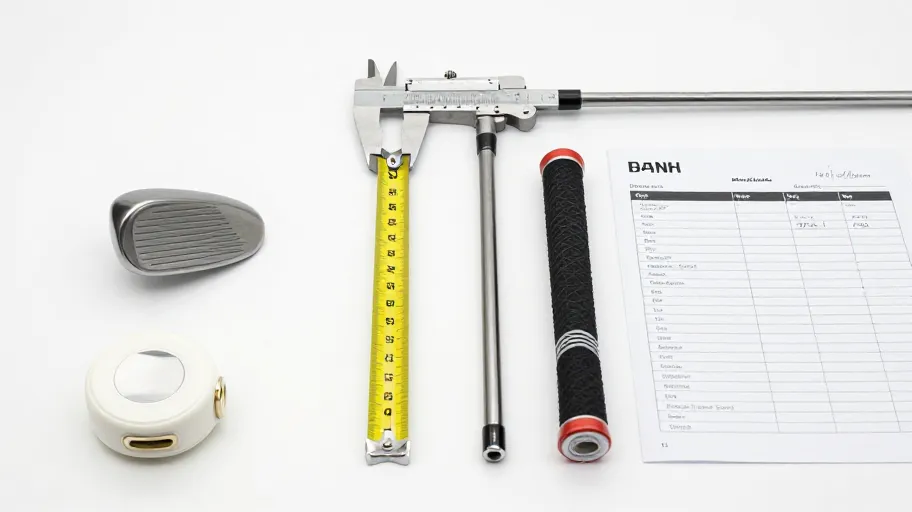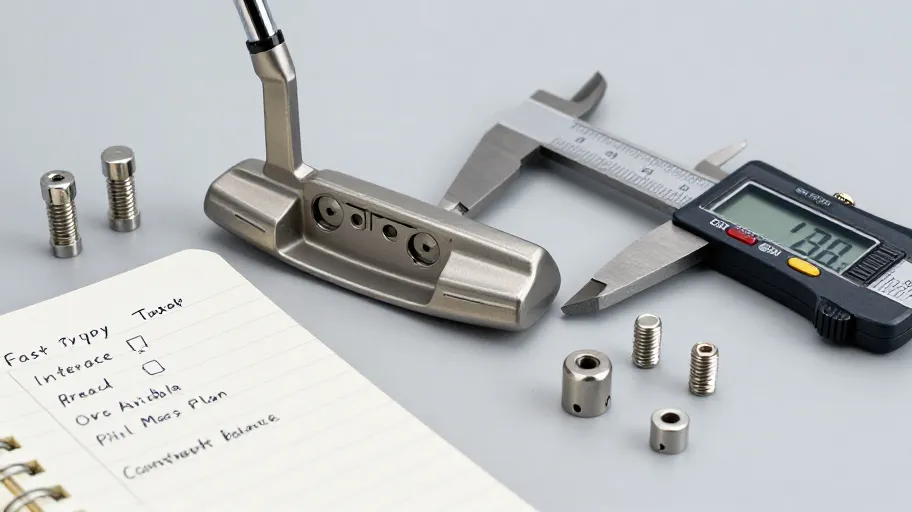
When you source replacement putter weights, the single most valuable thing you can produce is a written compatibility record before you order. That record should cover six items — fastener type, interface shape, thread dimensions, depth available, overall mass plan, and counterweight balance — captured against your exact putter brand, family, model and version. Because port geometry and threading differ between models, no listing alone can confirm fit; you verify by measuring, documenting and approving against the supplier's stated spec for that exact product.
The FIT-DOC framework
Use FIT-DOC as your recording structure during every fit and compatibility check:
- F — Fastener: the drive type of the installed weight or port (torque pattern, hex, slot or other). Record it, plus the tool the port actually accepts.
- I — Interface: the shape of the weight-to-sole interface — flush plug, flanged collar, keyed orientation. Note any locating features that prevent rotation.
- T — Thread: the thread form of the existing weight or port. Measure major diameter and pitch with a thread gauge where possible, and record whether the thread is on the weight or in the port.
- D — Depth: how much thread engagement and seated depth the port offers. Insufficient engagement is a fit failure even when the thread appears to match.
- O — Overall mass: your current head weight, the mass of the installed weights, and the target swing weight you are moving toward.
- C — Counterweight balance: any counterbalance or grip-end mass in the build, since changing sole weights shifts the balance point of the whole club.
The framework's purpose is not to tell you which weight to buy. It is to make your requirement explicit so you can compare it against what a supplier confirms for the exact product you are considering — and so you can diagnose a mismatch quickly if one occurs.
Decision table: sourcing routes and verification effort
| Sourcing route | What you must verify yourself | Verification effort | Records to keep |
|---|---|---|---|
| OEM-branded replacement weights for your model | Correct model and version; current availability | Low to moderate | Model, version, weights removed, masses recorded |
| Aftermarket weights listed as model-compatible | That the supplier's stated thread, fastener and interface match your FIT-DOC measurements | Moderate to high | Full FIT-DOC set plus supplier's written spec confirmation |
| Universal or cut-to-fit weights | Fitment into your specific port at all | High | Measurements, trial-fit notes, any modifications made |
| Tuning weight sets (multiple masses) | That each mass step produces the swing-weight change you planned | Moderate | Before/after swing-weight readings per combination |
No route can be endorsed here as the safer choice: fitment, stock and material claims depend on the exact product and must be confirmed with current first-party evidence from the supplier before you approve the order.
What to record before, during and after the check
Treat the compatibility check as a documented procedure, not a visual glance:
Pre-order measurement checklist
- Putt brand, family, model and version/year recorded exactly as marked on the club.
- Current sole weights removed (where the design allows) and their masses recorded.
- Fastener drive type and required tool recorded.
- Thread measured: major diameter, pitch, and whether thread is internal or external.
- Seated depth and any flushness requirement recorded.
- Baseline swing weight and total club mass recorded.
- Target swing weight and the mass change implied written down.
- Supplier's written spec for the candidate weight compared line-by-line against your measurements.
- Current sample, returns, shipping and fee policies confirmed directly with the supplier — these were not supplied here and must be verified before ordering.
Post-installation records
- Measured swing weight after installation.
- Balance-point position before and after.
- Any torque values or seating notes from the install.
- Photographic record of the interface before and after.
These records also serve anyone who works on the putter later — a documented build is faster to diagnose, tune or reverse than an undocumented one.
Approval questions to put to the supplier
Before approving any putter-weight order, ask the supplier to confirm in writing, for the exact product and your exact model:
- Which putter brand, family, model and versions does this weight fit, per your current compatibility list?
- What is the thread specification — form, major diameter and pitch — and is it on the weight or in the port?
- What fastener drive does it use, and does the port accept it without modification?
- What seated depth and engagement does the design assume?
- What is the stated mass tolerance for this product, and how is it marked?
- What materials and finishes are used, and how are they stated on the current listing?
- What is your current policy on samples, fees, shipping and returns for this item? What you must confirm here is the policy itself — whether any fee applies, who covers shipping, and under what terms — since none of this can be stated on the reader's behalf.
- If the weight does not fit my documented measurements, what is the resolution process?
Question 7 matters more than it looks. Policies for samples, fees and returns are set by the supplier and can change; the only reliable approach is to confirm the current terms directly at the time of order and keep the written confirmation in your records.
Why the model and version matter as much as the family
A putter family can contain models with different sole configurations, and a single model can carry versions with different weight systems across production runs. When you record your requirement, capture the full identity: brand, family, model, and any version or date marking you can find on the head or shaft band. A weight sourced against "the family" is a guess; a weight sourced against a measured, version-confirmed FIT-DOC record is a verifiable specification. If any part of that identity is unreadable, say so explicitly in your supplier communication and ask them to confirm against the identifiers you do have, rather than assuming the match.
From fit to feel: linking mass to swing weight
Compatibility is the entry condition; balance is the outcome you are tuning toward. Sole weights sit far from the balance point, so a modest mass change at the head can move swing weight by a measurable step. Record your baseline before any change, plan the target, and re-measure after installation so the change is attributable and reversible. This is where the FIT-DOC "O" and "C" entries earn their place: they connect the sourcing decision to the on-green result without asserting any performance outcome — that you must judge from your own before/after records for your build.
Review the swing-weight guide to plan the mass change your build needs before you commit to a specific weight set.
FAQ
How do I know if an aftermarket putter weight will fit my model? You cannot know from the listing alone. Measure the installed weight and port against the FIT-DOC checklist, then ask the supplier to confirm the thread, fastener, interface and depth spec for the exact product in writing, and compare the two line by line.
Can I use weights from another model in the same family? Only if the supplier confirms the fastener and thread specification matches your measured port for your exact model and version. Family-level compatibility is an assumption until verified against your recorded measurements.
What is the minimum set of measurements I should record before ordering? Fastener drive type, thread form and pitch, major diameter, seated depth, current weight masses, and baseline swing weight. Add counterweight data if your build has any grip-end mass.
Do heavier putter weights change swing weight? Head-end mass is one of the inputs to swing weight, so a change at the sole can move it. The size of the shift depends on your whole build, which is why baseline and post-install measurements should both be recorded rather than estimated.
What should I do if the fit is wrong on arrival? Compare the received item against your written FIT-DOC record and the supplier's stated spec, document the discrepancy, and contact the supplier to confirm the current resolution process. Your records are what make the conversation precise.
Next step
Start with the low-friction option: run the pre-order measurement checklist above on your putter today and write the FIT-DOC record. Then, when you are ready to plan the mass change itself, review the swing-weight guide before selecting your replacement putter weights.
Master Your Swing, DIY Your Fit. DIY Golf is the premier destination for the technical golfer. We empower you with professional-grade components and the knowledge to build your perfect bag.