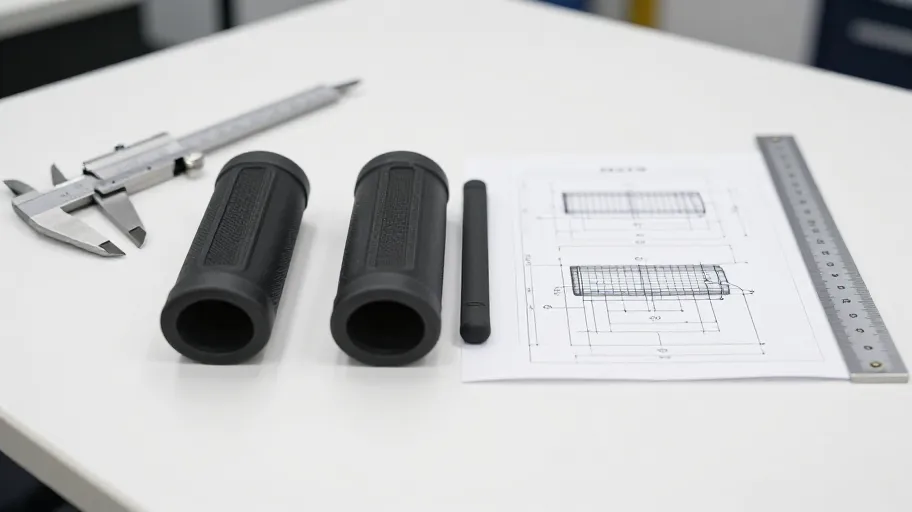
Comparing rory grip samples against drawings means setting a documented baseline from the drawing, inspecting each sample attribute against it, recording what you measure, and approving only when every deviation is explained in writing by the supplier. The DRAW–COMPARE–APPROVE framework keeps that process repeatable, so a decision to accept or reject a rory grip component rests on evidence rather than impressions.
The DRAW–COMPARE–APPROVE framework
D — Drawing baseline. Before any sample arrives, fix the drawing version you are sourcing against. Record the revision number, the attributes the drawing defines, and any notes the supplier has added. If the drawing is ambiguous on an attribute that matters for your build, ask now, not after inspection. A sample judged against an unclear baseline cannot produce a defensible approval.
R — Review samples. Inspect physical samples under consistent conditions: same measuring tools, same lighting, same person recording results where possible. Photograph each sample next to a scale or identifier so the evidence pack stays linked to the correct item.
A — Attribute-by-attribute comparison. Work through a fixed attribute list. For a rory grip, the list a club builder should build with the supplier includes items such as feel and surface texture, core or butt compatibility with the shaft you intend to build on, weight as stated on the drawing, wrap or texture alignment, colour and finish match, and any branding or marking placement. Each attribute gets a recorded observation, not a mental note.
W — Verify with the supplier. Every deviation you measure becomes a written question to the supplier. Confirm what the deviation means, whether it falls inside the drawing, and whether the production run will match the sample. Do not assume a deviation is acceptable because the sample looks usable; confirm it.
Approve — or reject with documented reasons. Approval means: drawing version recorded, every attribute checked, deviations explained in writing, and a retained reference sample labelled and stored. Rejection means the same paperwork, with the failed attributes named.
Decision table: sample vs. drawing attribute gate
| Attribute (confirm scope with supplier) | What to check on the sample | What to document | Approve / reject trigger |
|---|---|---|---|
| Core / butt fit for intended shaft build | Fit on the exact shaft model you plan to use | Shaft model tested, fit observation, photo | Approve only if fit on your shaft is confirmed for the exact model |
| Weight vs. drawing | Measure and compare to the drawing value | Measured value, drawing value, tool used | Approve only when supplier confirms the deviation in writing |
| Texture and surface finish | Feel, wrap seams, consistency across samples | Notes per sample, macro photos | Reject unexplained variation between samples in one batch |
| Colour and branding placement | Compare against drawing and approved references | Photos under consistent lighting | Approve only after supplier confirms colour reference version |
| Markings, labels, part identification | Legibility, position, correct part reference | Photo of each marking | Reject any mismatch in part reference |
| Packaging and protection | Condition on arrival, protection method | Arrival condition notes, photos | Raise with supplier before approving for production |
This table is a scope to adapt. The exact attributes, their limits and what counts as a pass belong to the drawing and the supplier's stated specification — both must be confirmed directly for your specific rory grip model.
Approval questions to put to the supplier
Turn unknowns into project-specific questions. Do not pre-answer them:
- Which drawing revision does this sample represent, and will production match the sample or the drawing if they differ?
- What are the stated dimensional limits for each attribute on the drawing, and how do we record them in our approval file?
- What is the current sample policy — cost, shipping arrangement, and whether samples are charged — and what are the terms we should plan around?
- If a measured attribute deviates from the drawing, what is the process to confirm whether it is within specification?
- Can we retain a signed-off reference sample for future production comparisons, and how is it versioned?
- What documentation accompanies each batch so we can compare deliveries against our approved reference?
None of these have assumed answers here. Policies on samples, fees, shipping and tolerances vary and must be confirmed in writing for the exact product and model you are sourcing.
Documentation practice that protects repeat orders
Keep three things together: the approved drawing version, the evidence pack from inspection (measurements, photos, supplier answers), and a retained physical reference sample labelled with the approval date and drawing revision. When a later delivery differs, you compare against your own record rather than memory. This is what turns a one-off sample check into a sourcing gate you can reuse across builds.
FAQ
What should I compare first on a rory grip sample? Start with the attributes that affect your build directly: fit on the intended shaft model and weight versus the drawing. Then move through texture, colour, markings and packaging. The order matters less than covering every attribute and recording each result.
Do I need a retained reference sample? Yes, if you plan repeat orders. A labelled reference sample plus the approved drawing version lets you compare future deliveries against an evidence-backed baseline instead of recollections or photos alone.
What if the sample and the drawing disagree? Do not choose one silently. Ask the supplier which governs production, whether the deviation is within the drawing's stated limits, and get the answer in writing. Only then approve, reject, or request a new sample.
Can I approve a rory grip sample from photos alone? Photos support a file; they do not replace inspection. Feel, fit on your shaft and weight need hands-on checks. Use photos as documentation, not as the sole basis for approval.
How do I handle multiple samples in one submission? Inspect each one separately against the same attribute list and record results per sample. Unexplained variation between samples in the same submission is itself a finding to raise with the supplier before any approval.
Next step
下载核对清单 — use it to run your next rory grip sample comparison through the DRAW–COMPARE–APPROVE gate, with every attribute, measurement and supplier answer recorded before you sign off.
If you are not ready for the full download, start with the short version: list your drawing attributes, measure each one on the sample, and write down any question you would need answered before approving. That single page is the minimum viable version of the same checklist.
Master Your Swing, DIY Your Fit. DIY Golf is the premier destination for the technical golfer. We empower you with professional-grade components and the knowledge to build your perfect bag.


