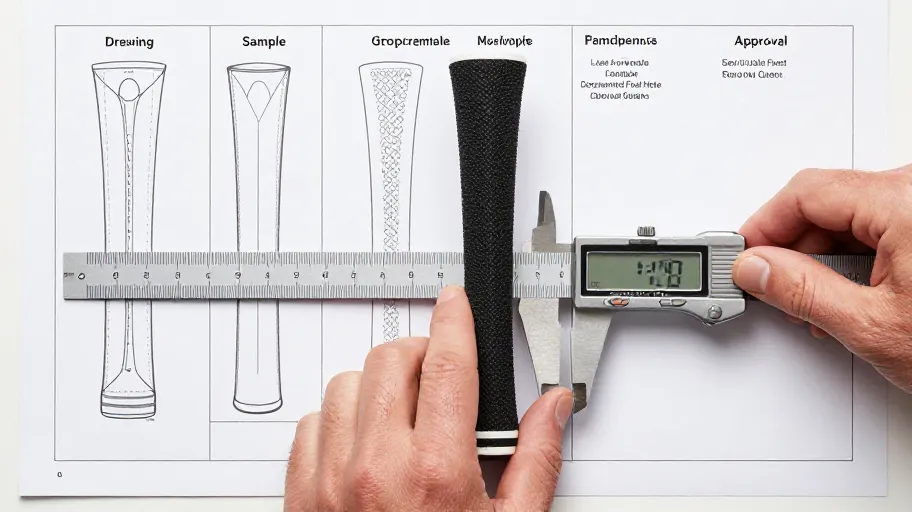
Sourcing a grip for a specific club brand, family and model starts with grip pressure — how much squeeze force the grip's surface and core construction ask of your hands — and the only reliable way to evaluate it is to compare a physical sample against its drawing before you approve anything. This article gives you a repeatable method: the Grip Sample Comparison Sheet, built on four columns — Drawing, Sample, Documented Feel Note, Approval Question — so your shortlist can be judged on evidence rather than marketing language.
Why grip pressure deserves its own sourcing step
Because pressure feel is subjective, your job as a sourcing reader is not to find "the correct" number. It is to build a documented comparison so that whoever signs off the component — you, a fitter, or a build partner — can review the same evidence. That is exactly what the Comparison Sheet does.
The Grip Sample Comparison Sheet
The framework has four columns. Use it identically for every candidate so the comparison stays fair.
- Drawing. Record what the technical drawing or spec sheet states: relevant construction notes as printed, surface pattern references and any build-relevant callouts. Write down only what the document actually says, and flag anything the document omits.
- Sample. Record what the physical sample shows when you handle it. Note texture under a dry hand, texture under a damp hand, and how the grip feels under a deliberate, repeatable squeeze. Handle samples in the same conditions each time.
- Documented Feel Note. Translate the squeeze into a short written note: light, moderate or firm resistance; where the resistance sits in the hand; whether the feel changes after repeated squeezes. Keep the vocabulary consistent across candidates.
- Approval Question. List what the drawing and the sample together still cannot answer. These become the questions you confirm directly with the relevant party.
The point of the fourth column is discipline. Anything you cannot verify from the drawing or the sample belongs there — not in your assumptions.
Decision table: comparing grip candidates
| Criterion | What to check on the drawing | What to check on the sample | What still needs direct confirmation |
|---|---|---|---|
| Surface texture | Pattern reference as printed | Feel dry and damp; note consistency around the circumference | Whether the shipped component matches the sample finish |
| Pressure feel under squeeze | Any construction notes stated | Repeatable squeeze test; record light / moderate / firm | Whether production runs to the same construction |
| Taper and section shape | Section profile references | Where pressure concentrates in the hands | Whether the exact club model's shaft seat interacts as expected |
| Core and build callouts | Core construction notes as stated | Flex and recovery feel when squeezed | Current availability of the exact component |
| Documentation completeness | Are key callouts present at all | Does the sample match each stated callout | Any missing spec you cannot verify locally |
Rank your candidates on the first three columns, then carry every item in the fourth column into your approval questions. Never let an undocumented assumption decide the ranking.
Approval questions to raise before ordering
These are the questions we recommend writing down before you commit to a component. We deliberately do not answer them here, because the answers depend on the specific product, model and current policy — and you should verify each one directly:
- Does the current production component match the sample I evaluated, finish for finish?
- Which parts of the drawing are binding, and which are indicative?
- Is the exact component I evaluated available for the club brand, family and model I am building for?
- What is the current commercial arrangement for obtaining evaluation samples, and who covers what? — confirm the current policy directly before relying on any assumption.
- What documentation accompanies a shipped order, and what happens if the received component differs from the sample?
Each question that gets a documented answer closes a column of your Comparison Sheet. A shortlist with every column closed is a shortlist ready to approve.
Fitment-specific notes for a specific model
When sourcing for one club brand, family and model, add two model-specific rows to your sheet: how the grip seats on that model's shaft, and whether any published fitment guidance from your own build records suggests a pressure preference for that head-and-shaft combination. Keep these as your own documented observations — first-party build notes, not external claims. DIY-Golf's fitment guidance pages are structured around exactly this kind of component-to-model matching, and our grip selection resources cover taper and section notes you can cross-reference against your drawing column.
FAQ
Q: Can I judge grip pressure from a spec sheet alone? No. A spec sheet can state construction callouts, but pressure feel emerges from texture, taper and construction together. Use the drawing to know what should be present, and the sample to confirm what is present. Anything unresolved goes into your Approval Question column.
Q: How many samples do I need for a fair comparison? Enough to apply the Comparison Sheet identically to each candidate under the same conditions — same hand, same temperature range, same squeeze method. The framework matters more than the count; consistency is what makes the ranking defensible.
Q: What if the drawing and the sample disagree? Record the disagreement as its own line item and raise it as an approval question before ordering. A documented mismatch is manageable; an undocumented one becomes a build problem later.
Q: Who do I confirm commercial terms with? Directly with the party supplying the component. No sample, cost, shipping or production policy stated anywhere in this article — assume nothing beyond what you have confirmed in writing for the exact product and model.
Q: Does a lighter or firmer grip pressure improve performance? We make no performance claim here. Pressure preference is a fitment judgment tied to your hands, your build and your model. Document your feel notes, compare candidates on the same criteria, and confirm fitment implications for your specific setup before deciding.
下载核对清单
The checklist packs the Grip Sample Comparison Sheet, the decision table and the full approval-question list into one page you can use in the workshop and attach to your own build records. It is the fastest way to turn this article into an approved component decision.
Low-friction alternative: before you leave, run the two-minute version — pick your top two grip candidates, write one Documented Feel Note for each, and list one Approval Question for each. If those notes survive a second reading tomorrow, the candidates are worth a full sheet.
Master Your Swing, DIY Your Fit. DIY Golf is the premier destination for the technical golfer. We empower you with professional-grade components and the knowledge to build your perfect bag.


