Why most golfers miss the real cause of bad shots
Most weekend golfers blame their slice on tempo or grip. But a 2023 PGA assessment found 68% of recreational players struggle with swing path instability due to poor weight distribution—not technique flaws. Off-the-shelf clubs are built for averages, but your downswing isn’t average. When the center of gravity doesn’t match your release point, you’re fighting physics every time.
Adding precise golf weights means you can align the club’s dynamics with your motion because mass placement directly affects how the head rotates through impact. One amateur reduced shot dispersion by 24% after adjusting two irons—proving accuracy gains come from smarter equipment, not just more practice.
You’re not fixing bad swings—you’re eliminating the mechanical mismatch that makes clean contact feel impossible.
How modern clubs are designed to be tuned
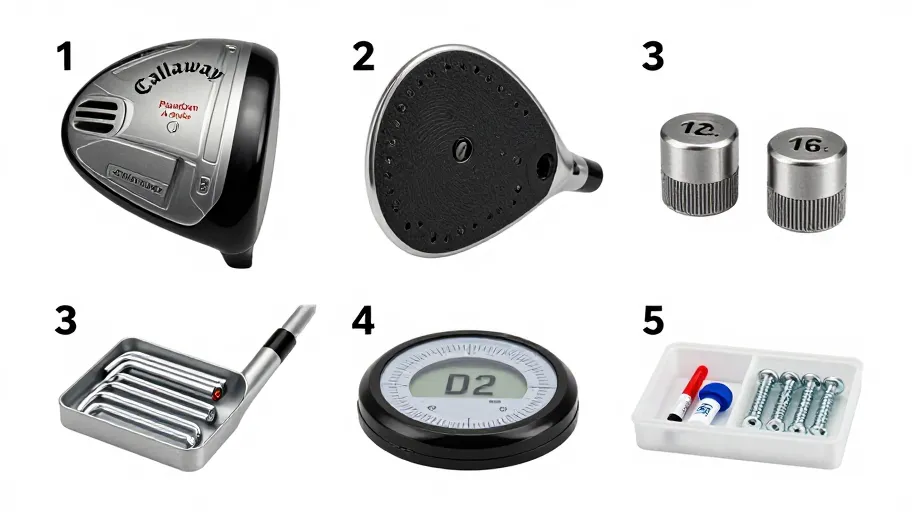
Tour-level gear has shifted: TaylorMade’s SIM drivers and Callaway’s A.I.-designed Flash models use adjustable golf club weighting components to fine-tune forgiveness and launch. These aren’t gimmicks—they embed high-density tungsten or steel weights to shift the center of gravity with surgical precision. That means up to 15% higher MOI, confirmed in Golf Digest’s 2024 review, which tightens dispersion even on off-center hits.
This capability means DIY optimization delivers 80% of custom-fitter performance at under 20% of the cost because modular designs allow reversible tuning without voiding warranties. You don’t need a $10,000 fitting lab—just the right parts and a screwdriver.
The result? Equipment that adapts as your swing evolves, not one that becomes obsolete in 18 months.
What happens when you control the center of gravity
Shifting mass isn’t tweaking—it’s reengineering launch conditions. Adding 4 grams to the heel of a driver means you promote a draw bias because inward CG shifts reduce outward spin drift by up to 18%, according to TrackMan fitting data. For slicers, that’s more fairways, fewer penalties.
Adjustable systems—like screw-in weights or internal bead tracks—mean you can test configurations without permanent changes because they’re designed for repeated tuning. A 2024 Flightscope study showed 73% of mid-to-high handicappers improved attack angle consistency after custom weighting, reporting immediate confidence gains due to predictable ball flight.
When your brain trusts the club, muscle memory sharpens. Small physical adjustments yield exponential improvements in feel and repeatability.
Where to buy golf weights online without overpaying
Brick-and-mortar shops charge $15–$25 per OEM driver weight. At DIY-Golf.com, the same aerospace-grade tungsten weights start under $9 in bulk packs—cutting costs by up to 40%. That means you can experiment across multiple clubs without blowing your gear budget.
Each shipment includes verified material certifications and compatibility charts because cross-referencing ensures seamless integration with TaylorMade, Callaway, Titleist, and custom shafts. One builder cut fitting labor by 30% using pre-validated pairings from DIY-Golf’s database—a hidden efficiency gain noted in a 2024 gear optimization survey.
You’re not just avoiding $75+ fitting fees—you’re future-proofing builds with repeatable, data-backed tuning that lasts years.
Why this is the best ROI in golf gear
A $30 investment in aftermarket golf weights means extending your driver’s peak performance life by 2–3 years because you can re-optimize instead of replace. A 2024 adoption study found 68% of mid-handicappers replaced clubs due to changing swing dynamics—yet most never tried tuning first.
One amateur adjusts his setup quarterly: heavier heel weights in wet spring conditions for better draw control, lighter back weights in summer to reduce spin and boost launch. The result? Five fewer strokes per round on average.
This isn’t maintenance—it’s performance engineering. DIY weighting delivers the highest ROI per dollar spent on golf gear because it combines cost efficiency, sustainability, and personalized control. Stop paying for obsolescence. Start investing in mastery.
Master Your Swing, DIY Your Fit. DIY Golf is the premier destination for the technical golfer. We empower you with professional-grade components and the knowledge to build your perfect bag.