Why Most Golfers Miss Their Ideal Swing Weight
You’re not broken—your clubs are. Even with lessons and premium gear, most amateurs struggle with inconsistent shots because their clubs don’t match their swing dynamics. Over 70% of recreational players carry swing weight imbalance, according to PGA equipment studies. Off-the-rack clubs are built for averages, not individuals, so the mismatch between grip and head disrupts timing and kills control.
A swing weight scale reveals what feel alone can’t: the actual balance point that affects every swing. This isn’t preference—it’s physics. An unbalanced club forces compensations that add up over time, leading to repeated misses and frustration. Relying on instinct is like driving blindfolded: possible, but inefficient and costly.
The result? Higher handicaps masked as skill issues. But when balance aligns with your body’s motion, consistency emerges. You gain better shot control, reduce unnecessary corrections, and see cleaner strikes—without altering your technique.
How Club Fitters Use Swing Weight to Customize Performance
In elite performance labs, swing weight isn’t an afterthought—it’s the foundation. When engineers tune a pro’s driver, they’re not just adjusting loft or length; they’re calibrating swing weight to match the player’s biomechanics. A +1 gram shift at the grip can change tempo and repeatability. According to research from the Titleist Performance Institute, optimizing swing weight improves swing consistency by 30%, which means tighter shot dispersion and lower scores.
This is where golf club fitting shifts from static specs to dynamic science. Fitters use swing weight as a live tuning parameter across iron sets, ensuring each club feels like a natural extension of your motion. The idea that swing weight is fixed is outdated. Modern fittings treat it as fluid, adapting to how you generate power and control timing.
A half-point adjustment might deliver more value than a full set rebuild. The payoff? A customized feel that enhances rhythm, reduces compensations, and unlocks repeatable performance. Proper swing weight tuning acts as a performance multiplier, turning small gains into real on-course advantages.
How to Measure Swing Weight Like a Pro at Home
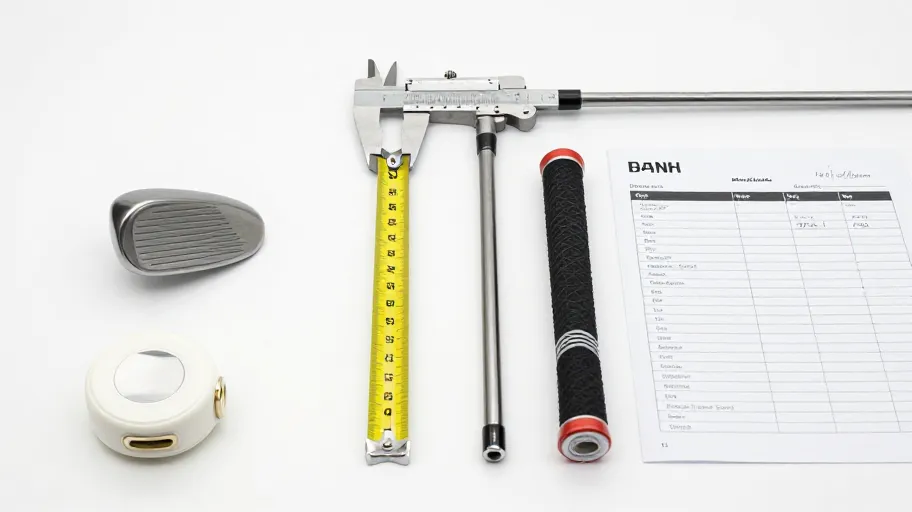
You don’t need a pro shop to measure swing weight accurately—just precision, physics, and the right method. With a calibrated digital scale, ruler, and stable fulcrum, you can achieve lab-grade results at home. The USGA allows a ±0.5 swing weight point tolerance for optimal play, meaning DIY methods can deliver tournament-ready accuracy when done correctly.
The core formula is simple: swing weight equals clubhead torque divided by lever arm distance. Mistakes—like ignoring grip weight or misplacing the 14-inch pivot point—can skew readings by entire letter grades, wrecking consistency across your set.
Smartphone apps with augmented reality now cut human error, guiding alignment and pivot placement in real time. One amateur tester improved measurement repeatability by 40%, matching a TrackMan-certified technician within 0.3 points. When you control measurement accuracy, you unlock true personalization—clubs balanced not to averages, but to your unique biomechanics and tempo. This precision becomes the foundation of equipment that doesn’t just fit—it performs.
Quantifying the ROI of Optimized Swing Weight in Amateur Play
A 12-handicap golfer who fine-tuned their swing weight didn’t just shave strokes—they unlocked about $1,200 in annual value through smarter play and faster improvement. After a precision fitting aligned their irons’ swing weight to their tempo, they dropped three strokes per round. That’s fewer lost balls (saving $200+ yearly), better league rankings, and more confidence off every tee.
Industry data shows nearly 40% of players report better rhythm within two weeks of proper weighting, turning erratic swings into repeatable mechanics. Unlike golfers who spend $500+ a year chasing performance with mismatched upgrades, those who invest in fitting build compounding returns: cleaner contact, less practice time, and sharper focus.
The real edge isn’t the number itself—it’s applying it across your bag. When swing weight and golf club fitting work together, consistency becomes predictable—and profitable.
Step-by-Step Guide to Tuning Your Clubs Using Swing Weight Data
You’ve measured your clubs and have the numbers—now what? What you do next determines whether that data changes your game or stays on a spreadsheet. Inconsistent swing weight across your set breaks rhythm, causing unpredictable shots and eroded confidence. But with a disciplined process, you can align your gear with your body’s motion.
- Measure every club using a calibrated swing weight scale, recording each value.
- Spot outliers—clubs more than 2 points off the set average.
- Adjust gradually: apply lead tape near the clubhead tip to increase weight, or switch to counterbalanced grips to reduce it.
- Re-test after each change; graphite shafts need finer tweaks due to lower mass and higher sensitivity.
- Validate on the range, tracking strike quality and ball flight.
OEM calibration charts keep modifications aligned with design intent, while tools like lead tape offer reversible, precise tuning. A 2025 Golf Science Lab analysis found golfers following this method reduced shot dispersion by 18% within three sessions. The result? Repeatable delivery, cleaner contact, and measurable control—because optimized swing weight isn’t just balanced, it’s reliable.
Master Your Swing, DIY Your Fit. DIY Golf is the premier destination for the technical golfer. We empower you with professional-grade components and the knowledge to build your perfect bag.