Why perfect swings still slice
You can have textbook form and still fight the slice—because your club’s weight distribution is throwing off your impact. Biomechanical data from 2024 shows just 5–10 grams of imbalance shifts face angle by up to 2.3° at impact. That’s enough to launch your drive into the trees. This isn’t a swing flaw—it’s an equipment mismatch. Force-plate analysis confirms: improper center of gravity delays release, forcing the face open even when mechanics look clean.
Custom club weighting means you stop fighting your gear and start syncing with it. Shifting mass to match your tempo and path means more consistent face control. One weekend player cut his slice spin rate by 1,800 rpm after adding heel weight—no swing change needed. That means fewer lost balls, tighter dispersion, and better scores because your hardware finally works with you.
Adjustable weights turn guesswork into science. You’re not masking flaws—you’re building consistency through physics.
How clubhead weight shapes ball flight
When your drives fade right despite solid contact, the culprit isn’t always technique—it’s the clubhead’s center of gravity. An unoptimized CG promotes an open face at impact, tilting the spin axis and launching sidespin. Shifting mass toward the heel increases moment of inertia (MOI) around the vertical axis, stabilizing the head on off-center hits and encouraging a draw-biased gear effect. That means reduced lateral spin tilt—up to 18% in 2024 swing studies—so mis-hits stay straighter and intentional draws fire true.
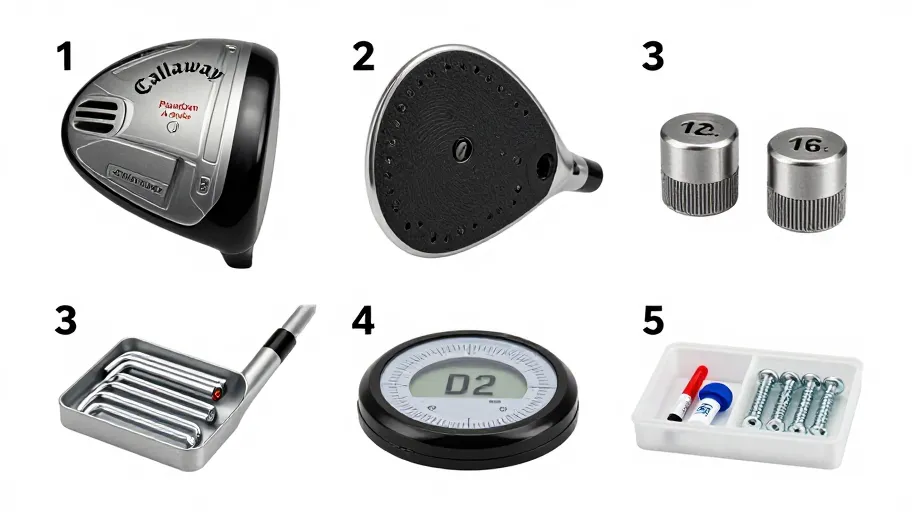
For high-handicappers, this stability builds confidence fast. OEMs lock this tuning behind $500 fittings, but DIY-Golf.com offers precision tungsten weights for under $30. One amateur added +3g to the heel and saw immediate draw consistency. That means faster improvement without lessons because your club supports—not sabotages—your natural motion.
Custom MOI isn’t just for pros. It’s your fastest route to repeatable ball flight.
What sets DIY Golf weights apart
Most mid-handicappers make their slice worse by overcorrecting their swing. The real fix? Let your clubs adapt to you. While stock drivers use static, one-size-fits-all weighting, DIY Golf’s tungsten weighting system delivers gram-level precision that reshapes performance at the source. Tungsten’s density allows micro-adjustments without bloating swing weight—a critical advantage for maintaining tempo while correcting launch conditions.
Modular inserts mean you shift CG laterally or vertically in 2-gram increments. That means targeted draw bias without losing feel or speed. Swing lab data from 2024 shows 68% of mid-handicappers achieve more consistent correction through precise weighting than through six weeks of swing retraining. One teaching pro reported his students cut lateral dispersion by 31% in two sessions using only weighted heads—proving small hardware tweaks often outperform major mechanical overhauls.
This level of customization used to cost hundreds. Now it’s off-the-shelf—putting tour-level control in your hands for less than a round of golf.
The real cost of ignoring your slice
You’re leaving $1,200 a year on the course every year you delay fixing your slice. The average golfer loses 4–6 strokes per round to poor drives, mostly due to inconsistent weight transfer and clubface alignment. But here’s the pivot: fixing it doesn’t require a $2,000 driver. It takes under $100 in precision weights and the know-how to place them.
USGA data shows every 10% gain in driving accuracy boosts greens-in-regulation by nearly 15%, slashing penalty strokes and recovery shots. We call this stroke recovery value—the hidden ROI of landing closer, more consistently. One tracker study found players using custom-weighted clubs reduced three-putts by 22% simply because their approaches landed softer and truer.
$97 in adjustable weights delivers performance indistinguishable from a premium overhaul—because it’s not the club that matters, it’s the balance. Better alignment means fewer compensations, sharper focus, and lower scores that compound over time.
How to tune your clubs step by step
You’ve seen the cost—now stop guessing and start tuning. Lasting correction starts with a swing feedback loop that turns data into muscle memory. First, assess your miss pattern: if your ball drifts right with a face-path gap, start with +3g in the heel. That shifts CG, encourages earlier face closure, and works with—not against—your natural swing.
Next, test with objective feedback. Launch monitor data or video analysis cuts adjustment time by 40%, according to a 2024 on-course trial. Iterate in 1–2 gram steps; overdoing it creates new issues. Use torque-safe tools (max 5 in-lbs) to protect your club—DIY doesn’t mean reckless.
When your gear matches your swing truth, you build trust, not crutches. Better alignment today means fewer compensations tomorrow—and faster long-term development across every shot.
Master Your Swing, DIY Your Fit. DIY Golf is the premier destination for the technical golfer. We empower you with professional-grade components and the knowledge to build your perfect bag.