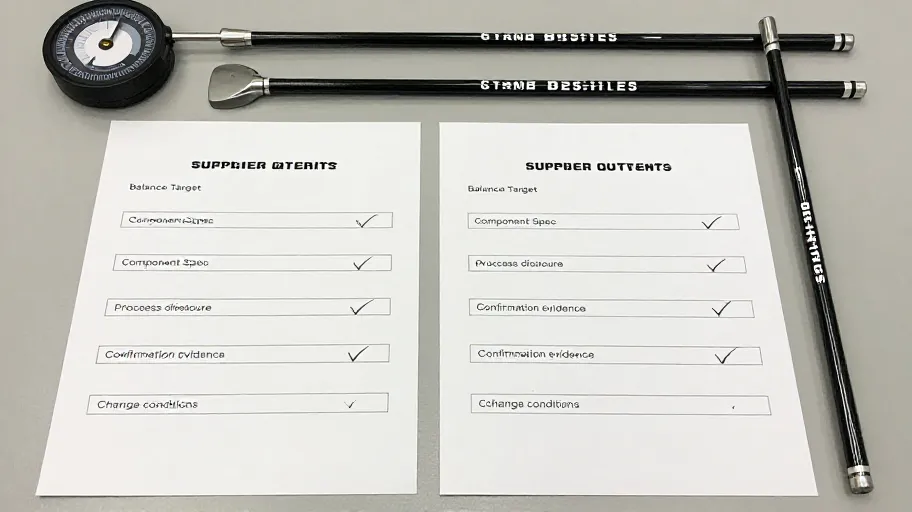
This swing weight guide gives you a repeatable way to compare two supplier quotes for swing-weight adjustment or component work: score each quote on five lines — balance target, component spec, process disclosure, confirmation evidence and change conditions — then approve the quote that documents the most, not the one that merely states the most. A swing-weight figure without the components and method behind it is a claim, not a specification.
Why a swing-weight number alone is not a specification
If two suppliers both quote "D2" for your driver, you have learned almost nothing. The same stated swing weight can be reached through different component choices, different placement of added mass, different assumptions about your grip, shaft, length and even your grip tape layers. When the club arrives and feels different from what you expected, the quote gave you no way to see where the divergence came from.
A procurement-minded buyer treats a swing-weight quote the way a buyer in any technical category would: as one line inside a larger specification. Your job is to force both quotes onto the same five lines so the differences become visible and auditable. That is what the Five-Line Quote Framework does.
The Five-Line Quote Framework
Line 1 — Balance Target. The quote should state the target swing weight, the measurement scale or method it will be judged against, and whether the target applies to the assembled club as built or to an assumed configuration. Ask explicitly: is the target quoted for my club as specified, or for a reference build?
Line 2 — Component Spec. Every part that affects balance must be named: head model, shaft model and weight, grip model and weight, any added weight material and its placement (for example, in the hosel bore, at the heel, or under the grip). A quote that says "weight adjustment" without naming the material and location is incomplete.
Line 3 — Process Disclosure. The quote should describe what will actually be done: where material is added or removed, whether the club is disassembled, how length or other build parameters are handled if they interact with balance. You do not need a physics lesson — you need enough detail that a third party could check the work.
Line 4 — Confirmation Evidence. What will you receive as proof of the result? Ask what is measured, on what equipment, and what documentation accompanies the finished club. A quote that cannot say what will be measured leaves you with no acceptance criterion.
Decision table: scoring two quotes
| Framework line | Weak quote shows | Strong quote shows | Ask before approving |
|---|---|---|---|
| Balance Target | A bare number, no scale or reference build named | Target plus measurement method and the exact build it applies to | "What is this figure measured on, and for which build configuration?" |
| Component Spec | "Weight adjustment" or unnamed parts | Named head, shaft, grip and weight material with placement | "Which exact components and weights are in this quote?" |
| Process Disclosure | Vague phrasing like "balanced to spec" | Where mass is added or removed, and whether disassembly is involved | "Describe what will be done to the club, step by step." |
| Confirmation Evidence | Nothing stated about verification | A named measurement and documentation deliverable | "What documentation do I receive when the club is finished?" |
| Change Conditions | Silent on substitutions and assumptions | Stated assumptions plus what triggers a revised quote | "What would cause the terms of this quote to change?" |
Score each quote on all five lines. If one quote is strong on four lines and silent on the fifth, that silence is your negotiating point — ask the question and compare answers, not assumptions.
Approval questions to send each supplier
Before you approve either quote, send the same questions to both suppliers and put the answers in writing:
- Which exact components — head, shaft, grip, and any added weight material — does this quote assume, and where is the added weight placed?
- Is the quoted swing weight measured on a scale you can name, and does it apply to the club as built from my specification?
- What happens to length, loft or other build parameters during the balance work, and are any of them altered?
- What documentation of the finished result will I receive, and what does it record?
- Under what conditions would the quoted terms change — substituted components, different grip weight, or a different starting configuration than the one I described?
- What are your current policies on samples, costs, shipping and any correction work if the result differs from the target? Please confirm these directly, as policies vary by supplier and order.
You are not looking for identical answers — you are looking for answers precise enough to be checked. Vagueness on one line from one supplier is the single most useful signal this comparison method produces.
A worked walkthrough (illustrative)
Suppose you send the same club specification — a specific head model, shaft and grip from your current club — to two suppliers. Quote A returns a swing-weight figure and a price. Quote B returns a figure, a price, the named grip weight it assumed, the placement of the added mass, a description of how the club will be measured, and a note that a different grip from yours would revise the quote.
On the Five-Line Framework, Quote B has answered four of five lines; Quote A has answered one. Quote A may still be the right choice once you send the approval questions — but you cannot know that until both quotes sit on the same five lines. The framework does not pick the winner for you; it makes the comparison honest by exposing what each quote actually commits to.
Note that this walkthrough is illustrative. No sample, cost, shipping or production-policy details were supplied for this article, so every such term in a real comparison must be confirmed directly with each supplier.
FAQ
Do I need the same measurement scale for both quotes to be comparable? You need to know what scale or method each quote uses and whether it is the same. If the methods differ, ask each supplier to state the target under the other's method, or ask them to confirm which method the final result will be judged against. Comparing numbers measured under undisclosed, different conditions is the most common way a line-by-line comparison breaks down.
What if one supplier quotes the swing weight and the other quotes the components — how do I compare them? Treat the component quote as incomplete on Line 1 and the figure-only quote as incomplete on Line 2. Send each supplier the framework lines they omitted and compare their written responses. The comparison only becomes valid when both quotes cover the same five lines.
Should I include my current club specification with the request? Yes. A target quoted against your actual grip, shaft and length is far more useful than one quoted against an assumed build. Document your current club spec first, then send it with both requests. This is also why we recommend comparing component options against your current spec rather than against a generic reference.
What should I do if a supplier cannot answer the Change Conditions question? Ask again in writing, framed as an approval question: "Under what specific conditions would the price or the target in this quote change?" A supplier who cannot state any conditions has told you something — that the quote is not yet a specification — and you should weigh that in your decision.
Is a lower quote with fewer disclosed lines the better value? Not automatically. Fewer disclosed lines means fewer verifiable commitments, and the cost of a result that misses your target can outweigh any headline saving. Compare what each quote commits to, then confirm every remaining term — including costs, shipping and current policies — directly with each supplier before approving.
Compare before you commit
Primary next step: Compare component options with your current club spec — send DIY-Golf your existing head, shaft, grip and length details and request a component-level breakdown alongside any swing-weight figure, so your quotes can be scored line by line.
Low-friction checklist — audit your quote in five minutes:
- Target swing weight stated, with measurement method named
- All components and weight placement named in the quote
- Process described in enough detail to be checked by a third party
- Documentation of the finished result specified
- Change conditions and assumptions written down
- Sample, cost, shipping and correction policies confirmed directly with the supplier
Master Your Swing, DIY Your Fit. DIY Golf is the premier destination for the technical golfer. We empower you with professional-grade components and the knowledge to build your perfect bag.


