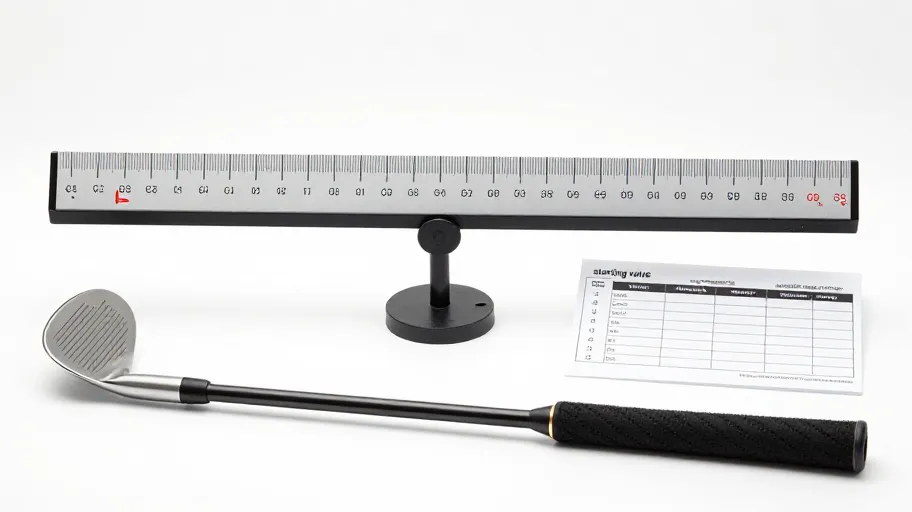
Swing weight is the balance-point expression of how heavy a club feels during the swing, measured on a scale and recorded on a letter-and-number scale rather than in grams. This swing weight guide covers the three measurements buyers skip in their first brief — the starting value, the exact component list of the current build, and the acceptable range of change — so that any replacement head, shaft, or grip you compare against your current club spec moves the feel where you want it.
Why first briefs fail
The Three-Anchor Spec Check
Use this framework to structure your brief. Each anchor answers one question a supplier needs before quoting components.
Anchor 1 — Starting spec. Document your current club as built: total weight, swing weight value, shaft model and flex, grip model, and playing length. If you never measured swing weight, record the components and let the supplier work backwards; a full component list determines balance even without a scale reading.
Anchor 2 — Target feel. State the direction and size of change you want: heavier feeling head, lighter overall, same feel with a different shaft. Vague goals like "more stable" cannot be approved or rejected. A stated direction can.
Anchor 3 — Change budget. Decide what you will accept. If a shaft swap moves the value outside your acceptable range, are you willing to adjust with tip weight, grip weight, or build length? Setting this before you compare options prevents a quote from stalling.
Decision table: what to measure and why
| Measurement | What it tells you | Why buyers miss it | Record before ordering |
|---|---|---|---|
| Current swing weight value | Your baseline for judging any change | Many golfers only record total weight | Scale reading, or component list if no scale |
| Total weight | Sum of all parts; separate from balance | Confused with swing weight | Grams, ideally per component |
| Shaft weight and model | The heaviest variable in most builds | Flex is recorded, weight is not | Exact model and stated weight |
| Grip weight | Small changes here shift balance noticeably | Grips are replaced as afterthoughts | Model and stated weight |
| Playing length | Length changes balance point directly | Assumed standard | Measured length, not catalogue length |
| Head adapter / hosel setup | Adapters add weight and alter balance | Hidden inside the head assembly | Adapter type on your exact model |
Approval questions to settle before you order
Treat these as questions to confirm with DIY-Golf and, where relevant, to answer from your own club before comparing options:
- What is the documented swing weight and total weight of the club I am replacing components on?
- For my exact brand, family, and model, which replacement heads, shafts, or grips are confirmed compatible — and can you point to first-party fitment guidance for that model?
- If the quoted combination changes my swing weight beyond my acceptable range, what adjustment options (grip weight, tip weight, length) are available for that component?
- What is the current sample, pricing, and shipping policy for this component, and who do I confirm that with?
- What documentation will I receive with the order so I can verify the build against my spec sheet?
If you are not ready to commit
Before you request a quote, complete this:
- Measured (or fully component-documented) swing weight and total weight of the current club
- Exact shaft model, flex, stated weight, and playing length recorded
- Exact grip model and weight recorded
- Adapter or hosel setup noted for your model
- Target direction of feel change written down in one sentence
- Acceptable range of change decided
- Compatibility for your specific model checked against DIY-Golf's fitment guidance
Send that list with your enquiry and the comparison becomes a documented decision instead of a guess.
FAQ
Is swing weight the same as total weight? No. Total weight is the sum of the components in grams. Swing weight expresses where that mass sits relative to the grip end. Two clubs with identical total weight can feel very different if the balance point differs. Record both.
I don't own a swing weight scale. Can I still order components? Yes, if you document every component in the current build — shaft, grip, adapter, length — the balance can be assessed from the parts list. Confirm with DIY-Golf what information they need for your specific model before comparing options.
Does replacing the grip really change swing weight? Grip weight shifts the balance point, and the effect is measurable. This is one reason the decision table asks for grip model and weight, not just "regripped". Confirm the direction and size of the shift for your specific grip pair before approving a build.
How do I know if a component fits my exact club model? Do not rely on family-level assumptions. Verify compatibility for your exact brand, family, and model against DIY-Golf's current fitment guidance, and ask them to confirm in writing before ordering.
What should I do if the new build feels different from the spec I approved? Document the as-built measurements against your approved spec and raise it with DIY-Golf directly. What counts as a resolution — adjustment, replacement, or return — depends on their current policy, which you should confirm before ordering rather than after.
Compare component options with your current club spec
Once your three anchors are documented, the productive next step is side-by-side comparison: put your starting spec next to DIY-Golf's component options for your club family and check each candidate against your target feel and change budget. Compare component options with your current club spec — and confirm fitment, policies, and documentation for your exact model before approving anything.
Master Your Swing, DIY Your Fit. DIY Golf is the premier destination for the technical golfer. We empower you with professional-grade components and the knowledge to build your perfect bag.


