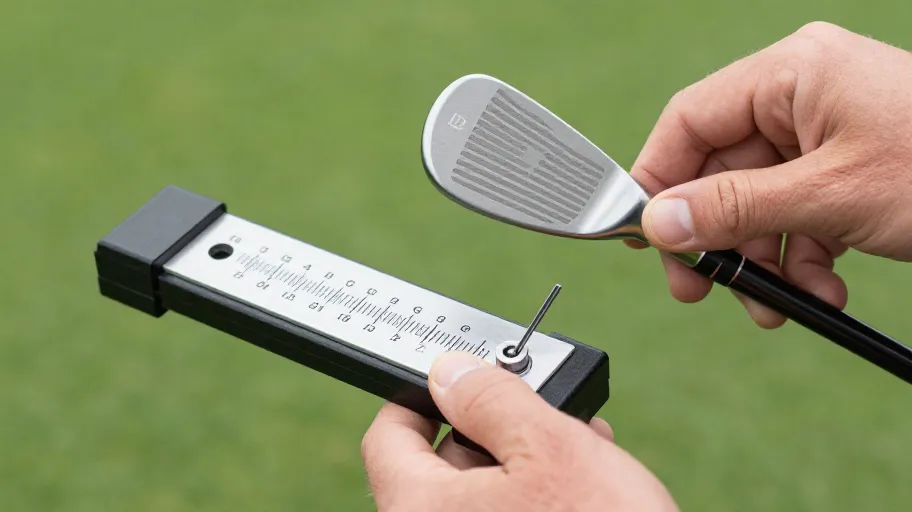
A useful swing weight guide does not start with formulas — it starts with decisions. Use the Approve–Verify–Document sequence: approve the balance feel you want in writing, verify it on a built sample against your current club spec, and document the confirmed result before you sign off on bulk production.
Why approval comes before calculation
Most club-balance content jumps straight to numbers. For a buyer sourcing replacement or tuning components, the harder problem is different: you are about to commit money to a configuration that may or may not match the feel of the club already in your bag. The swing weight itself is a recorded output of build choices — head weight, shaft weight and balance point, grip weight, length, and where mass sits in the head. Change any of those inputs and the recorded output moves.
That is why this swing weight guide treats your current club as the reference, not a catalogue value. Your existing club's spec is the only baseline you can actually feel. Anything else — a stated value on a spec sheet, a number quoted by a builder, a figure from a component listing — is a claim to verify, not a fact to assume.
The Approve–Verify–Document framework
Approve. Write down the target before you order anything. Not "a bit heavier in the head," but a documented statement of what you want the assembled club to feel like relative to your current club: same, slightly more head-heavy, slightly less. Include the exact club — brand, family, model, loft or number, shaft and grip as currently built. If you have a measured value for your current club, record it and note how and when it was measured. If you do not, record that too; it changes what you can verify later.
Document. Record the measured result, the method used, and the approved configuration in writing. This document becomes your acceptance reference. If the delivered production clubs differ from what you approved, the documented record is what allows a factual conversation rather than an argument about memory.
Decision table: component changes and the questions each raises
| Change you are considering | Effect on recorded balance output | Questions to resolve before approval |
|---|---|---|
| Different head model within the same family | Head mass and mass distribution can differ between models | What is the head weight of the exact model and loft? Is weight adjustment available on this head? Has this head been built and measured in the configuration you want? |
| Different shaft | Shaft weight and balance point shift the recorded value | What are the shaft's weight and balance point as specified by its maker? How was the sample built — raw length, tip trim, install depth? Confirm shaft-specific fitment for your club model directly. |
| Different grip | Grip mass changes the recorded value noticeably | What is the grip's mass? Does the build plan account for grip size and any wrapping? |
| Different length | Length changes the recorded value without any mass change | What final length is approved? Is the same length used on the sample and the production run? |
| Added weighting | Moves mass to a specific point in the build | Where is the weight added — head, shaft tip, grip end? Is the added weight part of the documented approved configuration? |
One caution: none of the effects in this table should be treated as a prediction you can order against. They are reasons to measure. The only balance output worth approving is one you have verified on a built example of your exact configuration.
Concrete approval questions to resolve before you sign off
Bring this question set to DIY-Golf and get written answers before approving bulk production. Each question converts an unknown into a documented commitment.
- Baseline: Can you measure my current club, or will I supply its documented spec? Which measurement method and scale will be used, and will the same method be used for the final acceptance check?
- Target: What exact recorded value or relative feel, measured against my current club spec, are we approving?
- Tolerance: What measurement acceptance band will you commit to for the production run, and how is conformance checked and recorded? (Set the band yourselves; this article does not assert what any builder offers.)
- Configuration lock: Which head, shaft, grip, length and added weights are frozen in the approved document? Can any component be substituted during production, and if so, under what notice?
- Acceptance: If delivered clubs fall outside the approved band, what is the resolution process? Confirm the current policy directly rather than relying on assumptions from any guide.
- Records: Will I receive the measured values for the production run, not just for the sample?
If a question cannot be answered in writing, treat that as unfinished work, not a formality to skip. Approving bulk production with undocumented answers is how balance feel and ordered components drift apart.
What to check before you approve — quick checklist
- Current club spec documented: brand, family, model, loft/number, shaft, grip, length, measured balance value and method
- Target balance outcome written and approved against that baseline
- Exact component configuration listed, part by part
- Sample or demonstration build arranged and terms confirmed directly with DIY-Golf
- Sample measured with the same method that will judge the production run
- Acceptance band, substitution rules and resolution process agreed in writing
- Approved document signed off before any bulk order
FAQ
Is a swing weight value on a component listing enough to approve an order? No. A listing value describes that component, not your assembled club. The recorded balance of the finished club depends on every build input together. Use listing figures as inputs to shortlist, then verify on a built sample of your exact configuration.
Do I need a measured value for my current club before starting? A measured value is the strongest baseline, but its absence is not a blocker — it just changes the plan. If you cannot measure your current club, approve a relative target ("match the feel of my current driver") and verify by direct comparison. Document whichever approach you use.
What should the sample verification actually compare? Two things: the recorded balance output, measured with the method you will accept for production, and the feel when you swing it against your current club. Both matter; a sample that passes one check but not the other is not verified.
What if the production clubs measure differently from the approved sample? That is exactly what the documented acceptance band and resolution process are for. This guide does not assert what any builder's terms are — resolve the question with DIY-Golf in writing before production, using question 6 above.
Can I change one component after approving? Any change after approval resets verification. Head, shaft, grip and length all affect the recorded balance output. If a substitution becomes necessary, re-verify on a rebuilt sample and issue a revised approved document.
Compare component options with your current club spec
Before you approve anything, put your current club spec next to the component options you are considering — head, shaft, grip and build details — and mark which inputs change. Compare component options with your current club spec on DIY-Golf's component selection and fitment guidance pages, and bring the unanswered questions from this guide to each candidate configuration. Verify, compare, document, approve — in that order.
Master Your Swing, DIY Your Fit. DIY Golf is the premier destination for the technical golfer. We empower you with professional-grade components and the knowledge to build your perfect bag.


