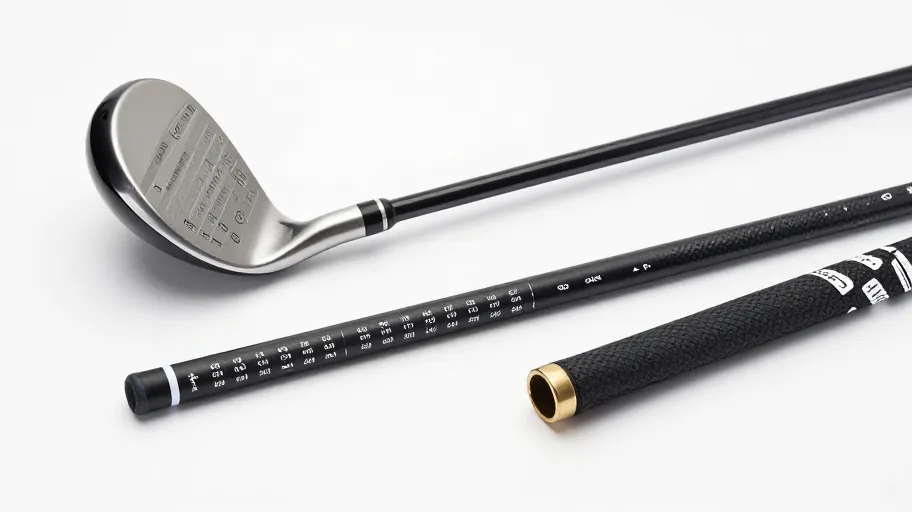
Before any supplier can quote a swing-weight adjustment accurately, they need four documented inputs: the exact head model and its stated specifications, the shaft model and flex, the grip model and weight, and your target balance or feel goal. Supply all four and quotes become comparable; omit one and every quote you receive is an estimate.
Swing weight is an output, not an input
A common misunderstanding among golfers researching replacement components is treating swing weight as something a supplier "sets" directly. In practice, swing weight is a measured outcome of the finished assembly: the head's mass and its position, the shaft's weight distribution and length, the grip's mass, and any added weighting. Change any one of those inputs and the measured value moves.
This matters for your buying decision because it reverses the usual conversation. Instead of asking a supplier "can you give me D2?", the more productive question is "here are my four documented inputs — what component options move the balance in the direction I want?" A supplier working from documented inputs can quote against your actual build rather than against assumptions.
It also explains why quotes vary. If you contact three suppliers and describe your club differently to each, you will receive three different numbers, none of which is wrong — they are quoting different projects. One complete specification sheet sent to all three produces quotes you can actually compare.
The Four-Input Quote Framework
Use this framework to prepare your request. Each input should be documented, not guessed.
| Input | What to document | Why the supplier needs it | What happens if it's missing |
|---|---|---|---|
| Head | Exact brand, family, model, and stated head weight or volume from the manufacturer's listing for that model | Head mass and its position drive the largest share of the measured balance | Supplier must assume from a similar model; quote may not match your club |
| Shaft | Shaft model, flex, weight as listed by the manufacturer, and installed playing length | Shaft mass and length shift the balance point along the club | Quote based on a default shaft, not yours |
| Grip | Grip model and listed weight, plus any added wrap or build-up | Grip mass sits at the handle end and moves the measured value in the opposite direction to the head | supplier compensates blind for the handle end |
| Target balance | Your goal in your own words — e.g. "current club feels light in the head" — plus any measured value if you have access to a scale | Distinguishes a feel problem from a spec problem and defines what "done" means | Supplier optimises for nothing in particular; the result may not match your goal |
Two practical notes on the framework. First, if you cannot find the listed specifications for your exact model, say so explicitly in your request rather than substituting a near-match silently — a supplier told "this is unverified" can plan around it. Second, if you have had the club measured (by a builder or on a swing-weight scale), include the measured value and note who measured it. Documented measurements, even informal ones, give the supplier something firmer than feel alone.
Matching your goal to the input that matters
Different goals point at different inputs. Use this decision table to work out which component conversation you should actually be having before you request quotes.
| Your goal | Input to prioritise | Question to bring to the supplier |
|---|---|---|
| The head feels light through impact | Head selection or added weighting options for your head model | What weighting or head options exist for my exact model, and how do they change the balance? |
| The club feels unstable or boardy | Shaft model and weight | Which shaft options list the weight and flex characteristics I should compare for my model? |
| The club feels fine but the handle end feels off | Grip model and weight | Which grip options list the weight range that would move the handle-side balance? |
| You want the same feel in a replacement part | All four inputs, unchanged where possible | Which replacement components match my current documented specs most closely? |
| You are unsure what the problem is | Target balance definition first | Can we define the goal from my documented specs before choosing a component? |
Note what the table does not do: it does not tell you which component to buy. That determination depends on your exact brand, family and model, and on options the supplier confirms are currently available and compatible. The table tells you which conversation to open.
What to document before you request a quote
Bring your request down to a single sheet:
- Club type and the exact brand, family and model as printed on the club.
- Head specifications as listed by the manufacturer for that model, or a note that they are unverified.
- Shaft model, flex, listed weight and installed playing length.
- Grip model and listed weight, including any build-up you have added.
- Your goal in plain language, plus any measured balance value and how it was measured.
- Photos if the club has non-standard features (aftermarket weighting, repaired sections, unusual length).
Approval questions to put to the supplier
Before you approve any quote for swing-weight-related component work, ask directly and get the answers in writing:
- Compatibility: "Is this component confirmed compatible with my exact head model, not just the family?" Get the confirmation specific to your model.
- Assumptions: "Which of my four inputs did you treat as verified, and which did you assume?" A quote built on an assumed shaft weight is a different project from one built on your documented shaft.
- Verification step: "How will the finished assembly's balance be checked before it ships, and what will you document for me?" Ask what record you will receive.
- Current policy: "What are your current sample, shipping, return and pricing policies for this order?" Policies change and vary by product; confirm the current terms directly rather than relying on anything you read elsewhere — including this article.
- Change control: "If any of my four inputs turns out to be different from what I documented, at what point do you stop and re-confirm with me?"
Question five is the one most buyers skip, and it is the one that prevents the most disappointment. A specification that is slightly wrong — a shaft that was cut down by a previous owner, a grip that is heavier than listed — changes the project. You want a supplier who treats that discovery as a stop-and-confirm event, not a quiet substitution.
Compare component options with your current club spec. Bring your four documented inputs to DIY-Golf's component selection and fitment guidance pages and request a quote against your actual build rather than an assumed one. (Confirm the destination link and current policies before publishing.)
FAQ
Does a heavier grip raise or lower the measured swing weight? Grip mass sits at the handle end of the measurement, so adding grip weight moves the measured value down, while the club's actual balance feel changes in ways the single number does not fully capture. Discuss grip options with your supplier in the context of your documented four inputs rather than chasing the number alone.
Can a supplier quote accurately from club photos alone? Photos help confirm the model and any visible non-standard features, but they do not replace listed head, shaft and grip specifications or an installed length. Treat photos as supporting evidence in your spec sheet, not as a substitute for it.
I only know my club's model, not its shaft or grip. What should I do? Say exactly that in your request. Ask the supplier what they can confirm from the model and what remains unverified, and ask them to flag any point in the process where an unverified input would change the recommendation. Do not let a missing input be silently filled with an assumption.
Is the swing weight value the same thing as the club's total weight? No. Total weight is the sum of the component masses; swing weight describes how that mass is distributed around the grip end as a fulcrum. Two clubs can share a total weight and measure very differently. When you compare quotes, check which of the two the supplier is describing.
Do I need a professional fitting before requesting component quotes? A fitting can define your target balance more precisely, but it is not a precondition for requesting a quote. What is a precondition is a documented spec sheet. If you do have fitting data, include it; if you do not, describe your goal in your own words and let the supplier tell you what else they need.
Before you order — verification checklist
- Exact brand, family and model written down as printed on the club
- Head, shaft and grip specs documented, or explicitly marked unverified
- Installed playing length measured and recorded
- Goal stated in plain language, with any measured balance value noted
- Written confirmation from the supplier on compatibility with your exact model
- Written answers on which inputs were verified versus assumed
- Current sample, shipping, return and pricing policies confirmed directly with the supplier
- A stop-and-confirm point agreed for any spec surprise
Compare component options with your current club spec before you commit to a purchase — a complete four-input sheet is the fastest route to a quote you can actually evaluate.
Master Your Swing, DIY Your Fit. DIY Golf is the premier destination for the technical golfer. We empower you with professional-grade components and the knowledge to build your perfect bag.


