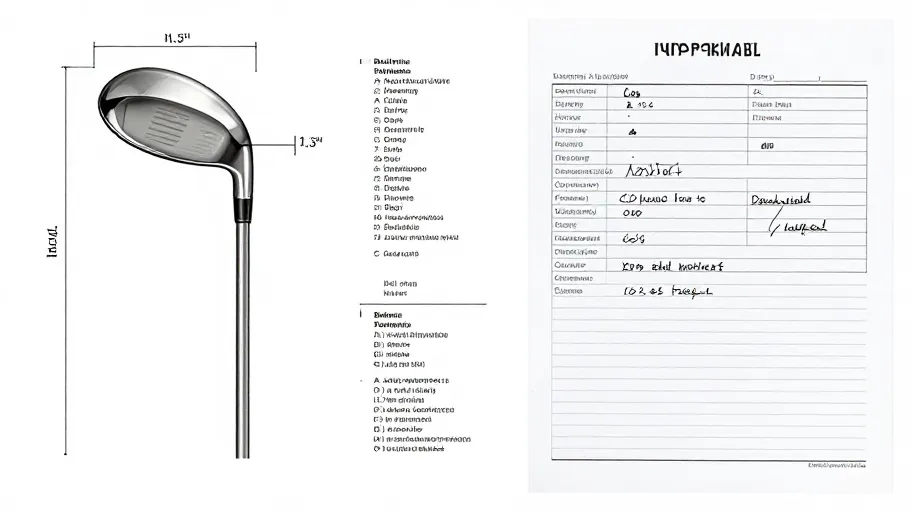
When you order or modify components to change how a club feels at address, every balance-related detail should exist in one of three places: the drawing, the bill of materials, or the approval notes. This swing weight guide walks through that Drawing–BOM–Approval split, so you can compare component options with your current club spec and put each decision in writing before anything is built.
Why balance details belong in documents, not conversations
Swing weight is the result of several component weights interacting: head mass, shaft mass and balance point, grip mass, length, and any added material. When those inputs are discussed verbally or left to assumption, the builder and the buyer can each hold a different version of the spec. That is not a supplier problem or a customer problem — it is a documentation problem, and documentation is the part you control.
The remedy is unglamorous but effective: before you commit to an order, sort every balance-related decision into one of three containers. If a detail fits none of them, it is not yet decided.
The Drawing–BOM–Approval (DBA) split
Drawing. The drawing carries geometry and mass-critical dimensions: assembled length, head placement, hosel depth, and any point where material is added or removed. Anything the builder must physically locate belongs here. A length change of even a small amount shifts swing weight, so length is a drawing item, not a note.
BOM. The bill of materials carries the parts themselves: the exact head model, the shaft with its weight classification as specified on the component page, the grip model, and any weights, ferrules or adapters as separate line items. Each line should reference the specific brand, family and model you researched. A "similar" shaft is a different BOM line.
Approval notes. The approval notes record intent and authority: what swing-weight feel you are targeting, what you asked to be changed, what stays untouched, and who signs off if a substitution becomes necessary. This is also where you record that the current policy on samples, costs, shipping or returns was confirmed directly with DIY-Golf — we do not state those policies here, because they must be verified for your specific order.
Decision table: which detail goes where
| Detail | Container | Why |
|---|---|---|
| Assembled club length | Drawing | A physical dimension the builder must set, not describe |
| Head model and family | BOM | A purchasable part; must match your current club spec |
| Shaft model and weight class | BOM | Shaft mass and balance point drive the balance result |
| Grip model | BOM | Grip mass affects balance at the handle end |
| Added weight ports or tape | Drawing + BOM | Location is a drawing matter; the weight itself is a BOM line |
| Target swing-weight feel | Approval notes | Intent, not geometry or a part |
| What must not change | Approval notes | Protects the rest of your set from accidental variation |
| Who approves a substitution | Approval notes | Prevents silent swaps of a listed component |
| Sample and shipping policy | Approval notes (as confirmed) | Confirm directly with DIY-Golf; do not assume |
Approval questions to send before ordering
Put these in writing, in the same message as your spec, and keep the reply with your order record:
- Which exact component models, at which listed weights, will fill each BOM line?
- If a listed component is unavailable at order time, will you substitute, hold the order, or contact me first?
- How will my assembled length be recorded, and where in the drawing does it appear?
- What documentation will I receive with the finished build that lets me compare it against my current club spec?
- What is the current sample, cost, shipping and return policy for this specific order? (Ask directly; DIY-Golf's current policy for your case must be confirmed, not assumed.)
Worked checklist for a single-club order
Use this before you send any balance-change request:
- Record your current club's assembled length and component list as you believe them to be.
- Note the head, shaft and grip models currently in the club, as far as you can identify them.
- Decide and write down the feel you are targeting, in your own words.
- List each new component as a BOM line with brand, family and model.
- Add any added-weight items to both the drawing (location) and BOM (part).
- State what must not change.
- Ask the five approval questions above and attach the answers to the order.
- Confirm the current sample, cost, shipping and return policy directly with DIY-Golf for this order.
The single next step we recommend: compare component options with your current club spec on the DIY-Golf component pages, then send the checklist as your enquiry. That comparison — not a generic recommendation — is what turns a feel into a buildable document.
FAQ
Does swing weight change if I only replace the grip? Grip mass influences the balance result, so any grip change is a BOM change worth documenting. Rather than relying on a general rule, list the exact grip model and ask the supplier to confirm how it will be recorded against your spec.
Do I need a drawing for a simple length change? Yes. Length is the drawing's job because the builder must set it physically. A short note describing a length change leaves room for two people to hold two different numbers.
What if I don't know the exact shaft model in my current club? Say so in the approval notes, and ask DIY-Golf what identification they need before quoting a replacement. Confirming identification first protects you from ordering a component that does not match the club you are tuning.
Who is responsible if the finished club feels different from my target? That depends on what was documented, which is precisely why the approval notes exist. If your target feel, your spec and the supplier's confirmation are all in writing, the review becomes a comparison of documents rather than a dispute of memory.
Where do I confirm sample, shipping or return terms? Directly with DIY-Golf, for your specific order, before you pay. This guide deliberately does not state those terms, because they must be verified for the exact components and models involved.
Compare component options with your current club spec
The fastest way to de-risk a balance change is to open the component pages for your club family, list each candidate part against the spec you recorded above, and send that list — plus the approval questions — as one enquiry. Document first, order second.
Low-friction checklist before your next order
- Current spec written down
- BOM lines with exact models
- Drawing items (length, weight locations) recorded
- Approval notes with target feel and no-change list
- Sample, cost, shipping and return policy confirmed directly with DIY-Golf
Master Your Swing, DIY Your Fit. DIY Golf is the premier destination for the technical golfer. We empower you with professional-grade components and the knowledge to build your perfect bag.


