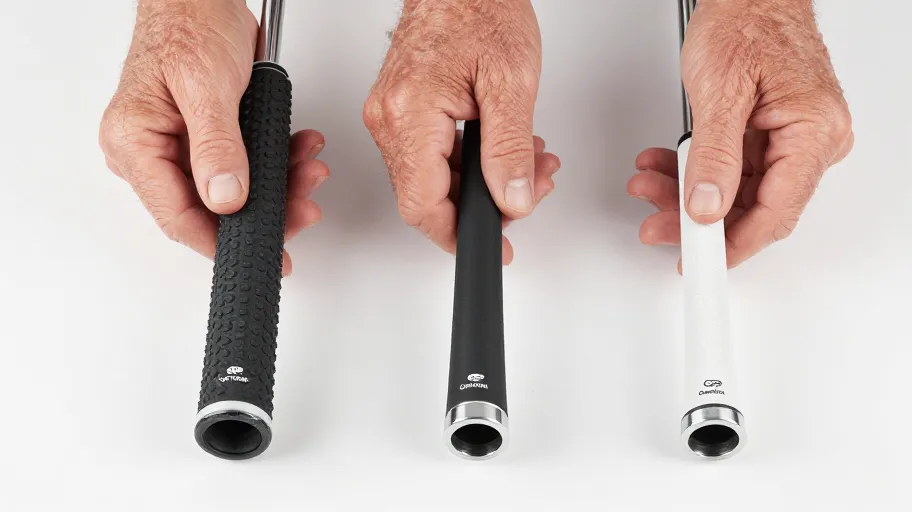
Most golfers choosing golf grips for seniors should compare three variables in a fixed order: grip size first, then surface texture, then weight. This Size–Texture–Weight method turns a confusing catalogue into a short, verifiable shortlist — provided you confirm every choice against your club's exact brand, family and model before you order.
Why grip choice is a fitment decision, not a generic one
Grips are the most frequently replaced component on any club, but they are also the component where model-specific fitment matters most. A grip that seats correctly on one shaft may not seat correctly on another from the same brand two model years later. Core internal sizing, butt-end diameters and even grip cap geometry can differ across a manufacturer's families.
That is why the first step is never "pick a grip" — it is "verify the club". Before comparing any grip, confirm three things:
- The club brand — not a general category, but the maker of the club you are re-gripping.
- The family — the product line the club belongs to.
- The model — the specific version and, where relevant, the model year, because component specs can change between model years within the same family.
DIY-Golf's pages are organised around this structure precisely so that component selection starts from your club, not from a generic grip list.
Step one — Size: verify before you trust the label
Grip size affects how your hands sit on the club and how much the club can rotate through your release. As hand strength and grip pressure change with age, many senior golfers re-evaluate size — but the sizing labels themselves are not uniform across brands.
Rather than relying on a single label, verify:
- Hand measurement against grip core sizing. Measure or note your glove size and how many fingers overlap or underlap when you close your hand around the current grip. Document this before browsing.
- The current grip's stated size. If your existing grip has a printed size marking, record it. This becomes your reference point, whatever the new grip's label says.
- Butt-end compatibility for your specific shaft. Core sizing must match the shaft's butt diameter for the grip to seat correctly. This is a model-specific question, not a general one — confirm it through the fitment selector rather than assuming.
- Whether build-up tape or sizing adjustments were used previously. If a previous re-grip involved added layers under the grip, the club's current "size" is not what the grip label says.
Ask yourself this approval question before moving on: "Have I verified that this grip's core sizing is compatible with the butt end of my specific club model?" If the answer depends on a guess, use the fitment selector before proceeding.
Step two — Texture: match the surface to your hands and conditions
Texture determines traction, and traction needs change with grip pressure, skin condition and the conditions you play in. Senior golfers frequently report that a surface which felt adequate years ago now demands more grip pressure than comfortable — which is exactly the signal to re-examine texture rather than squeeze harder.
Compare texture across these dimensions, and document your current grip as the baseline:
| Texture dimension | What to compare | What to confirm before ordering |
|---|---|---|
| Surface firmness | Softer rubber compounds vs. firmer compounds | Whether the compound suits your grip pressure and any hand sensitivity |
| Cord or pattern | Textured/corded vs. smooth patterns | Whether the pattern grips gloves, bare hands, or both as you play |
| Taper profile | Uniform vs. tapered lower hands | How the taper interacts with your hand position on the grip |
| Traction in damp conditions | How the surface performs when wet | Only what the product page itself states about the material — do not assume wet-weather performance |
One caution: photographs and marketing language cannot tell you how a compound will feel after a round in damp conditions. Where the product page does not state a performance characteristic, treat it as unconfirmed and either ask DIY-Golf directly or choose a grip whose stated properties you can verify.
Step three — Weight: how grip weight interacts with the whole club
Grip weight changes the finished club's balance. Swapping to a grip that differs in weight from your current one alters how the club loads and feels at address, even though the head and shaft are untouched.
For senior golfers and club builders tuning a specific club, keep weight changes deliberate:
- Record the current grip's stated weight before removing it, where the marking or specification is available.
- Compare against the replacement's stated weight on the product page. If the difference is not stated, that is a question for DIY-Golf, not an assumption to make.
- Consider whether you are tuning one club or a set. Matching grip weight across a full set keeps the set consistent; a single-club change is easier to evaluate but changes feel relative to the rest of the bag.
Decision table: comparing size, texture and weight priorities
| Your priority | Size check | Texture check | Weight check |
|---|---|---|---|
| Easier, more relaxed hold with less grip pressure | Verify core sizing and butt-end match for your exact model | Softer compound; confirm material on the product page | Compare stated weight against current grip; document the difference |
| More secure traction without squeezing harder | Confirm sizing does not force a tighter grip radius | More pronounced texture or cord pattern; confirm pattern type on the listing | Confirm stated weight; note interaction with any size increase |
| Restoring a current feel rather than changing it | Match the current grip's stated size as closely as verifiable | Match the current grip's surface type | Match or minimally differ from the current grip's stated weight |
| Tuning a single club's feel | Verify compatibility with that club's specific shaft and butt end | Choose deliberately; document what changes | Track the weight delta against your documented baseline |
Use this table to narrow candidates to one or two, then move to the approval questions below.
Approval questions before you order
Answer each of these in writing before committing to a purchase. Where a question cannot be answered from the product page, confirm it directly with DIY-Golf.
- Have I confirmed my club's exact brand, family and model using the fitment selector?
- Is this grip's core sizing compatible with the butt end of my specific club model?
- What is the stated weight of the replacement grip, and how does it compare with my current grip?
- What does the product page actually state about the surface material and pattern — and is anything I care about left unstated?
- If the grip arrives and does not seat or feel as expected, what are DIY-Golf's current ordering, return and support terms? (Confirm these directly before purchase — no such policy is stated in this article.)
FAQ
Do grip sizes use one universal standard across brands? No. Grip sizing labels and core specifications vary across manufacturers and model families, which is why this article asks you to verify size against your specific club rather than trust a label alone. Confirm compatibility through the fitment selector for your exact brand, family and model.
Will a larger grip change my ball flight? A larger grip changes how your hands interface with the club, and hand action affects how the club is delivered. But this article makes no performance promise about any specific grip, because the outcome depends on your swing, your hands and the specific club. Decide size based on comfort, verified fit and a deliberate comparison — then evaluate on the course.
Can I mix grip sizes or textures across a set? Some golfers and builders do vary grips across a set deliberately. What matters for fitment is that every grip is compatible with its specific shaft, and what matters for feel is that you document what you installed where, so any future replacement starts from a known baseline.
How do I know if my current grips need replacing? Look at the surface: worn smooth patches, cracking, or a surface that has lost the traction you need are visible signals. Grip pressure is another — if you find yourself squeezing harder to hold the club, re-evaluate size and texture using the STW method above rather than compensating with grip strength.
Ready to shortlist grips for your specific club? Use the on-site fitment selector and verify the club brand, family and model before choosing a component — it takes less time than re-ordering the wrong grip.
Before you order, run this checklist:
- Club brand, family and model confirmed in the fitment selector
- Current grip's size and weight documented
- Replacement grip's core sizing checked against the club's butt end
- Surface material and pattern stated on the product page
- Weight difference between old and new grip noted
- Any unstated detail (samples, costs, shipping, returns) confirmed directly with DIY-Golf
Master Your Swing, DIY Your Fit. DIY Golf is the premier destination for the technical golfer. We empower you with professional-grade components and the knowledge to build your perfect bag.


